

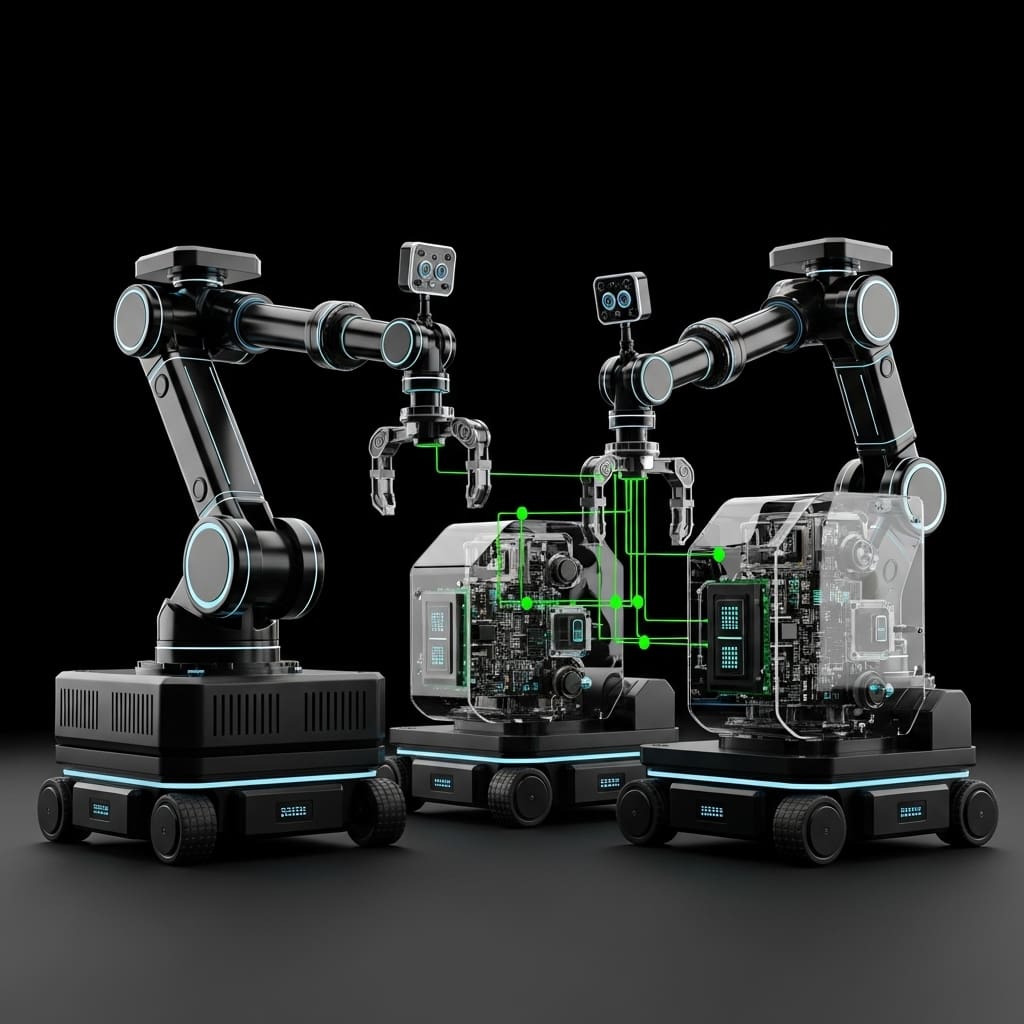
The increasing demand for sustainable and autonomous operation presents significant challenges for heavy-duty mobile machinery, as industries transition from traditional diesel-hydraulic systems to clean, electric alternatives and seek to reduce reliance on human operators. Mehdi Heydari Shahna from Tampere University, and colleagues, address these challenges with a new control framework that simplifies the design of control systems for electrified machinery, regardless of the energy source. This research establishes hierarchical control policies which guarantee both safety and performance, a critical step towards achieving reliable autonomy in complex robotic systems, and offers methods to ensure these ‘black-box’ learning strategies meet stringent international safety standards. By validating the framework across diverse robotic platforms and conditions, the team delivers a robust and adaptable solution poised to accelerate the development of safe and efficient heavy-duty automation.
Adaptive Backstepping and Control Techniques
Researchers are actively developing advanced control techniques for robotic systems, with a strong emphasis on backstepping control, an approach frequently extended with adaptive, dynamic surface, command filtered, neural network, and sliding mode control methods. These techniques address the challenges of controlling complex systems, particularly those with uncertainties and disturbances, and are often applied to robots, hydraulic systems, underwater vehicles, and power electronics.
Hierarchical Control for Electric, Autonomous Machines
A new control framework addresses the increasing demand for sustainable and autonomous operation in heavy-duty mobile machinery, as industries move away from diesel-hydraulic systems towards electric alternatives. This research establishes hierarchical control policies that guarantee both safety and performance, a critical step towards reliable autonomy in complex robotic systems, and offers methods to ensure artificial intelligence strategies meet stringent international safety standards.
Scientists formulated a robust control strategy for multi-body machines, ensuring stability regardless of the power source, and developed algorithms to compensate for disturbances and component failures, optimizing operational efficiency. The framework also incorporates methods to interpret and validate “black-box” learning strategies, paving the way for their stable integration into machine control systems.
Robust Control of Electrified Heavy Machines
This work presents a novel control framework designed to address the challenges of electrifying heavy-duty mobile machines and integrating artificial intelligence, while simultaneously guaranteeing safety and stability. Researchers developed a modular control approach applicable to various energy sources and actuation types, simplifying the design process for these complex machines, and focused on creating a system that balances robustness with responsiveness.
Rigorous testing across diverse scenarios, including robots and manipulators equipped with electric linear actuators, demonstrates the framework’s ability to maintain stable operation even with significant disturbances and varying loads. The research successfully integrates learning strategies while ensuring adherence to international safety standards, overcoming a major obstacle to deploying AI in safety-critical applications.
Electrification and Autonomy Control Framework Demonstrated
This research presents a control framework designed to facilitate the transition of heavy-duty mobile machines towards full electrification and increased autonomy. The work establishes a generic, modular control strategy applicable to a variety of actuators and energy sources, simplifying design and enabling future modifications. The team defined hierarchical control policies that successfully integrate artificial intelligence while maintaining guaranteed safety, performance, and stability, critical requirements for heavy-duty applications.
The framework’s effectiveness has been demonstrated through validation across diverse case studies, including mobile robots and robotic manipulators, advancing the fields of nonlinear control and robotics and supporting the transitions towards cleaner, more automated heavy-duty machinery.
👉 More information
🗞 Robust Deep Learning Control with Guaranteed Performance for Safe and Reliable Robotization in Heavy-Duty Machinery
🧠 ArXiv: https://arxiv.org/abs/2512.23505
