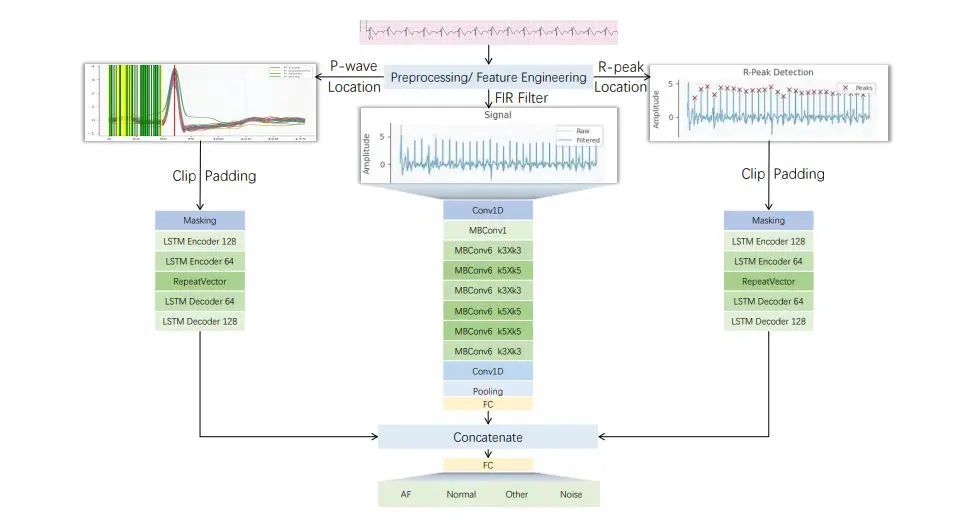
Electrocardiograms, which measure the heart’s electrical activity, represent a vital diagnostic tool for detecting cardiac abnormalities, and their rapid, non-invasive nature makes them widely applicable in healthcare. Hanhui Deng from Hunan University, Xinglin Li, and Jie Luo, alongside Zhanpeng Jin from the University at Buffalo and Di Wu, present a new deep learning approach designed to improve the speed and accuracy of ECG analysis, potentially easing the workload on medical professionals. Their research focuses on building a diagnostic model that automatically extracts key features from ECG data, overcoming the limitations of existing systems prone to misdiagnosis. The team developed EfficientECG, a lightweight classification model based on EfficientNet, capable of handling complex, high-frequency ECG data, and further enhanced it with a cross-attention feature fusion technique to incorporate multiple patient characteristics, demonstrating superior performance and efficiency on standard ECG datasets.
Cross-Attention Improves ECG Signal Classification
Novel Deep Learning Approaches Improve ECG Classification Accuracy
Enhancing Accuracy through Novel Feature Fusion Techniques
This research details a deep learning approach to improve the accuracy and efficiency of electrocardiogram (ECG) classification, crucial for early detection and treatment of heart conditions. Scientists developed a novel architecture leveraging cross-attention mechanisms and feature fusion to better analyse ECG signals and identify cardiac abnormalities like arrhythmia and atrial fibrillation. The core innovation lies in allowing the model to focus on the most relevant parts of the ECG signal and capture complex relationships between different features. This is achieved by combining cross-attention with feature fusion, creating a comprehensive representation of the ECG data.
Researchers utilised squeeze-and-excitation networks to enhance feature representation and employed the EfficientNet architecture for model scaling and efficiency. The model was rigorously tested on widely used datasets including the MIT-BIH Arrhythmia Database, the PhysioNet/Computing in Cardiology Challenge dataset, and a substantial dataset from a high-tech competition. Results demonstrate improved accuracy in ECG classification compared to existing methods, allowing the model to capture subtle patterns indicative of cardiac abnormalities. This focus on efficiency also makes the model suitable for real-time applications and deployment on resource-constrained devices, potentially improving cardiac diagnosis and monitoring.
Deep Learning for ECG Data Analysis
This research pioneers a deep learning approach to efficiently analyse electrocardiogram (ECG) data, aiming to create a diagnostic model that reduces the workload on medical professionals. Scientists addressed limitations in existing ECG models by developing techniques for automatic feature extraction through end-to-end training. They devised EfficientECG, a classification model built upon the existing EfficientNet architecture, specifically adapted for handling high-frequency, long-sequence ECG data with diverse lead types. To improve diagnostic accuracy, the team engineered a cross-attention-based feature fusion model integrated with EfficientECG, enabling analysis of multi-lead ECG data alongside patient attributes like gender and age.
This innovative approach allows the system to leverage a broader range of information for more informed diagnoses. The researchers meticulously compared the characteristics of ECG data and previous studies, informing their feature engineering process and the adaptation of EfficientNet. Experiments employed datasets including the widely used MIT-BIH database, the 2017 PhysioNet Computing in Cardiology Challenge dataset, and a substantial 40,000 8-lead ECG dataset. This dataset uniquely included patient gender and age labels, facilitating research into multi-feature ECG analysis. Evaluations demonstrate the superiority of this model against state-of-the-art methods in terms of precision, multi-feature fusion capabilities, and lightweight design, paving the way for real-time diagnostic applications.
Designing Highly Efficient Systems for Cardiac Analysis
Designing Highly Efficient Systems for Cardiac Analysis
Efficient ECG Classification via Deep Learning
EfficientECG: Achieving Breakthrough Performance in ECG Analysis
Architectural Breakthrough: Introducing EfficientECG Model
This work presents a breakthrough in electrocardiogram (ECG) analysis through the development of EfficientECG, a deep learning model designed for accurate and lightweight classification of high-frequency ECG data. Researchers addressed limitations in existing models, which often struggle with computational demands and require extensive manual feature extraction. The team successfully implemented an optimized EfficientNet architecture, adapting it specifically for the characteristics of ECG data and multi-lead analysis. Experiments demonstrate the effectiveness of this approach, achieving high precision in ECG classification.
The model’s performance was further enhanced through a novel cross-attention mechanism, enabling effective fusion of multi-feature data, including patient age and gender. Evaluations using three authoritative ECG datasets confirm the efficiency and accuracy of EfficientECG, showcasing improvements over previous methods in both total parameters and classification metrics. The research team meticulously engineered features and optimized the model structure, resulting in a system capable of classifying complex ECG signals with greater speed and reliability. Specifically, the model excels at processing multi-lead ECG data, delivering richer information than single-lead equipment commonly used in earlier studies. This advancement paves the way for more efficient and accurate cardiac diagnoses, potentially reducing the burden on medical professionals and improving patient care.
Efficient ECG Analysis with Deep Learning
This research presents EfficientECG, a novel deep learning model designed to improve the analysis of electrocardiogram data and assist in cardiac abnormality detection. The team developed an accurate and lightweight classification model, building upon the existing EfficientNet architecture, specifically tailored to handle the characteristics of high-frequency, long-sequence ECG data. Further enhancements involved a cross-attention module, enabling the fusion of multi-feature data, including gender, age, and information from multiple leads, to improve classification performance. Evaluations conducted on representative ECG datasets demonstrate that EfficientECG achieves high precision and effectively utilizes multi-feature data while maintaining low computational resource consumption, surpassing the performance of existing state-of-the-art models.
The researchers also validated the contribution of each component within the multi-feature fusion model through detailed ablation studies. Future work will focus on adapting the model to incorporate a wider range of ECG features and optimising training and inference methods to enhance overall efficiency and effectiveness in real-time diagnosis. This research represents a significant step forward in the application of deep learning to real-world healthcare challenges.
🗞 EfficientECG: Cross-Attention with Feature Fusion for Efficient Electrocardiogram Classification
🧠 ArXiv: https://arxiv.org/abs/2512.03804