Researchers demonstrate a deep learning-based error mitigation technique that enhances the performance of the variational eigensolver (VQE) algorithm on noisy quantum computers. Training multilayer perceptrons with circuit descriptors predicts accurate expectation values, exceeding the performance of conventional error mitigation strategies and reducing computational cost.
Quantum computation offers the potential to solve problems intractable for classical computers, but current devices are limited by inherent noise. Researchers are actively developing methods to mitigate these errors and extract meaningful results from near-term quantum processors. A new approach, detailed in research by Cantori et al., focuses on enhancing the performance of the variational quantum eigensolver (VQE) – an algorithm used to find the lowest energy state of a quantum system – through a tailored error mitigation strategy. The team, from the University of Camerino, demonstrate a deep-learning technique that predicts accurate results from noisy quantum outputs, utilising a computationally efficient method for generating training data. Their work, entitled ‘Deep-learned error mitigation via partially knitted circuits for the variational quantum eigensolver’, suggests a powerful synergy between variational algorithms and classical machine learning for improving the reliability of quantum computation.
Deep Learning Enhanced Error Mitigation for Variational Quantum Eigensolvers
Quantum computation holds promise for solving complex problems intractable for classical computers. However, current quantum hardware suffers from limitations including qubit decoherence and gate infidelity – collectively termed ‘noise’ – which impede performance. The variational eigensolver (VQE) is a leading algorithm designed for near-term, noisy quantum computers. VQE approximates the ground state energy of a quantum system by optimising parameters within a quantum circuit. Deeper circuits, while necessary for increased accuracy, are particularly vulnerable to noise accumulation.
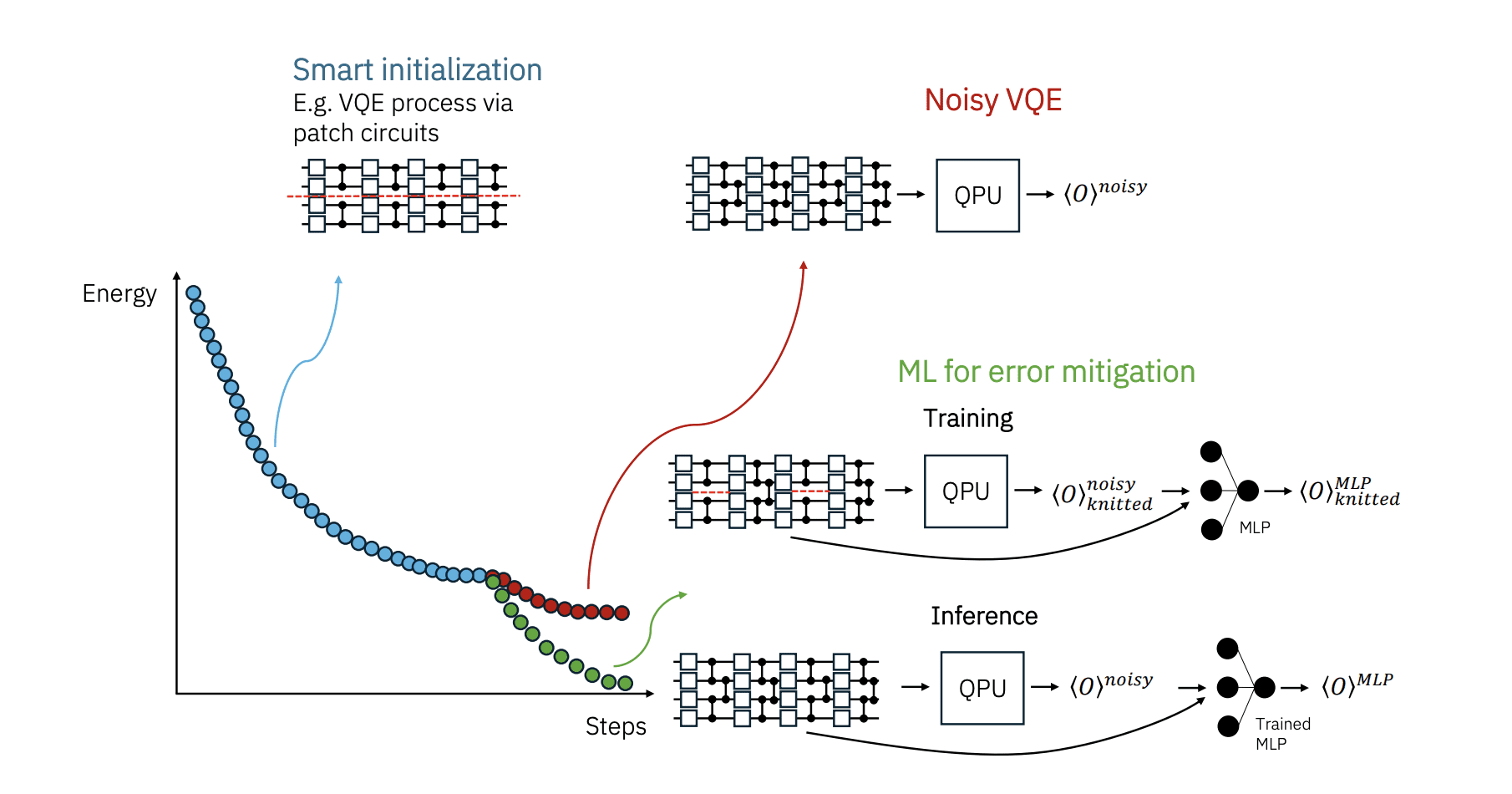
To address this, we developed an error mitigation technique employing deep learning to improve VQE’s performance. This method utilises multilayer perceptrons – a type of artificial neural network – trained in situ to predict the ideal expectation values (the average result of a quantum measurement) directly from the noisy outputs of the quantum computer, effectively correcting for errors.
A key feature of our approach is the incorporation of ‘circuit descriptors’ as inputs to the deep learning model. These descriptors characterise the structure and complexity of each quantum circuit, allowing the model to tailor the error mitigation process accordingly. For example, descriptors might include the number of gates, the types of gates used, and the connectivity of qubits. This allows the model to learn and predict errors more accurately than methods employing a generic error model.
Training deep learning models typically requires large datasets, presenting a significant computational burden. To mitigate this, we adopted a ‘circuit knitting’ technique, specifically ‘partial knitting’. Circuit knitting involves strategically combining different circuit variations to generate a diverse training dataset. Partial knitting focuses computational resources on the most noise-sensitive parts of the circuit, reducing the overall computational cost without sacrificing the representativeness of the dataset.
We benchmarked our deep-learned error mitigation technique against established methods including zero-noise extrapolation (ZNE) and probabilistic error cancellation (PEC). ZNE attempts to extrapolate to the zero-noise limit by running the circuit with varying levels of added noise, while PEC uses knowledge of the noise process to correct the results. Our results demonstrate a clear advantage, achieving higher accuracy in estimating the ground state energy of the systems investigated.
These findings highlight the potential of hybrid quantum-classical algorithms and the utility of deep learning in overcoming the challenges posed by noisy quantum hardware. By effectively mitigating the effects of noise, we enable more reliable and accurate quantum simulations, facilitating research into increasingly complex problems.
The ability to learn noise characteristics directly from the data, combined with the efficiency of partial circuit knitting, makes our method a promising pathway towards realising the full potential of VQE on noisy intermediate-scale quantum (NISQ) devices. We anticipate that this approach can be generalised to other variational quantum algorithms, further expanding its impact.
This research underscores the growing importance of integrating classical machine learning techniques with quantum algorithms. The combination of variational algorithms and deep learning represents a powerful paradigm for tackling complex problems in diverse fields, including materials science, drug discovery, and financial modelling.
Future research will focus on optimising the deep learning model and exploring new techniques for generating training data. Investigating more sophisticated machine learning architectures and incorporating additional circuit descriptors could further improve accuracy and efficiency. Furthermore, applying this technique to other variational quantum algorithms and different quantum hardware platforms will be crucial for expanding its impact.
👉 More information
🗞 Deep-learned error mitigation via partially knitted circuits for the variational quantum eigensolver
🧠 DOI: https://doi.org/10.48550/arXiv.2506.04146