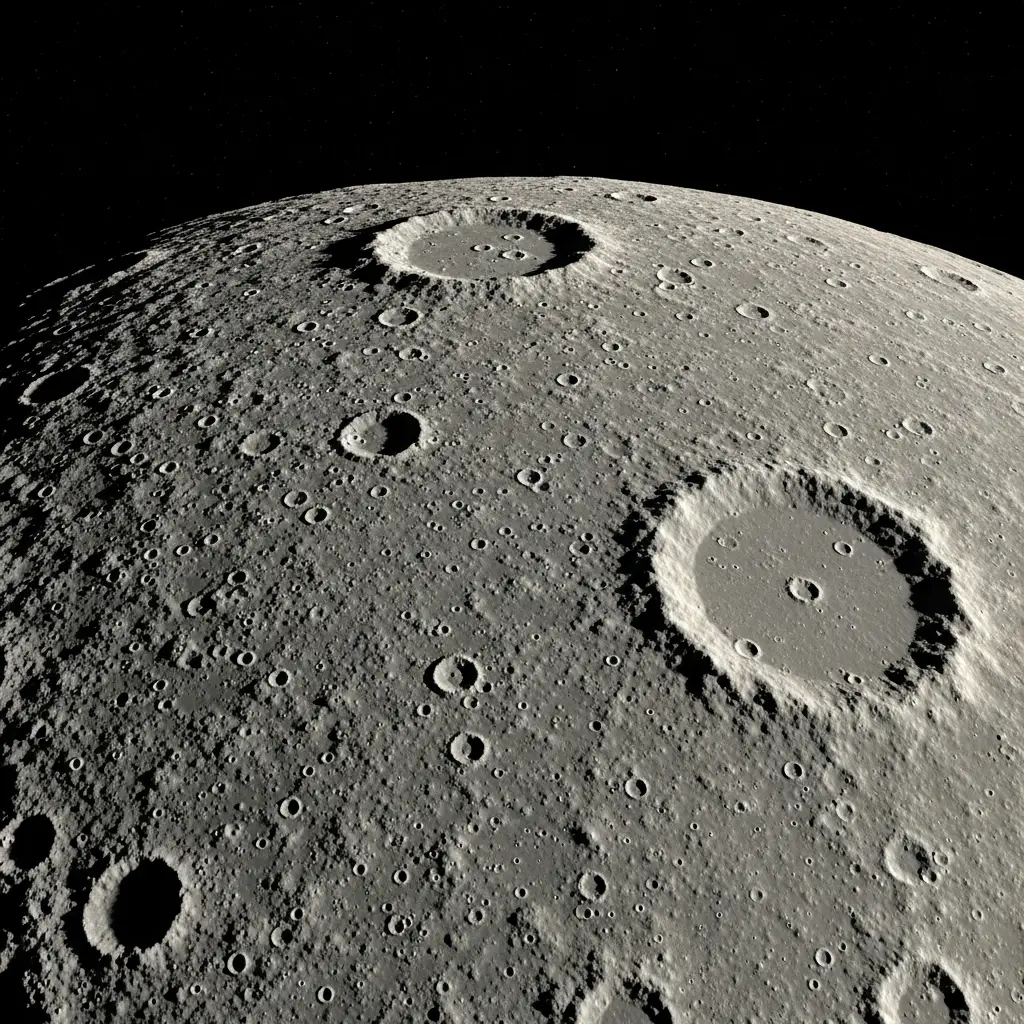
Accurate topographic models are fundamental to understanding planetary surfaces and the geological processes that shape them, yet detailed, meter-scale data remains a significant challenge, even for well-studied bodies like the Moon. Hao Chen, Philipp Gläser, and Konrad Willner, from the Technische Universität Berlin and the German Aerospace Center, address this limitation with a novel deep learning approach to reconstruct lunar topography from existing imagery. Their research enhances previous frameworks by improving scale recovery and extending reconstruction capabilities to the Moon’s challenging polar regions, where low solar illumination presents a major obstacle. The team demonstrates that this method surpasses traditional shape-from-shading techniques in both accuracy and robustness across varied terrain and lighting conditions, offering the potential to unlock unprecedented topographic resolution for lunar science and future missions. This advancement promises to leverage extensive image datasets to facilitate detailed investigations of the Moon’s complex features and geological history.
Even for the Moon, despite the availability of extensive high-resolution orbital imagery, constraints on detailed planetary investigations persist. Scientists demonstrate a breakthrough in fine-scale topographic reconstruction by leveraging recent advances in deep learning, exploiting single-view imagery constrained by existing low-resolution topography. This study addresses the limitations of current methods by enhancing their robustness and general applicability across varied lunar landscapes and challenging illumination conditions.
Advancements in Lunar Deep Learning Reconstruction Framework
The research team built upon a previously established deep learning framework, significantly improving its scale recovery scheme and extending its capabilities to the lunar polar regions, areas often subject to low solar illumination. Experiments show the proposed deep learning approach surpasses traditional single-view shape-from-shading methods in robustness, consistently delivering more accurate topographic reconstructions even with varying illumination. The team achieved reliable reconstruction of topography across a wide spectrum of lunar features, encompassing diverse scales, morphologies, and geological ages, demonstrating a significant advancement in topographic modelling. This work unveils high-quality topographic models of the lunar south polar areas, including permanently shadowed regions, proving the method’s ability to reconstruct complex terrain under extremely low-illumination conditions.
The study establishes that the deep learning approach can effectively leverage extensive lunar datasets, offering a substantial improvement over conventional techniques. These findings suggest a pathway towards supporting advanced lunar missions and enabling investigations at an unprecedented level of topographic resolution, opening new avenues for understanding the Moon’s evolution. The research establishes a novel method for creating detailed lunar topographic models, resolving small-scale details comparable to shape-from-shading techniques while maintaining the overall terrain morphology consistent with stereo-photogrammetry derived data. This innovative approach also achieves substantially faster processing speeds, demonstrating the potential for efficient, high-quality topographic mapping across the lunar surface. By successfully modelling diverse terrain and overcoming the challenges of variable illumination, this work provides a crucial tool for analysing geological processes spanning the Moon’s history.
Lunar Topography Reconstruction via Deep Learning
Topographic models are fundamental to characterizing planetary surfaces and understanding geological processes, yet meter-scale data remains limited, even for well-studied bodies like the Moon. This work addresses this challenge by building upon a previously developed deep learning (DL) framework to reconstruct fine-scale topography from single-view imagery, constrained by low-resolution data. Scientists incorporated a more robust scale recovery scheme and extended the model’s capabilities to lunar polar regions, notorious for low solar illumination. The study pioneered a DL approach that demonstrably outperforms traditional shape-from-shading methods in reconstructing lunar topography.
Robust Topographic Modeling Across Diverse Lunar Environments
Experiments revealed greater robustness to varying illumination conditions and consistently more accurate reconstructions across diverse lunar landforms. The team engineered the system to reliably reconstruct topography across features exhibiting diverse scales, morphologies, and geological ages, overcoming limitations inherent in traditional stereo-photogrammetry and shape-from-shading techniques. These conventional methods struggle with limited stereo overlap, suboptimal viewing angles, and sensitivity to illumination variations. The innovative methodology extends beyond equatorial regions, successfully producing high-quality topographic models of the lunar south polar areas, including permanently shadowed regions.
This achievement was enabled by the DL framework’s ability to function effectively in low-illumination environments, a significant advancement for lunar science. The approach leverages extensive lunar datasets, offering a pathway to support advanced missions and enable investigations at unprecedented topographic resolution. The system delivers detailed geometric context, essential for quantifying impact energies, analyzing volcanic vent dynamics, and interpreting a wide range of geological processes. Researchers harnessed the power of deep learning to overcome the inherent limitations of two-dimensional imagery, providing quantitative topographic information such as slope, relief, roughness, and volumetrics. This method achieves a significant leap forward in lunar surface analysis, providing a crucial tool for understanding the Moon’s evolution and supporting future exploration efforts. The technique reveals the potential of DL-based approaches to unlock the wealth of information contained within existing lunar datasets.
Lunar Topography Reconstructed with Deep Learning
Potential Applications for Advanced Space Exploration
Topographic models are crucial for characterizing planetary surfaces and understanding geological processes. Scientists achieved a breakthrough in fine-scale lunar topography reconstruction by developing an enhanced deep learning framework. The work addresses the existing limitations of meter-scale topographic data, even for well-imaged bodies like the Moon. Experiments demonstrate that the team successfully incorporated a robust scale recovery scheme and extended the model’s capabilities to polar regions with low solar illumination. The research team measured significant improvements in topographic reconstruction accuracy using their deep learning approach compared to traditional shape-from-shading methods.
Results demonstrate greater robustness to varying illumination conditions and more consistent reconstructions across diverse lunar features. Specifically, tests using data from the Hponds area yielded root mean square errors (RMSE) of 2.46 meters with the new RANSAC-based scale recovery, an improvement over the 2.67 meters achieved with the previous max-min mapping technique. Similar improvements were recorded across multiple Apollo 11 test sites, with RMSE values ranging from 2.13 to 2.55 meters using RANSAC, compared to 2.17 to 2.80 meters with the earlier method. Measurements confirm the model’s ability to reliably reconstruct topography across features of varying scales, morphologies, and geological ages.
The breakthrough delivers high-quality topographic models even for the challenging south polar areas, including permanently shadowed regions. In the lunar south polar region, the team recorded an RMSE of 0.65 meters using the RANSAC scale recovery, a substantial reduction from the 0.92 meters obtained with the max-min approach. This demonstrates the method’s capability in reconstructing complex terrain under low-illumination conditions. Scientists trained ELunarDTMNet using high-quality SPG-derived NAC DTMs as ground truth, initially focusing on latitudes within ±60°. To adapt the model to polar regions, they fine-tuned it using SPG-derived polar regional DTMs and 20-meter resolution LOLA data. This fine-tuning, conducted over 20,000 iterations with a learning rate of 0.00001, enabled the network to effectively handle the unique terrain and illumination characteristics of the lunar poles. These findings suggest that deep learning-based approaches can leverage extensive datasets to support advanced missions and enable investigations of the Moon at unprecedented topographic resolution.
ELunarDTMNet For Single-View Lunar Topography
Despite the existing availability of meter-level lunar imaging data, the full potential for high-resolution topographic modelling has not been realised. This study demonstrates that a deep learning-based, single-view digital terrain model reconstruction approach, ELunarDTMNet, effectively addresses limitations inherent in conventional methods, such as the need for stereo image pairs. The research successfully evaluates the robustness of this framework under varying illumination and its ability to generalise across diverse terrain types, both crucial for reliable topographic mapping. The results indicate ELunarDTMNet generates topographic models of greater consistency and quality than single-view shape-from-shading methods, even with changing solar angles.
The system accurately models landforms of different ages and scales, and importantly, reconstructs high-quality terrain models of the lunar south polar region, including permanently shadowed regions, utilising ShadowCam imagery. The authors acknowledge that applying this deep learning framework to Mercury is currently constrained by the limited availability of high-resolution optical imagery compared to the Moon. Future work could focus on adapting the methods to account for the spatial and resolution limitations of data obtained from Mercury, potentially broadening the scope of planetary surface investigations achievable with single-view imagery.
🗞 High-fidelity lunar topographic reconstruction across diverse terrain and illumination environments using deep learning
🧠 ArXiv: https://arxiv.org/abs/2601.09468