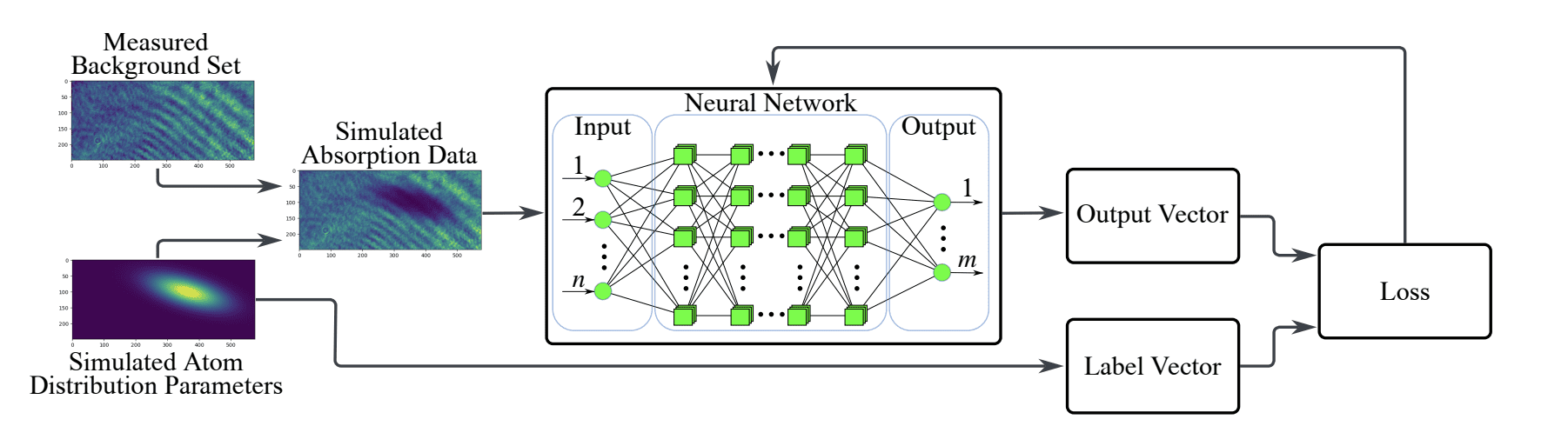
Deep learning models accurately determine ultracold atom cloud parameters from absorption images, matching the precision of least-squares fitting but with reduced computation time. Performance remained consistent whether analysing single images or those incorporating background data, potentially enabling simplified, single-exposure imaging techniques.
Precise characterisation of ultracold atom clouds is fundamental to advances in quantum simulation, sensing and atomic clocks. Researchers are continually seeking methods to rapidly and accurately determine the spatial distribution of these clouds, typically achieved through absorption imaging. A team led by Jacob Morrey (Universities Space Research Association) and including colleagues from the Space Dynamics Laboratory and the Air Force Research Laboratory, now demonstrate a deep learning approach to analysing these images. Their work, entitled ‘Deep Learning for Absorption-Image Analysis’, details modified image classification models applied to regression tasks, achieving comparable accuracy to established least-squares techniques, but with substantially reduced computational time. The team overcame limitations in experimental data acquisition by training the models on simulated images, and importantly, showed that performance remained consistent even when utilising single absorption images, potentially simplifying future experimental setups.
Machine Learning Accelerates Analysis of Ultracold Atom Clouds
Researchers have demonstrated a considerable acceleration in the analysis of ultracold atom clouds by employing convolutional neural networks (CNNs) to directly determine key atomic parameters from absorption images. Traditionally, extracting information such as cloud size, position, and temperature requires computationally intensive fitting of theoretical models to experimental images, limiting the speed and scalability of research. This new approach circumvents this process, offering a faster and potentially more precise alternative.
The study centres on training CNNs – a type of deep learning algorithm particularly adept at image analysis – on a large, simulated dataset of absorption images. These simulations incorporate variations in atomic cloud parameters, allowing the network to learn the relationship between image features and the underlying physical properties. This is a crucial step in developing a robust and accurate analysis tool. The team experimented with different CNN architectures, including EfficientNet and RegNet, to optimise performance.
Researchers achieve comparable, and in some instances improved, accuracy in determining atomic parameters when contrasting the CNNs with conventional least-squares fitting techniques, validating the effectiveness of the machine learning approach. This accuracy is particularly noteworthy given the computational efficiency of the CNNs, which operate substantially faster than traditional methods, enabling near real-time analysis of atomic cloud images. The robustness of the CNNs to image noise and imperfections further enhances their practicality in real-world experimental settings, ensuring reliable data analysis even under challenging conditions.
A key finding is the significant reduction in processing time, allowing researchers to analyse data much more quickly than previously possible. This speed advantage is particularly valuable in dynamic experiments where rapid feedback and control are essential, allowing for real-time adjustments to experimental parameters. Transfer learning – utilising pre-trained image recognition models – proves beneficial in improving the network’s performance.
The research also demonstrates the feasibility of single-exposure absorption imaging, simplifying experimental setups and reducing hardware demands. The CNNs perform similarly whether trained on single images of the atom cloud or images incorporating background information, streamlining experimental procedures and lowering costs. By automating the parameter extraction process, researchers can dedicate more time to experimental design and interpretation, fostering innovation.
This methodological shift has implications beyond simply speeding up data analysis, as it opens new avenues for experimentation and control. Researchers can now explore closed-loop experiments, where parameters are adjusted based on CNN analysis, demonstrating the potential for real-time feedback and control.
Expanding the training dataset to include a wider range of simulated and experimental images further enhances the CNN’s reliability and applicability, ensuring its long-term viability as a research tool. This research represents a significant advancement in the field of atomic physics, offering a powerful new tool for data analysis and experimental control. By leveraging the power of deep learning, researchers can now analyse data more quickly, accurately, and efficiently, opening new avenues for scientific discovery and innovation.
👉 More information
🗞 Deep Learning for Absorption-Image Analysis
🧠 DOI: https://doi.org/10.48550/arXiv.2506.04517