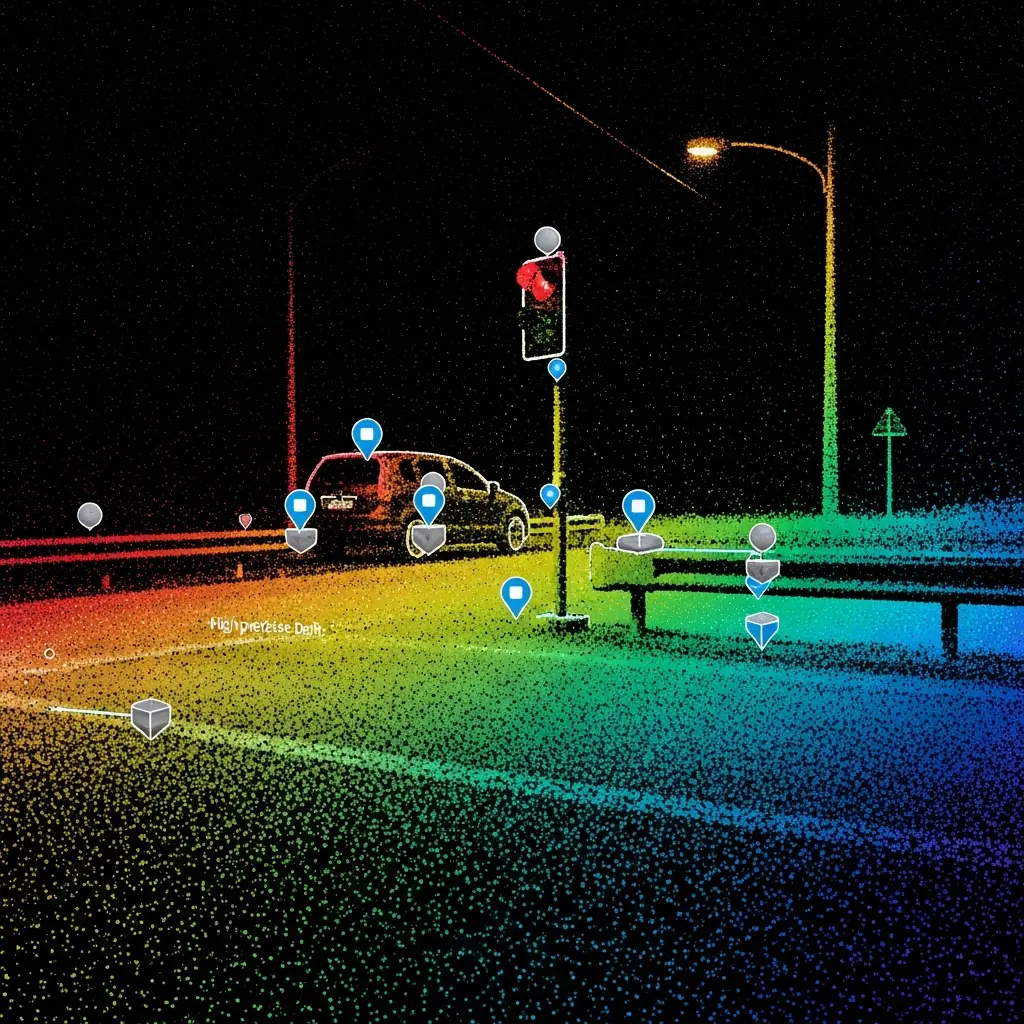
The efficient and automated inventory of roadside infrastructure represents a significant challenge in the development of smart cities and effective facility management. Chong Liu, Luxuan Fu, and Yang Jia, alongside colleagues from Wuhan University and the Sichuan Highway Planning, Survey, Design and Research Institute, present a novel framework, SVII-3D, designed to overcome the limitations of current methods reliant on sparse street imagery. Their research tackles issues of robustness, localization accuracy, and detailed condition assessment, offering a pathway to create comprehensive digital twins of infrastructure assets. By combining advanced detection techniques with geometry-guided refinement and a vision-language model, SVII-3D achieves decimeter-level 3D localization and automatically diagnoses the operational state of assets. This work provides a scalable and cost-effective solution, promising to transform infrastructure digitisation and enable proactive, intelligent maintenance strategies.
Asset digitisation is a critical task in smart city construction and facility lifecycle management. However, utilising cost-effective sparse imagery remains challenging due to limited robustness, inaccurate localisation, and a lack of fine-grained state understanding. To address these limitations, SVII-3D, a unified framework for holistic asset digitisation, is proposed. First, LoRA fine-tuned open-set detection is fused with a spatial-attention matching network to robustly associate observations across sparse views, improving object recognition even with limited data. Second, a geometry-guided refinement mechanism is introduced to resolve structural errors, achieving precise decimeter-level 3D localisation of assets within the environment. Third, moving beyond static geometric mapping, the framework aims to provide a dynamic and comprehensive understanding of asset states over time.
Street-view imagery and vision-language models for 3D localisation
The accurate assessment of civil infrastructure during its operations and maintenance phase demands current, detailed 3D data to inform effective decision-making. Researchers are addressing the need for high-precision 3D perception with cost-effective acquisition methods, aiming to build comprehensive databases detailing the 3D location, category, attributes and operational status of infrastructure assets. Current methods present a challenge: LiDAR systems offer precision but are expensive, while image-based approaches are affordable but often produce meter-level localisation errors. This study explores the potential of combining sparse, low-cost street-view imagery with vision-language models to achieve automated, high-precision 3D localisation of various infrastructure targets.
The methodology centres on utilising sparse street imagery and vision-language models (VLMs) to automatically diagnose fine-grained operational states of infrastructure. Existing approaches often rely on Google Street View or crowdsourced images, employing object detection and depth estimation to generate 2D coordinates, but these methods struggle with robust infrastructure identification and are prone to errors in asset counting due to a lack of global reasoning. These systems also typically provide only 2D coordinates with meter-level inaccuracies and fail to capture detailed semantic attributes crucial for intelligent management. To overcome these limitations, the research incorporates a Vision-Language Model agent leveraging multi-modal prompting for automated diagnosis.
Achieving high-fidelity asset digitization for maintenance
The system, named SVII-3D, aims to bridge the gap between sparse perception and automated intelligent maintenance by providing high-fidelity infrastructure digitisation. Experiments were conducted to demonstrate SVII-3D’s ability to significantly improve identification accuracy and minimise localisation errors, offering a scalable and cost-effective solution. The core innovation lies in the ability to extract key attributes and operational states from sparse imagery, providing deeper semantic support for infrastructure management and decision-making. By integrating VLMs with street-view data, the framework addresses the challenges posed by data sparsity, a significant limitation of applying dense 3D reconstruction and multi-object tracking techniques to this type of imagery. The resulting system offers a pathway towards comprehensive, high-precision 3D infrastructure data acquisition and analysis.
Sparse Imagery Enables Decimetre-Level 3D Asset Localization
Unified frameworks for precise, decimeter-level localization
Scientists have developed SVII-3D, a unified framework for holistic asset digitization, addressing challenges in creating digital twins from sparse imagery. The research team achieved precise decimeter-level 3D localization of assets, a significant advancement in automated infrastructure mapping. Experiments demonstrate the framework’s ability to robustly associate observations across limited viewpoints, overcoming limitations previously encountered with cost-effective sparse image data. This breakthrough delivers a scalable solution for high-fidelity digitization, effectively bridging the gap between limited visual input and detailed environmental understanding.
Further refinement involves examining unassigned observations for potential merges, absorbing singletons into existing clusters if their ray-to-center distance falls below τmerge. Pairwise singletons are merged only if they satisfy a physical size consistency check, calculated using the equation S ≈ s2d · |(ctri −p) · d|, where S represents physical size, s2d is the 2D bounding box size, and |(ctri −p) · d| is the projection depth. Tests prove that this bidirectional refinement ensures centimeter- to decimeter-level localization accuracy, even with sparse and noisy data. The resulting centers are computed from geometrically coherent ray sets, guaranteeing faithful instance counting.
Diagnosing infrastructure state using vision-language models
Beyond geometric mapping, the study incorporated a State-discriminative Vision-Language Model (VLM) agent to diagnose fine-grained operational states of infrastructure. This agent, leveraging pre-trained large vision-language models like Qwen-VL, GLM-4v, or LLaVA, avoids computationally expensive fine-tuning by employing a training-free inference strategy. Through task-specific multi-modal prompting, expert knowledge injection derived from national standards, and retrieval-augmented generation, the VLM agent accurately infers detailed attributes and operational health status, delivering results in a structured JSON format. This allows for reliable distinction between structural damage and surface dirt, offering essential evidence for prioritizing maintenance and analyzing spatiotemporal changes.
Detailed 3D Mapping and Asset Diagnosis
SVII-3D represents a significant advance in automated roadside infrastructure inventory, utilising sparse street-view imagery to create detailed digital twins. The framework combines open-set detection, spatial matching and geometry-guided refinement to achieve decimeter-level 3D localisation accuracy, demonstrated through experiments on city-scale datasets from Wuhan and Shanghai. This approach effectively addresses challenges posed by wide baselines and visual ambiguities commonly found in urban environments, improving both identification accuracy and retrieval completeness. Beyond precise geometric mapping, the incorporation of a Vision-Language Model agent allows for the automatic diagnosis of fine-grained operational states of infrastructure assets. This enables the system to extract detailed attributes and identify conditions such as structural damage or surface dirt, offering actionable insights for maintenance and facility management. The authors acknowledge limitations inherent in relying on sparse imagery, and future work will focus on developing a self-verifying “Digital Quality Inspector” to enhance the trustworthiness of the automated inventory system through detection of perception failures.
🗞 SVII-3D: Advancing Roadside Infrastructure Inventory with Decimeter-level 3D Localization and Comprehension from Sparse Street Imagery
🧠 ArXiv: https://arxiv.org/abs/2601.10535