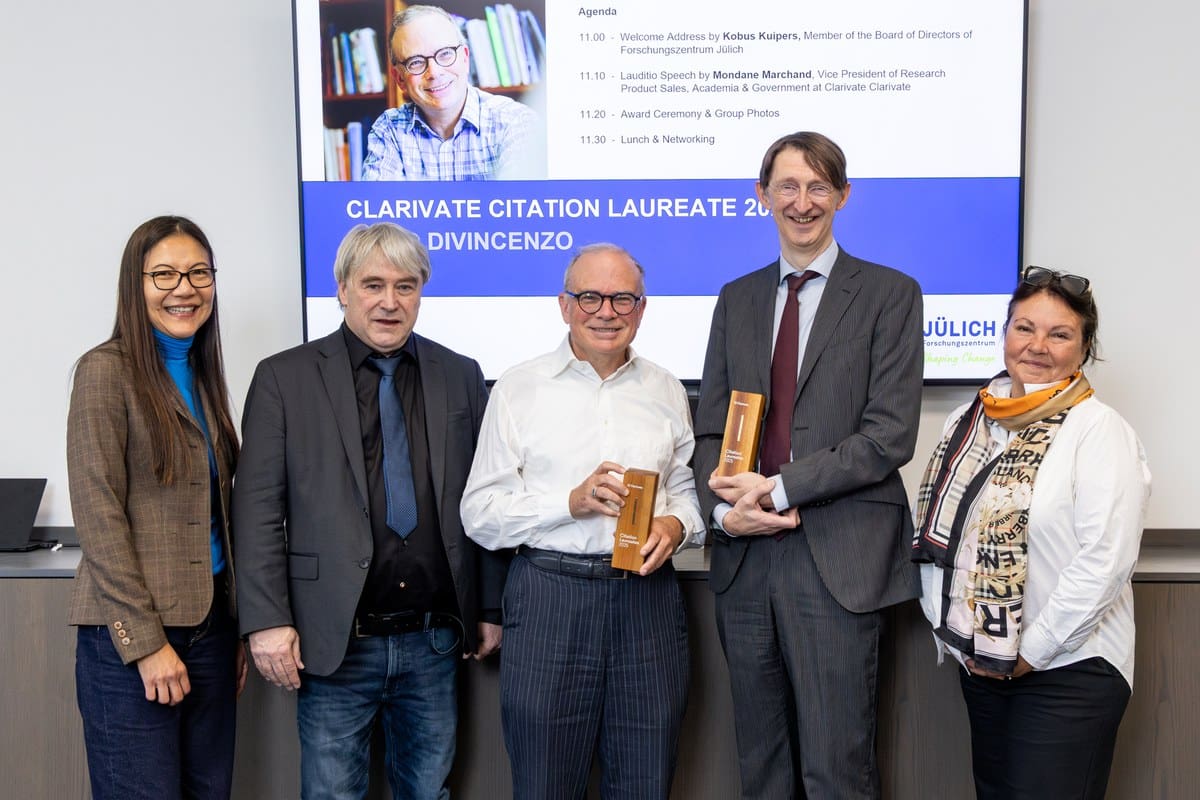
David DiVincenzo’s Citation Laureate Recognition David DiVincenzo has been named a 2025 Clarivate Citation Laureate for his groundbreaking contributions to the field of quantum computing. The award, announced on September 25, 2025, recognises researchers whose publications are frequently cited, signifying a substantial impact on their field. DiVincenzo shares this honour in the physics category with Swiss scientist Daniel Loss. For 14 years, DiVincenzo conducted research at Forschungszentrum Jülich, becoming a pioneer in the development of quantum computing before transitioning to RWTH Aachen University.
DiVincenzo’s foundational work centers on defining the essential requirements for a functional quantum computer. In the early 1990s, recognizing the potential of this emerging field, he developed what are now known as the “DiVincenzo criteria.” These five statements outline the physical characteristics a quantum computer must possess to operate effectively. These criteria are: a scalable system of well-characterized qubits; the ability to initialize those qubits to a defined state; a universal set of elementary quantum gates for computation; the capacity to measure individual qubits; and, crucially, a coherence time – the duration qubits maintain their quantum state – that significantly exceeds the time required to perform a computational operation.
The significance of DiVincenzo’s work extends to the very building blocks of quantum computation. Alongside Daniel Loss, he proposed utilizing electron spins in quantum dots as qubits. This approach involves trapping electrons within semiconductor structures, restricting their movement and allowing for precise control and measurement. The spin of these trapped electrons then serves as the quantum bit, or qubit, carrying information. This concept, while abstract, offers a pathway to leverage existing technologies for scalable quantum computers.
DiVincenzo’s career trajectory includes research at the IBM Watson Research Centre and, later, being awarded the prestigious Alexander von Humboldt Professorship in 2011. He used the funding from this award to establish a new research group in Germany, continuing his work at Forschungszentrum Jülich and RWTH Aachen University, focusing on optimizing both spin and superconducting qubit systems. He is a member of the US National Academy of Sciences and a fellow of the American Physical Society, solidifying his position as a leading figure in quantum physics. Despite a long and distinguished career spanning 46 years, DiVincenzo expresses his intention to continue his scientific pursuits.
Furthermore, JUNIQ serves as a central resource, offering access to a diverse range of quantum systems at varying stages of development. This infrastructure provides researchers, including DiVincenzo and his team, with the computational power necessary to explore and refine quantum algorithms and hardware. JUNIQ’s unique platform caters to both scientific exploration and industrial applications, positioning Jülich as a key player in the advancement of quantum technology. The establishment of these resources underscores Jülich’s commitment to becoming a European hotspot for quantum research, with a vision to develop a quantum computer capable of revolutionizing data processing.
DiVincenzo’s work at Jülich, spanning 14 years, focused on optimizing both spin qubit and superconducting qubit systems, leveraging the infrastructure and collaborative environment provided by JUQCA and JUNIQ. His research, alongside that of other scientists at the institution, aims to unlock the secrets of the quantum cosmos and translate theoretical advancements into tangible technological breakthroughs. The integration of his research within these larger initiatives highlights the importance of institutional support in driving innovation in the complex field of quantum computing.