

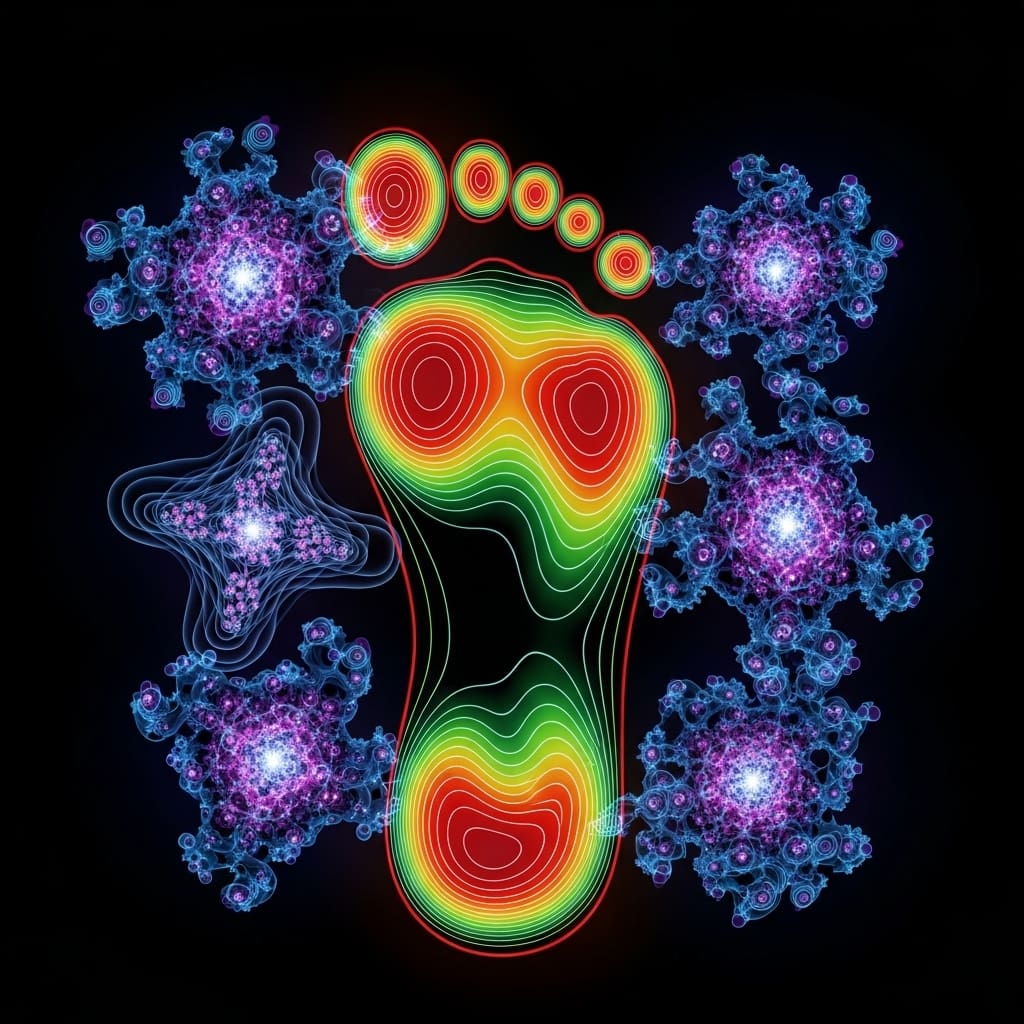
Scientists are increasingly exploring biometric footstep recognition as a novel approach to security and safety applications. Robyn Larracy, Eve MacDonald, and Angkoon Phinyomark from the University of New Brunswick, in collaboration with Saeed Rezaei at University College Cork, Mahdi Laghaei from Islamic Azad University, Ali Hajighasem working with colleagues at the University of New South Wales, and Aaron Tabor and Erik Scheme from the University of New Brunswick, have facilitated significant advancement in the field through the First International StepUP Competition for Biometric Footstep Recognition. This competition addressed a key limitation hindering progress, the scarcity of comprehensive footstep datasets, by leveraging the newly released UNB StepUP-P150 dataset. The event attracted 23 teams globally and revealed promising solutions, with the top-performing team, Saeid_UCC, achieving an equal error rate of 10.77%, though persistent difficulties in adapting to varying footwear demonstrate a crucial focus for future research.
Recent advances in identifying individuals by their unique walking patterns have been hampered by a lack of comprehensive data for training and testing algorithms. Competitors faced the dual challenge of generalizing to new users with limited reference data and adapting to unseen footwear and walking speeds, conditions that mimic real-world deployment scenarios. The top-performing team, Saeid_UCC, achieved an equal error rate (EER) of 10.77% using a generative reward machine (GRM) optimisation strategy, demonstrating a significant step forward in accuracy. The EER represents the point where false acceptance and false rejection rates are equal, serving as a key metric for evaluating the accuracy of biometric systems. Footstep recognition, a behavioural biometric modality, identifies people based on the unique pressure patterns of their feet during walking, offering inherent robustness to environmental factors and requiring no active user participation. A high-resolution pressure-sensing floor comprised the core data acquisition system, capturing unique footstep patterns during walking. This specialised floor utilised an array of sensors to record dynamic plantar pressure distributions as participants traversed its surface. Each footstep generated a detailed pressure map, quantifying the force exerted by different regions of the foot during the gait cycle. Participants completed a standardized walking protocol, systematically varying both footwear, including boots, sneakers, and dress shoes, and walking speed, ranging from slow to fast paces. This carefully controlled experimental design ensured that the dataset captured substantial intra- and inter-subject variability, mirroring the challenges of real-world deployment. The resulting recordings, comprising approximately 200,000 individual footsteps from 150 participants, were meticulously labelled and partitioned into training, validation, and testing sets. The competition framework employed a verification paradigm, assessing the ability of submitted algorithms to correctly identify registered users versus imposters. Performance was evaluated on a separate, unseen test set, deliberately designed to introduce challenging variations in footwear and walking speed not present in the training data. This rigorous evaluation protocol aimed to measure the generalisation capability of each algorithm, highlighting its robustness to real-world conditions and limited reference data. The use of a dedicated test set prevented overfitting and provided a fair comparison of competing approaches. The StepUP competition not only showcased promising solutions but also highlighted persistent difficulties in generalizing to unfamiliar footwear, indicating a crucial area for future research and development. Analysis of all submissions revealed consistent difficulties in generalizing to previously unseen footwear, suggesting that footwear represents a significant source of variability in footstep pressure patterns. The relentless pursuit of reliable biometric identification has found an unlikely ally in the simple act of walking. For years, researchers have struggled to build robust footstep recognition systems hampered by a lack of sufficiently large and varied datasets. This isn’t merely an academic exercise; monitoring gait changes could offer early detection of mobility issues, aiding preventative healthcare or tracking rehabilitation progress. Law enforcement could benefit from enhanced surveillance capabilities, and search-and-rescue operations might leverage footstep analysis to locate individuals in challenging environments. However, current systems still struggle to generalise when faced with changes in footwear, a practical limitation that highlights the need for even more comprehensive data capturing diverse shoe types and walking surfaces. The focus now must shift towards creating datasets that mirror real-world complexity, moving beyond controlled laboratory settings and incorporating data collected from everyday life, accounting for variations in terrain, speed, and even emotional state. Furthermore, exploring the fusion of footstep biometrics with other modalities, such as gait analysis, could yield more resilient and accurate identification systems.
👉 More information
🗞 First International StepUP Competition for Biometric Footstep Recognition: Methods, Results and Remaining Challenges
🧠 ArXiv: https://arxiv.org/abs/2602.11086

