The accelerating demand for sustainable energy solutions necessitates a rapid and efficient approach to materials discovery, moving beyond traditional trial-and-error methods. Researchers are increasingly reliant on data-driven techniques and computational modelling to accelerate this process, yet existing platforms often lack the breadth of chemical space and integrated validation necessary for practical application. Jifeng Wang, Jiazhe Ju, and colleagues from Fudan University address this challenge with the development of the Clean Energy Materials Platform (CEMP), a comprehensive, open-access resource detailed in their recent publication, ‘CEMP: a platform unifying high-throughput online calculation, databases and predictive models for clean energy materials’. The platform integrates high-throughput computational workflows, a substantial materials database, and multi-scale machine learning models, facilitating the rapid screening, analysis, and optimisation of materials for clean energy technologies.
Computational Materials Science Accelerates Discovery of Energy Storage Solutions
The pursuit of advanced batteries and renewable energy technologies demands the rapid identification of novel, high-performance materials. Traditional materials discovery relies heavily on iterative experimentation, a time-consuming and resource-intensive process, prompting a transition towards computationally accelerated methods integrating theoretical modelling, large-scale screening, and machine learning techniques. These approaches offer the potential to identify functional materials with increased efficiency and accuracy, crucial for practical applications in clean energy technologies and sustainable power generation.
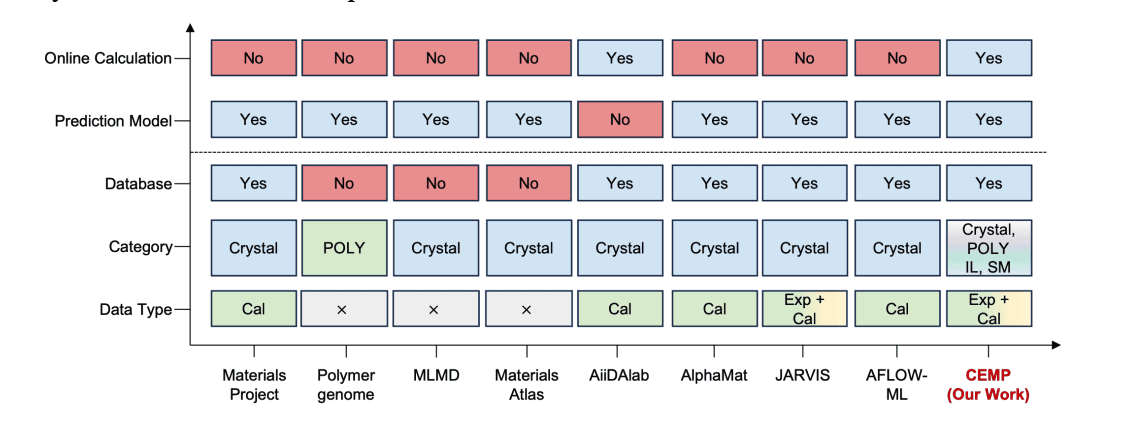
Current materials design platforms generally facilitate structural visualisation, data retrieval, and property prediction, proving effective for screening inorganic solids, yet they often exhibit limitations in scope. These platforms primarily focus on inorganic crystals, neglecting other important material classes such as polymers, small molecules, and ionic liquids, hindering comprehensive materials exploration and limiting the potential for discovering innovative solutions beyond traditional inorganic compounds. A significant challenge lies in the static nature of many existing workflows, offering limited support for user-defined structures, interactive analysis, and real-time calculations, which are essential for accelerating the discovery cycle.
The integration of both computed and experimentally measured data is paramount, as many key material properties, including conductivity and mechanical strength, require experimental confirmation to accurately reflect their behaviour in practical applications. Bridging the gap between theoretical modelling and experimental validation represents a critical step towards realising the full potential of computational materials discovery, enabling researchers to refine models and validate predictions with real-world data. Recognising this need, researchers increasingly emphasise the importance of real-time online computation, allowing for immediate assessment of material properties through simulations and offering a dynamic alternative to static, pre-calculated predictions.
CEMP Utilises Data and Algorithms to Explore Diverse Clean Energy Materials
The Clean Energy Materials Platform (CEMP) represents a methodological advance in materials science, moving beyond traditional empirical approaches towards a data-driven and algorithm-oriented research paradigm. Unlike existing platforms largely focused on inorganic crystals, CEMP deliberately broadens the chemical space to encompass small molecules, polymers, ionic liquids, and crystals, acknowledging the diverse range of materials crucial for clean energy technologies. This expansion necessitates a robust and integrated system capable of handling heterogeneous data types, a challenge CEMP addresses through a combination of high-throughput workflows, multi-scale machine learning models, and a comprehensive materials database containing approximately 376,000 entries.
A central innovation lies in the platform’s online calculation module, which automates molecular dynamics simulations triggered by structured data uploads, effectively streamlining the validation process and accelerating material screening. Molecular dynamics, a computational method simulating the physical movements of atoms and molecules, requires substantial computational resources and expertise, which CEMP’s automation lowers the barrier to entry for researchers. The platform’s methodological strength resides in its harmonisation of data originating from experimental measurements, theoretical calculations, and artificial intelligence-based predictions, creating a synergistic relationship between these sources.
The database itself, containing approximately 376,000 entries—including 6,000 experimental records, 50,000 computational calculations, and 320,000 AI-predicted properties—provides a substantial foundation for these predictive models, with machine learning models demonstrating robust predictive power indicated by R-squared values ranging from 0.64 to 0.94. The platform establishes a closed-loop workflow, beginning with data acquisition and culminating in material discovery and real-time online validation, fostering a continuous cycle of improvement and promoting collaboration within the scientific community.
CEMP Delivers a Data-Driven Platform for Clean Energy Materials Discovery
CEMP establishes an open-access platform integrating high-throughput workflows, multi-scale machine learning (ML) models, and a comprehensive materials database specifically designed for clean energy applications, addressing limitations within current materials science approaches. These limitations include a concentration on inorganic crystals, sparse experimental data, and a lack of integrated online validation tools, which CEMP overcomes through its comprehensive database and automated workflows.
Central to CEMP’s functionality is an online calculation module, which automates molecular dynamics simulations through structured table uploads, facilitating rapid material screening and analysis of structure-property relationships. The platform harmonises heterogeneous data originating from experimental measurements, theoretical calculations, and artificial intelligence-based predictions, encompassing four key material classes: small molecules, polymers, ionic liquids, and crystals. Currently, CEMP hosts approximately 376,000 entries, including around 6,000 experimental records, 50,000 computational calculations, and 320,000 AI-predicted properties, with the database covering twelve critical material properties.
The corresponding ML models demonstrate robust predictive power, achieving R2 values ranging from 0.64 to 0.94, enabling multi-objective optimisation for clean energy applications. The platform employs computational chemistry techniques, including Density Functional Theory (DFT), to calculate electronic structures and material properties, and Molecular dynamics (MD) simulations model atomic movements over time, utilising force fields like UFF and MMFF94, alongside water models such as TIP3P-FB and TIP4P-FB. CEMP aims to create a digital ecosystem for clean energy materials, establishing a closed-loop workflow that integrates data acquisition, material discovery, and real-time online validation, ultimately contributing to the efficient design of next-generation energy materials.
CEMP Accelerates Clean Energy Material Innovation Through Integrated Digital Resources
CEMP establishes a robust digital infrastructure for materials discovery, integrating high-throughput computation, machine learning, and a comprehensive database. This platform addresses limitations within current materials science, which often relies on empirical methods and suffers from restricted chemical space and a lack of rapid validation tools, offering a comprehensive solution for materials discovery and optimisation. CEMP harmonises data from diverse sources – experimental measurements, theoretical calculations, and artificial intelligence predictions – across four material classes: small molecules, polymers, ionic liquids, and crystals, providing a holistic approach to materials research.
Currently, the platform hosts a substantial dataset of approximately 376,000 entries, comprising around 6,000 experimental records, 50,000 computational results, and 320,000 AI-predicted properties, with twelve critical material properties covered. The corresponding machine learning models demonstrate strong predictive capabilities, achieving R2 values ranging from 0.64 to 0.94, facilitating rapid material screening, detailed structure-property relationship analysis, and multi-objective optimisation tailored for clean energy applications. A key innovation within CEMP is the online calculation module, which automates molecular dynamics simulations through structured data uploads, streamlining the computational process and enabling researchers to perform calculations efficiently.
The platform’s design supports a closed-loop workflow, encompassing data acquisition, material discovery, and real-time online validation, fostering a dynamic and iterative research process. Future work focuses on expanding the database to encompass a wider range of materials and properties, thereby increasing the platform’s versatility, and integrating additional computational methods, such as advanced quantum chemical techniques, will enhance the accuracy and reliability of predictions. Developing user-friendly interfaces and APIs will broaden accessibility and encourage wider adoption within the research community, and incorporating automated data curation and quality control mechanisms will ensure the long-term integrity and usability of the platform’s data resources.
👉 More information
🗞 CEMP: a platform unifying high-throughput online calculation, databases and predictive models for clean energy materials
🧠 DOI: https://doi.org/10.48550/arXiv.2507.04423