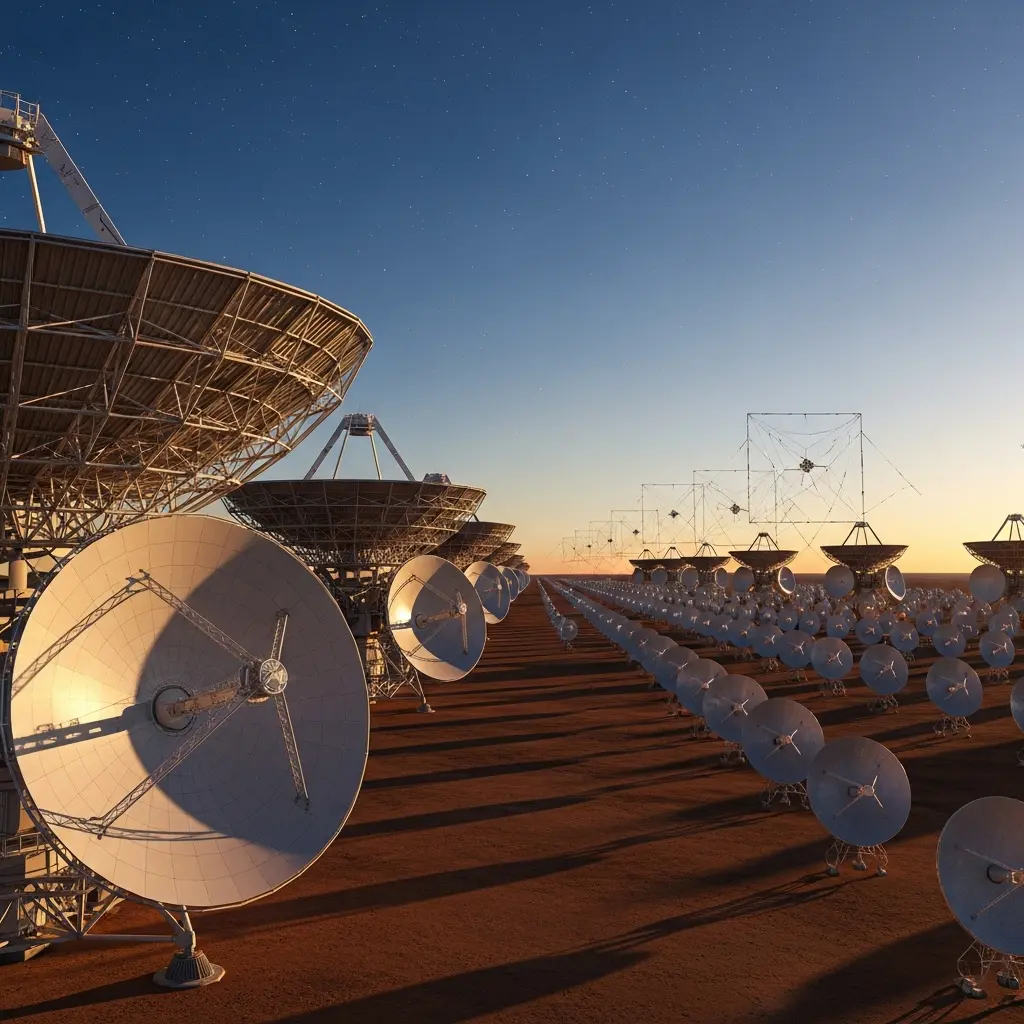
The search for dark photons, hypothetical particles extending the Standard Model of particle physics, drives innovative astronomical research, and a team led by Ethan Baker and Hongwan Liu from Boston University now forecasts the potential of next-generation radio telescopes to detect these elusive particles. The researchers detail a comprehensive analysis pipeline to assess the Square Kilometre Array’s sensitivity to dark photons, focusing on how these particles might convert into detectable signals within the vast spaces between galaxies. Their work demonstrates that combining the power of the SKA with existing galaxy surveys and 21-centimetre experiments offers a promising pathway to discover dark photons with masses ranging from micro-electronvolts to electronvolts, and with incredibly small interaction strengths, opening a new window onto the hidden sector of the universe.
Cosmic 21cm Signal and Large-Scale Structure
Current research extensively investigates the early universe, focusing on the Cosmic Microwave Background and the Epoch of Reionization. Scientists are actively studying the 21cm signal, searching for subtle anomalies and primordial signals that could reveal details about the universe’s infancy, alongside investigations into large-scale structure to explore the formation and evolution of cosmic structures. This research relies heavily on advanced data analysis techniques and statistical methods, employing tools like Astropy and NumPy to process vast astronomical datasets. Radio astronomy plays a crucial role, with instruments like LOFAR and HERA used to study the 21cm signal and other faint radio sources. Researchers meticulously measure the polarization of the Cosmic Microwave Background, searching for B-mode polarization patterns that could provide evidence for inflation and gravitational waves. They modelled the conversion of high-energy photons into dark photons, a process that would create subtle temperature variations in the cosmic microwave background and radio frequencies. To accurately predict the SKA’s capabilities, the team simulated this conversion occurring in dark matter halos, the intergalactic medium during the Epoch of Reionization, and the late-universe intergalactic medium. To realistically assess the SKA’s performance, scientists generated mock radio maps representing foreground signals at SKA frequencies using sophisticated codes.
These maps formed the foundation of a data processing pipeline mirroring techniques that will be applied to real SKA observations. The pipeline employs an internal linear combination algorithm to optimally combine radio maps, maximising the signal-to-noise ratio of the dark photon signal while minimising foreground contamination. Scientists demonstrate that visible photons from the cosmic microwave background can convert into dark photons, generating temperature variations across the sky, and detail the pipeline used to compute SKA’s sensitivity to these conversions occurring within the intergalactic medium. Results show that both SKA, when combined with galaxy surveys, and 21-cm experiments could discover dark photons with masses ranging from 5 × 10⁻¹⁵ to 5 × 10⁻¹² eV, and detect kinetic mixing parameters as low as 10−8. The study focuses on resonant conversions, where the probability of photon-to-dark photon conversion is enhanced when the dark photon mass matches the effective plasma mass in ionized gas. Researchers developed detailed models of how visible photons could convert into dark photons, generating detectable signals through resonant interactions within the intergalactic medium and dark matter halos. The team demonstrated that the SKA, when combined with galaxy surveys, possesses the capability to identify dark photons with masses between 10−13 eV and 5 × 10⁻¹³ eV, and with a kinetic mixing parameter as low as 10−8, representing a fourfold improvement over previous analyses. The analysis pipeline successfully addresses the challenges posed by foreground radio emissions, employing a needlet internal linear combination algorithm to extract faint signals.
🗞 Dark Photons in the Radio Sky: II. Resonant Conversions in the Intergalactic Medium
🧠 ArXiv: https://arxiv.org/abs/2511.09637