

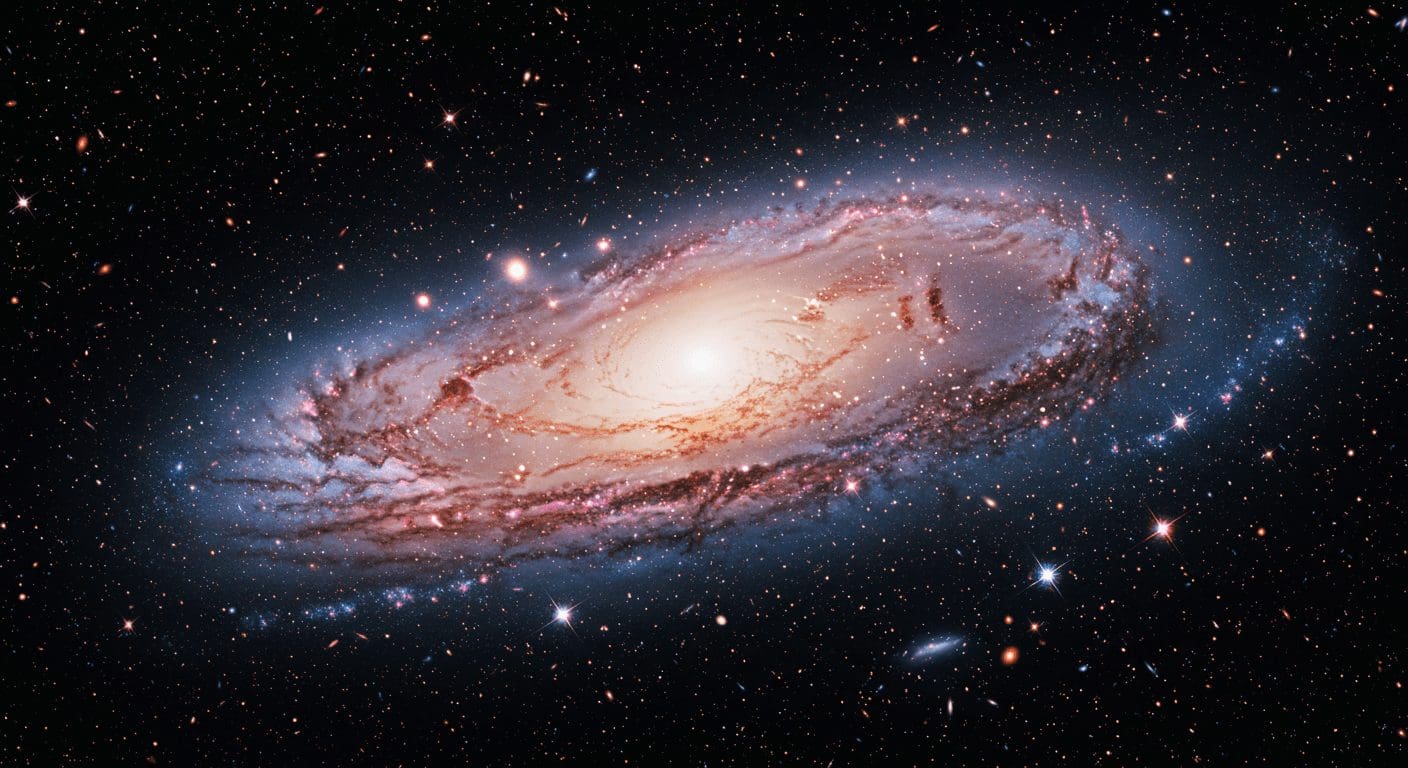
A mysterious phenomenon at the center of our galaxy involving unexplained chemical reactions in hydrogen gas clouds has led scientists to propose a new type of low-mass dark matter. In a study published in Physical Review Letters on March 10, 2025, researchers, including Dr. Shyam Balaji of King’s College London, suggest that lighter-than-expected dark matter particles could be annihilating each other and producing charged particles, ionizing the hydrogen gas.
This explanation addresses discrepancies with previous theories involving cosmic rays or WIMPs (Weakly Interacting Massive Particles). It may also account for a specific X-ray emission line observed at the galaxy’s center. The findings offer a novel perspective on dark matter’s potential nature by analyzing phenomena directly in the Milky Way’s Central Molecular Zone.
Explaining Unexplained Chemical Reactions in the Milky Way
The study proposes a novel hypothesis regarding dark matter, suggesting that lighter particles rather than the previously dominant WIMPs (Weakly Interacting Massive Particles) could explain certain astrophysical phenomena. These lighter dark matter particles annihilate each other, producing charged particles such as electrons or positrons. These charged particles interact with hydrogen gas in the galaxy’s center, leading to ionization observed at the Milky Way’s core.
This theory addresses inconsistencies with previous explanations involving cosmic rays, which do not align with observed energy signatures. Additionally, it accounts for a specific X-ray emission line (511 keV) detected at the Milky Way’s core, providing a plausible mechanism for its generation.
The implications of this research extend beyond explaining hydrogen ionization and the X-ray emission line. If confirmed, the existence of lighter dark matter particles would necessitate a reevaluation of current theoretical frameworks and experimental strategies. It could also enhance our understanding of dark matter’s role in cosmic structure formation and evolution, potentially reshaping approaches to studying this enigmatic component of the universe.
The study challenges the WIMP paradigm by offering an alternative explanation for observed phenomena, aligning with additional astrophysical data such as the 511 keV X-ray emission line. This new theory provides a more accurate and direct explanation for these observations, suggesting that lighter dark matter particles may play a significant role in cosmic processes.
Broader Implications for Understanding Dark Matter
The study introduces a novel hypothesis suggesting that lighter dark matter particles, rather than Weakly Interacting Massive Particles (WIMPs), could explain certain astrophysical phenomena. These lighter particles annihilate each other, producing charged particles such as electrons or positrons. These charged particles interact with hydrogen gas in the galaxy’s center, leading to ionization observed at the Milky Way’s core.
This theory addresses inconsistencies with previous explanations involving cosmic rays, which do not align with observed energy signatures. Additionally, it accounts for a specific X-ray emission line (511 keV) detected at the Milky Way’s core, providing a plausible mechanism for its generation.
The implications of this research extend beyond explaining hydrogen ionization and the X-ray emission line. If confirmed, the existence of lighter dark matter particles would necessitate a reevaluation of current theoretical frameworks and experimental strategies. It could also enhance our understanding of dark matter’s role in cosmic structure formation and evolution, potentially reshaping approaches to studying this enigmatic universe component.
The study challenges the WIMP paradigm by offering an alternative explanation for observed phenomena, aligning with additional astrophysical data such as the 511 keV X-ray emission line. This new theory provides a more accurate and direct explanation for these observations, suggesting that lighter dark matter particles may play a significant role in cosmic processes.
While WIMPs have long been the leading candidate for explaining dark matter, this study introduces a compelling alternative that addresses unresolved issues and aligns with additional observational data. Exploring lighter dark matter particles represents a significant step forward in unraveling the mysteries surrounding this elusive component of the cosmos.
More information
External Link: Click Here For More


