

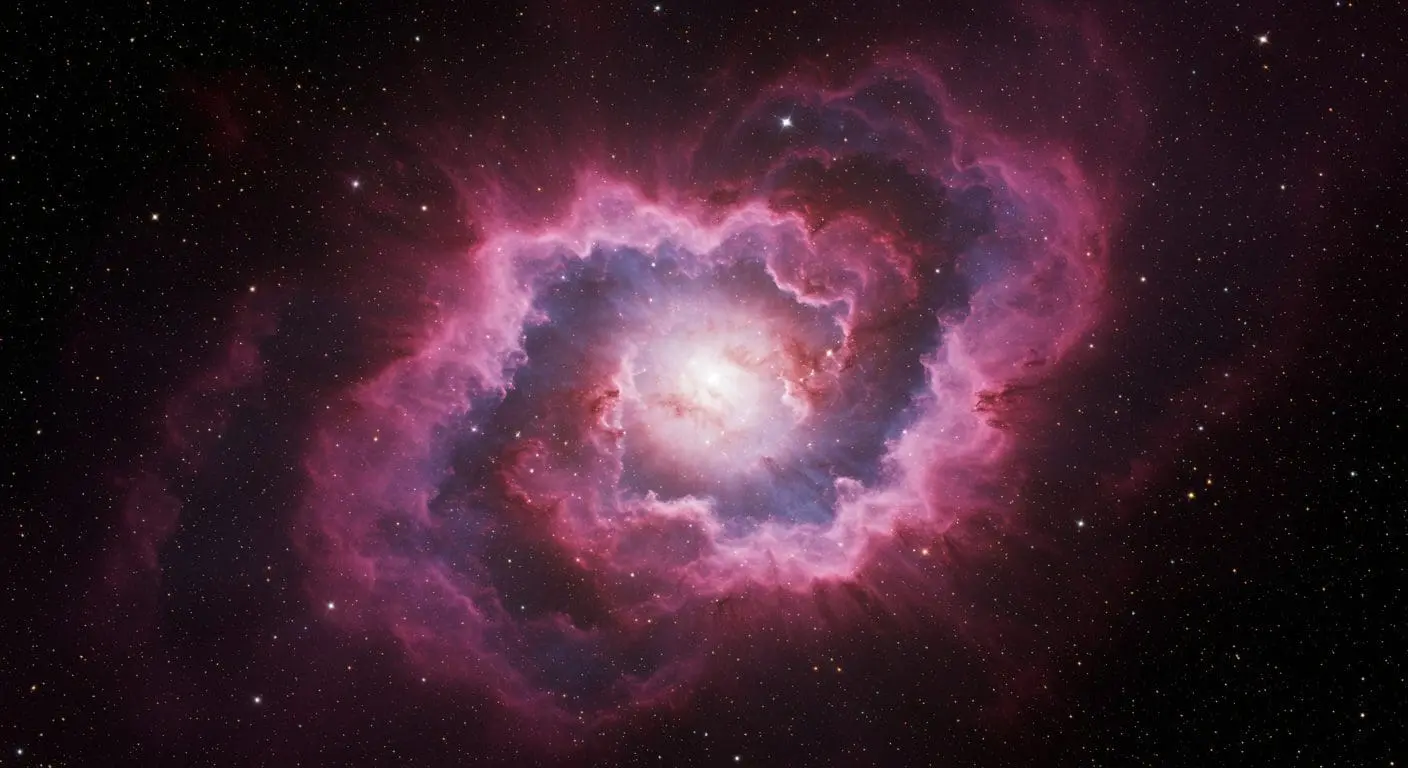
In the vast expanse of the early universe, a team of international researchers has uncovered compelling evidence that dark matter was dominant in shaping the halos of supermassive black holes within galaxies approximately 13 billion light years away.
By leveraging data from the Atacama Large Millimeter/submillimeter Array (ALMA) and employing sophisticated gas kinematics analysis, the scientists have made a significant breakthrough in understanding the mysterious nature of dark matter.
Their findings, published in The Astrophysical Journal, reveal that dark matter comprised a substantial portion of the mass budget in two quasar host galaxies at redshift z∼6, providing valuable insights into the formation and evolution of galaxies in the distant universe. This groundbreaking research sheds new light on the intricate relationship between dark matter, black holes, and galaxy development, ultimately refining our understanding of the cosmos and its underlying mechanisms.

A recent study published in The Astrophysical Journal has found that two quasar host galaxies in the early universe, approximately 12.5 billion years ago, have a low fraction of dark matter. This challenges current models of galaxy formation, which suggest that dark matter plays a crucial role in the evolution of galaxies.
The researchers used Atacama Large Millimeter/submillimeter Array (ALMA) observations to study gas kinematics in these galaxies. They found that the rotation curves of the galaxies, which describe how the speed of stars and gas orbiting the galaxy changes with distance from the center, are relatively flat and do not show the characteristic rise expected if dark matter is present.
The results suggest that these early universe galaxies have a low fraction of dark matter, which contrasts what is observed in similar galaxies in the local universe. The researchers propose that this could be due to the galaxies being in a different stage of evolution, with dark matter playing a less important role at early times.
This study provides new insights into the formation and evolution of galaxies in the early universe and highlights the need for further research to understand the role of dark matter in galaxy formation. The findings also have implications for our understanding of the distribution of dark matter in the universe and its impact on the formation of structure.
External Link: Click Here For More


