

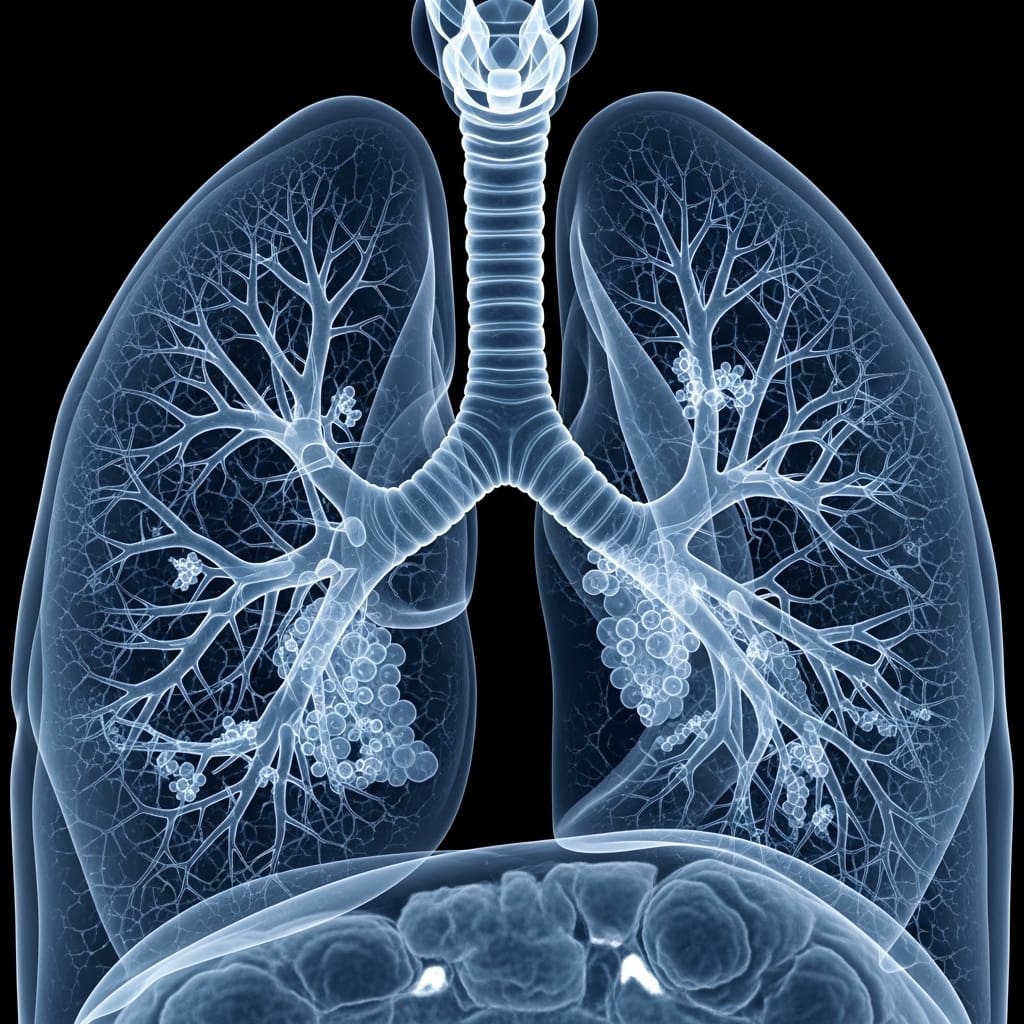
Pulmonary tree reconstruction from CT images often suffers from topological incompleteness, including missing or disconnected branches, hindering accurate anatomical analysis and limiting the effectiveness of current modeling techniques. Ziqiao Weng from The University of Sydney, Jiancheng Yang of Aalto University, and Kangxian Xie from University of Buffalo, alongside Bo Zhou and Weidong Cai, address this challenge with a novel framework called TopoField. Their research introduces a topology-aware implicit modeling approach that directly tackles topology repair as a core component, enabling unified multi-task inference for pulmonary tree analysis. By representing anatomy with sparse point clouds and learning a continuous implicit field, TopoField effectively repairs topology even with incomplete data and synthetic structural disruptions, ultimately improving anatomical labeling, lung segment reconstruction, and computational efficiency for potentially impactful clinical applications.
Repairing topological incompleteness in pulmonary trees via implicit field modelling enables realistic and anatomically plausible reconstructions
Scientists have developed TopoField, a new framework for modelling pulmonary trees extracted from CT images, addressing a critical limitation in current anatomical analysis pipelines. Pulmonary trees often exhibit topological incompleteness, with missing or disconnected branches that hinder accurate downstream analysis.
Existing methods relying on dense volumetric processing or explicit graph reasoning suffer from inefficiencies and reduced robustness when faced with realistic structural corruption. TopoField overcomes these challenges by treating topology repair as a core modelling problem, enabling unified multi-task inference for comprehensive pulmonary tree analysis.
The research introduces a topology-aware implicit modelling framework that represents pulmonary anatomy using sparse surface and skeleton point clouds. This allows the system to learn a continuous implicit field capable of repairing topological defects without requiring complete or explicitly annotated disconnection information.
Training is achieved by introducing synthetic structural disruptions into already incomplete trees, enabling the model to learn restoration without relying on perfect data. This innovative approach allows for robust repair even in scenarios with significant anatomical damage. Building upon this repaired implicit representation, anatomical labelling and lung segment reconstruction are jointly inferred through task-specific implicit functions within a single forward pass.
Extensive experiments conducted on the Lung3D+ dataset demonstrate that TopoField consistently improves topological completeness and achieves accurate anatomical labelling and lung segment reconstruction, even under challenging incomplete conditions. Notably, the implicit formulation of TopoField achieves high computational efficiency, completing all tasks in just over one second per case, making it practical for large-scale and time-sensitive clinical applications. The code and data supporting this work will be made available publicly.
Joint Geometric and Topological Modelling of Pulmonary Structures enables detailed anatomical analysis
Sparse and skeleton point clouds form the basis of the TopoField framework for modelling pulmonary anatomy. The research team employed surface, skeleton point cloud representations to jointly model both geometry and connectivity within the pulmonary tree. A super-point descriptor was then integrated to enhance local structural encoding, capturing nuanced features of the tree’s branching patterns.
Crucially, a surface-to-skeleton attention mechanism was developed to facilitate communication between surface and skeletal information, enabling more accurate topology repair. This mechanism allows the model to focus on relevant features during the reconstruction of missing or disconnected branches. A unified implicit field was then learned, supporting fine-grained yet scalable structural restoration of the pulmonary tree.
To address the challenge of incomplete trees, the study introduced a novel topological repair strategy that does not require explicit disconnection annotations. Synthetic structural disruptions were introduced to already incomplete trees during training, forcing the network to learn connectivity restoration under realistic, yet unknown, disconnection patterns.
This approach circumvents the need for costly and often unavailable precise breakpoint supervision, aligning with practical clinical scenarios. Building upon the repaired implicit representation, anatomical labeling and lung segment reconstruction were jointly inferred through task-specific implicit functions within a single forward pass.
This unified design enables end-to-end optimisation across all tasks, significantly improving efficiency and reducing error accumulation. The entire pipeline completes all tasks in just over one second per case, representing a nearly two-orders-of-magnitude speedup compared to existing implicit graph-based methods like IPGN. Extensive experiments utilising the Lung3D+ dataset demonstrate consistent improvements in topological completeness alongside accurate anatomical labelling and lung segment reconstruction, even under challenging incomplete conditions.
Rapid Pulmonary Tree Analysis via Topology-Aware Implicit Field Learning enables accurate and efficient reconstruction of airway structures
TopoField completes all tasks, topology repair, anatomical labeling, and lung segment reconstruction, in just over one second per case. This represents a nearly two-orders-of-magnitude reduction in inference time when compared to existing state-of-the-art implicit graph-based pipelines such as IPGN. The research introduces a topology-aware implicit modeling framework that addresses topological incompleteness frequently observed in pulmonary trees extracted from CT images.
This framework treats topology repair as a primary modeling problem, enabling unified multi-task inference for comprehensive pulmonary tree analysis. TopoField represents pulmonary anatomy using sparse and skeleton point clouds, learning a continuous implicit field that supports topology repair without requiring complete or explicitly annotated disconnections.
The system achieves this by training on synthetically introduced structural disruptions applied to already incomplete trees. By employing a surface-to-skeleton attention mechanism and a unified implicit field, the work facilitates fine-grained and scalable structural restoration. A key innovation is a topological repair strategy that operates without disconnection annotations, allowing the model to learn connectivity restoration even with unknown and unlocalized disruptions.
The study validates this weak supervision approach, demonstrating its reliability in real-world deployment settings. Building upon the repaired implicit representation, anatomical labeling and lung segment reconstruction are jointly inferred through task-specific implicit functions within a single forward pass.
This unified design enables end-to-end optimization across all tasks, contributing to the observed computational efficiency. Experiments conducted on the Lung3D+ dataset demonstrate consistent improvements in topological completeness alongside accurate anatomical labeling and lung segment reconstruction, even under challenging incomplete scenarios. The extended Lung3D dataset serves as a comprehensive benchmark supporting multi-disconnection simulation and unified evaluation across tasks.
Restoring pulmonary tree topology via continuous implicit field learning enables accurate anatomical modeling
Scientists have developed TopoField, a new framework for analysing incomplete pulmonary trees extracted from CT images. This method addresses the common problem of missing or disconnected branches which hinders accurate anatomical analysis and modelling. TopoField uniquely treats topology repair as a core modelling task, enabling simultaneous inference for multiple aspects of pulmonary tree analysis.
The framework represents pulmonary anatomy using sparse point clouds and learns a continuous implicit field to repair topological flaws without requiring complete data or explicit disconnection markers. Training involves introducing synthetic structural disruptions to already incomplete trees, allowing the model to learn restoration.
Anatomical labelling and lung segment reconstruction are then jointly inferred, resulting in a unified and efficient process. Experiments on the Lung3D+ dataset demonstrate consistent improvements in topological completeness alongside accurate anatomical labelling and lung segment reconstruction, even with significant structural imperfections.
Notably, TopoField completes all tasks in just over one second per case, making it suitable for large-scale clinical applications. Although effective, the current work primarily focuses on topological disconnections and does not explicitly address leakage artefacts, where non-airway tissue is incorrectly included in the tree structure.
Future research will expand the dataset and modelling strategy to incorporate these more complex forms of topological corruption, considering both missing connections and spurious structures. Further investigation will enhance the robustness and clinical applicability of topology-aware pulmonary tree modelling.
👉 More information
🗞 Learning Topology-Aware Implicit Field for Unified Pulmonary Tree Modeling with Incomplete Topological Supervision
🧠 ArXiv: https://arxiv.org/abs/2602.02186

