

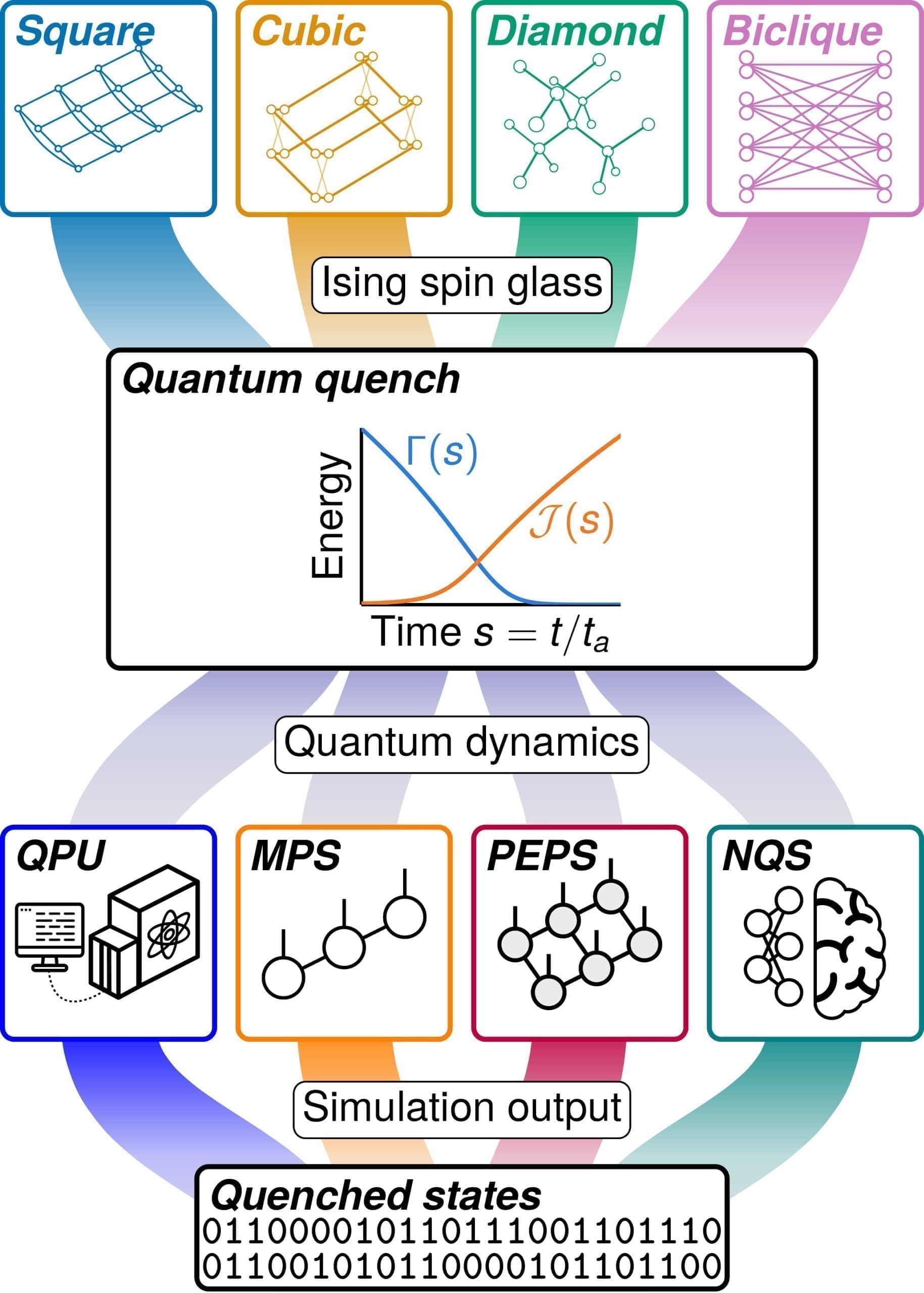
Researchers from D-Wave have demonstrated that superconducting quantum annealing processors achieve computational advantage in simulating complex quantum spin dynamics, outperforming classical supercomputers in solving problems related to the transverse-field Ising model.
By comparing their results with high-precision matrix product state simulations and advanced classical techniques like tensor networks and neural networks, they showed that classical methods would require millions of years of computing time and excessive energy to match the quantum processor’s performance. This finding highlights the potential for quantum advantage in optimization and AI applications, addressing previously deemed classically impossible scientific questions.
Quantum Annealing Processors Achieve Computational Advantage in Simulating Quantum Entanglement Problems
Quantum annealing processors have demonstrated a significant computational advantage over classical supercomputers in simulating quantum spin dynamics. Researchers evaluated the performance of these processors using the transverse-field Ising model (TFIM) and compared their results with high-precision matrix product state (MPS) simulations conducted on classical systems.
The study revealed that quantum annealing processors outperformed classical methods across various TFIM topologies. Classical approaches, even when employing advanced techniques like tensor networks and neural networks, would require an impractical amount of resources to match the quantum results. Specifically, achieving comparable performance with MPS methods would necessitate millions of years of supercomputing time and energy consumption exceeding global annual usage.
This finding underscores a clear computational advantage for quantum annealing in practical scientific applications, particularly in optimization and artificial intelligence domains. The ability to address complex problems that are classically intractable highlights the potential of quantum annealing processors in advancing scientific research and technological innovation.
Implications for Optimization and AI Applications
The computational advantage demonstrated by quantum annealing processors in simulating complex quantum systems has significant implications for optimization and artificial intelligence applications. By outperforming classical supercomputers in solving intricate problems like the transverse-field Ising model, these processors highlight a potential paradigm shift in addressing real-world challenges that are computationally intensive or intractable using conventional methods.
In optimization, where finding optimal solutions among vast possibilities is often computationally prohibitive, quantum annealing offers a promising avenue. The ability to simulate quantum dynamics with high precision and efficiency suggests that quantum annealing could be particularly effective in solving combinatorial optimization problems, such as those encountered in logistics, finance, and materials science. These applications often require exploring large solution spaces, where classical methods struggle due to exponential scaling.
The demonstrated computational advantage for artificial intelligence opens new possibilities for advancing machine learning algorithms and neural network architectures. Quantum annealing could enhance the training of complex models by efficiently navigating high-dimensional parameter spaces, potentially leading to more accurate and robust AI systems. Additionally, the ability to simulate quantum dynamics with precision may enable the development of novel quantum-inspired algorithms that leverage insights from quantum mechanics to improve classical AI techniques.
The study underscores the potential for quantum annealing processors to address scientific questions and practical challenges that remain unsolved using classical computing resources. While current limitations in hardware imperfections persist, the demonstrated computational advantage provides a foundation for further advancements in theoretical understanding and practical implementations of quantum technologies.
More information
External Link: Click Here For More


