

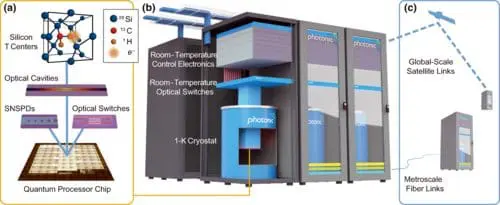
Quantum information processing has the potential to revolutionize technology, but scaling barriers pose a significant challenge. The core issue is distributing high-quality entanglement at scale, which affects the execution of quantum algorithms. These algorithms are crucial for tasks like quantum chemistry and cybersecurity. A proposed solution is a quantum information-processing architecture based on optically active spins in silicon. This architecture combines quantum networks and quantum information processors into the same core entanglement-distribution technology, potentially overcoming the scaling barriers. However, the advent of large-scale, scalable, fault-tolerant quantum technologies is believed to be a decade or more away.
What are the Challenges in Scaling Quantum Technologies?
Quantum information processing has the potential to unlock technological capabilities that cannot be achieved with classical methods. However, the scaling barriers currently faced by both quantum networking and quantum computing technologies ultimately amount to the same core challenge: distributing high-quality entanglement at scale. This challenge is significant because it affects the ability to execute quantum algorithms, which offer superpolynomial speedups over their known classical counterparts. These algorithms are critical for useful tasks including quantum chemistry and the design of novel materials, as they enable precise simulations of chemical processes in important technological applications ranging from catalysts to batteries and pharmaceuticals.
Another area where quantum algorithms can have a significant impact is cybersecurity. For instance, once implemented on a large-scale fault-tolerant quantum computer, Shor’s algorithm will allow efficient decryption of any data protected by Rivest-Shamir-Adleman (RSA) cryptography and its variants, which currently underpin 90% of all financial and Internet traffic. However, numerous so-called quantum-safe RSA replacement encryption algorithms have already fallen to classical or quantum attacks, highlighting the need for more robust quantum technologies.
In addition to quantum computing, quantum networks provide greater connectivity and security for quantum devices and enable applications beyond the power of standalone quantum devices. These include secure communications that even future quantum computers cannot break, blind computing of both classical and quantum algorithms, and modular quantum computing. However, the scaling of quantum networks is currently blocked by the unavailability of reliable quantum repeaters, which are necessary to scale quantum networks.
Can Silicon Color Centers Help Overcome These Challenges?
In this perspective, a novel quantum information-processing architecture based on optically active spins in silicon is proposed. This architecture offers a combined single technological platform for scalable fault-tolerant quantum computing and networking. The architecture is optimized for overall entanglement distribution and leverages color-center spins in silicon T centers for their manufacturability, photonic interface, and high-fidelity information-processing properties. Silicon nanophotonic optical circuits allow for photonic links between T centers, which are networked via telecom-band optical photons in a highly connected graph.
This high connectivity unlocks the use of low-overhead quantum error-correcting codes, significantly accelerating the timeline for modular, scalable, fault-tolerant quantum repeaters and quantum processors. By combining quantum networks and quantum information processors into the same core entanglement-distribution technology, it is argued that both will achieve ultimate scale. The networking of quantum computers will allow for true horizontal scaling of quantum resources through modularity, and the introduction of quantum repeaters (small quantum computers) will scale the topologies and total distance of telecom quantum networks.
What is the Future of Scalable Fault-Tolerant Quantum Technologies?
Delivering the full potential of quantum information processing requires the construction of scalable fault-tolerant quantum (SFTQ) computing and networking technologies. Although the global race to deliver SFTQ technology is already considerable and accelerating, and the performance of some small-scale quantum systems are approaching the levels needed to operate individual logical qubits, scaling such systems seems to be a considerable challenge. Therefore, the advent of large-scale SFTQ networking and computing technologies is believed by some to be a decade or more away, based upon the quantum architectures known today.
However, by emphasizing entanglement distribution, the proposed quantum architecture could be reasonably expected to deliver SFTQ technologies and the corresponding transformation. This architecture, which combines quantum networks and quantum information processors into the same core entanglement-distribution technology, could potentially overcome the scaling barriers currently faced by both quantum networking and quantum computing technologies.
In conclusion, while there are significant challenges in scaling quantum technologies, the proposed quantum architecture based on optically active spins in silicon offers a promising solution. By leveraging the properties of silicon T centers and combining quantum networks and quantum information processors into the same core entanglement-distribution technology, it may be possible to accelerate the timeline for scalable, fault-tolerant quantum technologies.
Publication details: “Scalable Fault-Tolerant Quantum Technologies with Silicon Color Centers”
Publication Date: 2024-03-13
Authors: Stephanie Simmons
Source: PRX Quantum 5, 010102
DOI: https://doi.org/10.1103/PRXQuantum.5.010102


