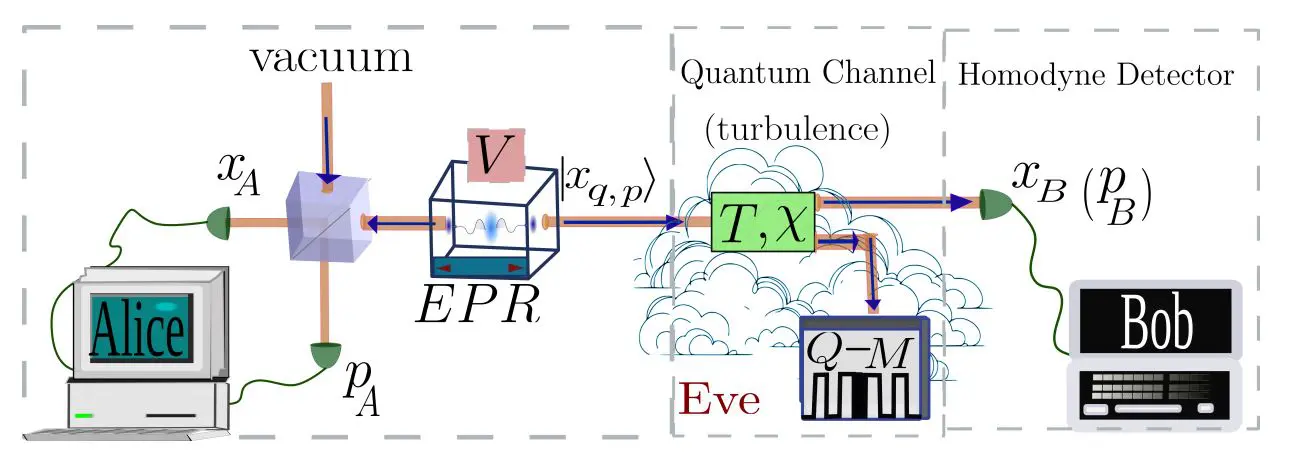
Continuous-variable quantum key distribution (CV-QKD) offers a promising route to secure communication, but its performance in realistic conditions, such as those found in free-space links with rapidly changing signal strength, remains a significant challenge. Miguel Castillo-Celeita from Universidad de Valladolid and Matteo Schiavon from Sorbonne Université investigated how different methods of accounting for these channel fluctuations impact the security of CV-QKD protocols. Their work compares two approaches to estimating the potential for eavesdropping, one averaging a key security parameter over channel conditions and the other calculating it from averaged data, revealing substantial differences in the resulting key rates. This research demonstrates that the choice of model for handling channel fluctuations critically affects the achievable security of CV-QKD systems, offering vital insights for the practical implementation of quantum communication networks.
The research examines how different averaging techniques affect key rates and security, focusing on estimating channel parameters and optimising key generation under realistic fading conditions. The findings contribute to a better understanding of the limitations and potential of CV-QKD in practical free-space communication scenarios, paving the way for the development of more robust and efficient quantum communication systems.,
The team considered two methods for evaluating security against eavesdropping, the Holevo bound average (HBA) and the covariance matrix average (CMA), both designed to account for collective attacks. Analytical expressions were developed for both approaches, allowing for a rigorous comparison of their performance. The findings demonstrate that the secret key rate is significantly influenced by how channel fluctuations are treated, highlighting the importance of choosing the model that best describes the actual implementation.,
Gaussian States Advance Continuous Variable QKD
Research details advancements in Continuous Variable Quantum Key Distribution (CV-QKD) and related quantum communication topics. CV-QKD represents a promising approach to secure communication, leveraging the principles of quantum mechanics to distribute cryptographic keys. Unlike discrete-variable QKD, which uses photons in distinct quantum states, CV-QKD encodes information onto continuous variables of light, such as the amplitude and phase of coherent states. A significant portion of the research utilises Gaussian states, such as coherent and squeezed states, as carriers of quantum information, due to their ease of generation and characterisation, and their compatibility with classical communication channels. Coherent states, resembling classical light, are readily produced by lasers, while squeezed states exhibit reduced noise in one quadrature component, enhancing the signal-to-noise ratio and improving key rates.,
A large number of references address the security proofs and potential attacks against CV-QKD systems, including the impact of imperfections like detector noise, channel loss, and side-channel attacks. Security proofs typically rely on establishing an upper bound on the information an eavesdropper can gain about the key, often expressed using the Holevo bound. Detector noise, arising from imperfections in the single-photon detectors used to measure the quantum signals, introduces errors and reduces the achievable key rate. Channel loss, particularly significant in free-space communication, attenuates the signal, requiring the use of techniques like error correction and privacy amplification to compensate. Side-channel attacks exploit vulnerabilities in the hardware or software implementation of the QKD system, potentially revealing information about the key. Researchers actively investigate countermeasures to mitigate these attacks, such as shielding, randomisation, and calibration.,
The collection also covers finite-size effects, which arise from the limited number of quantum signals exchanged in real-world systems, and how these fluctuations can compromise security. In practical QKD systems, the number of exchanged signals is finite, leading to statistical fluctuations that can affect the accuracy of parameter estimation and the validity of security proofs. Researchers employ techniques like statistical data processing and parameter estimation to account for these finite-size effects and ensure the security of the key. Many references discuss various channel models, including free-space channels affected by atmospheric turbulence and scattering, and fibre optic channels experiencing loss and dispersion. Atmospheric turbulence, caused by variations in air density, distorts the wavefront of the light, leading to signal degradation and increased bit error rates. Fibre optic channels experience loss due to absorption and scattering, limiting the transmission distance. Researchers develop channel models that accurately capture these effects and design QKD systems that are robust to channel impairments. Many references discuss the design and implementation of practical CV-QKD systems, including the use of optical amplifiers, detectors, and data processing techniques. A substantial portion of the research focuses on free-space QKD, particularly relevant for satellite-based quantum communication. Free-space QKD offers the potential for long-distance secure communication, but it is challenging due to atmospheric turbulence, scattering, and absorption. Researchers are developing adaptive optics systems and advanced data processing techniques to mitigate these effects and improve the performance of free-space QKD systems.,
The references also cover essential steps in QKD, such as reconciliation and error correction, used to extract the secret key from raw quantum data. Reconciliation aims to correct errors introduced during the quantum transmission, while preserving the privacy of the key. Error correction employs classical coding techniques to identify and correct errors, while privacy amplification removes any residual information an eavesdropper might have gained. Researchers have explored side-channel attacks, which exploit imperfections in hardware or software, and countermeasures to protect against them. While Gaussian states are dominant, there is growing interest in using non-Gaussian states to enhance the security and performance of CV-QKD. Key areas include security proofs against Gaussian attacks, Gaussian modulation techniques, and accounting for finite-size effects.,
🗞 The role of averages in CV-QKD over fast fading channels
🧠 ArXiv: https://arxiv.org/abs/2511.12721