Quantum key distribution offers the promise of secure communication, and continuous variable protocols are gaining prominence due to their high data rates and compatibility with existing infrastructure. Renzhi Yuan, Zhixing Wang, and Shouye Miao, along with colleagues including Mufei Zhao and Haifeng Yao, investigate a method to improve the performance of these protocols in challenging real-world conditions. The team focuses on atmospheric turbulence, a significant obstacle for satellite-to-ground communication, and proposes a novel receiver design called the multi-stage CD-Kennedy receiver. Their work demonstrates that this quantum receiver outperforms traditional methods in turbulent channels, reducing errors and increasing the rate at which secure keys can be generated, with the Type-II receiver exhibiting particular resilience to adverse channel conditions. This advancement represents a crucial step towards practical, long-distance quantum communication networks.
Homodyne detectors are widely employed in continuous-variable quantum key distribution (CV-QKD) protocols, but their detection performance is limited by the standard quantum limit (SQL). Researchers recently demonstrated quantum receivers, based on displacement operators, that outperform the SQL under various conditions. This work explores the potential of these quantum receivers to enhance CV-QKD protocols operating through turbulent atmospheric channels, a critical requirement for satellite-to-ground optical communication.
Coherent State Security Analysis Against Eavesdropping
This document details a rigorous analysis of a quantum communication protocol employing coherent states, focusing on security against eavesdropping. The core objective is to determine the maximum amount of information an eavesdropper, known as Eve, can gain about the transmitted information and to optimize the protocol to minimize this information leakage. The analysis centers on understanding how coherent states can be used to encode information securely. Researchers utilize mathematical tools to quantify information leakage, employing concepts like density matrices to describe the quantum state of the system and eigenvalue decomposition to analyze the information shared between the sender and Eve. The team measures information leakage using metrics like mutual information and Helevo information, striving to minimize the statistical dependence between the transmitted data and Eve’s knowledge. This work contributes to the development of secure quantum communication systems by providing a detailed understanding of the vulnerabilities and optimization strategies for coherent state-based protocols.
Multi-Stage Receiver Boosts Quantum Key Distribution
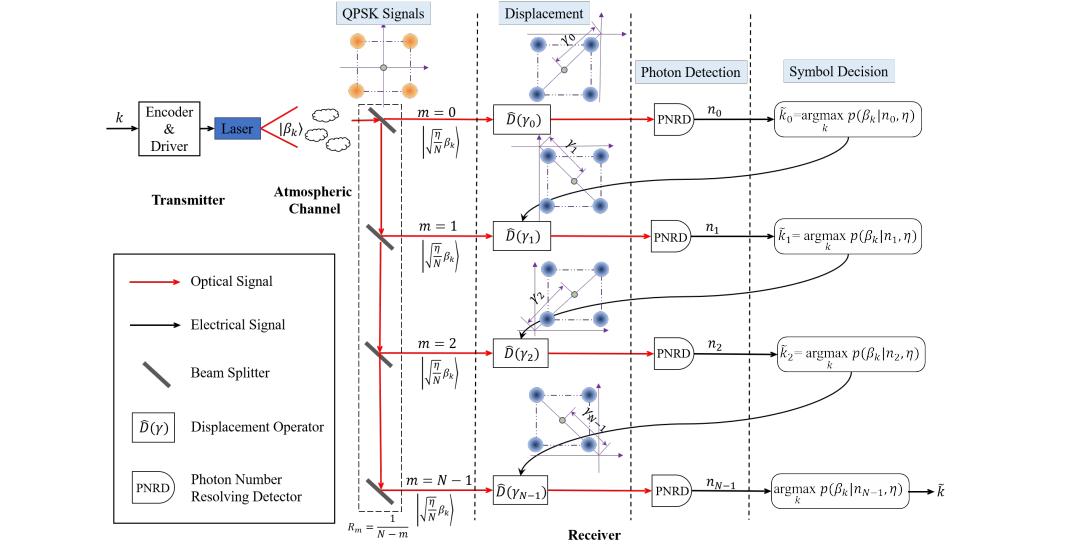
Researchers have achieved a significant breakthrough in continuous-variable quantum key distribution (CV-QKD) by demonstrating the enhanced performance of a multi-stage CD-Kennedy receiver in turbulent channels, crucial for satellite-to-ground optical communication. This work addresses a key limitation of existing CV-QKD systems, which typically rely on classical coherent receivers constrained by the standard quantum limit (SQL). The team developed three distinct receiver types, Type-I, Type-II, and Type-III, each employing different displacement choices to optimize performance in challenging atmospheric conditions. Experiments reveal that the multi-stage CD-Kennedy receiver consistently outperforms classical coherent receivers in terms of both error probability and secret key rate (SKR) within turbulent channels.
Specifically, the Type-II receiver exhibits superior tolerance to worsening channel conditions compared to Type-I and Type-III, maintaining lower error rates under increased turbulence. Further analysis demonstrates that the Type-III receiver provides a beneficial trade-off between error probability and SKR across all received signal strengths, delivering significant improvements in both metrics, particularly in weak link scenarios. Measurements confirm that this quantum receiver approach effectively mitigates the impact of atmospheric turbulence, a major obstacle in satellite communication. The team’s results demonstrate a clear path toward practical implementation of quantum receivers in space-air-ground integrated networks, paving the way for secure communication links resilient to environmental disturbances. This advancement represents a crucial step in realizing the full potential of CV-QKD for secure global communication networks.
Multi-Stage Receivers Boost Turbulent CV-QKD
This work presents a detailed investigation into enhancing the performance of continuous-variable quantum key distribution (CV-QKD) systems operating through atmospheric turbulence, a significant challenge for satellite-to-ground communication. Researchers developed and analysed three types of multi-stage CD-Kennedy receiver, Type-I, Type-II, and Type-III, to improve detection capabilities beyond the limitations of standard coherent receivers. By carefully designing how displacement operators are applied, the team aimed to overcome the signal degradation caused by turbulence and increase the secure key rate. The results demonstrate that these multi-stage receivers outperform conventional homodyne detection, with the Type-II receiver proving particularly robust under challenging channel conditions, exhibiting the lowest error probability.
The Type-III receiver also showed strong performance, offering improvements in both error probability and secure key rate, especially when signal strength is weak. These findings suggest that employing advanced quantum receivers can significantly enhance the feasibility and security of CV-QKD systems in practical, long-distance communication scenarios. This research provides a valuable contribution to the field of quantum communication, paving the way for more secure and reliable long-distance communication networks.
🗞 Multi-Stage CD-Kennedy Receiver for QPSK Modulated CV-QKD in Turbulent Channels
🧠 ArXiv: https://arxiv.org/abs/2509.20030