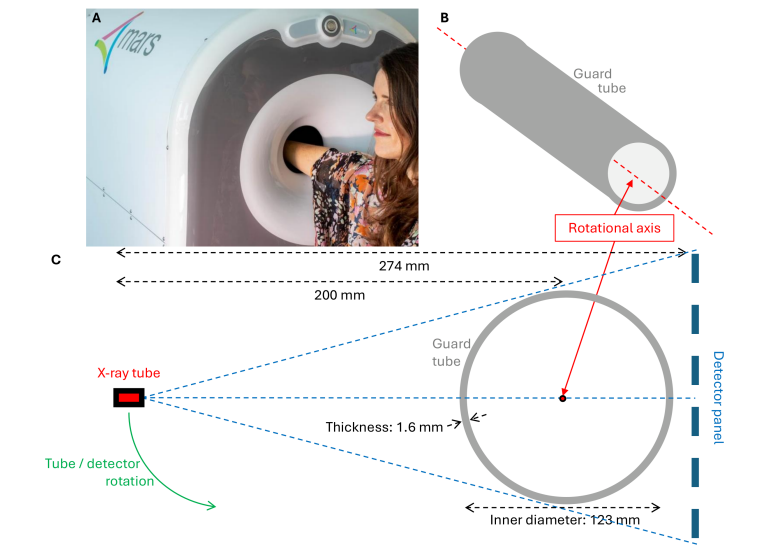
Reducing radiation exposure during medical imaging remains a critical goal, and researchers are continually refining techniques to minimise risk without compromising diagnostic quality. Pierre-Antoine Rodesch, Anaïs Viry, Mouad Khorsi, and colleagues investigate spectral shaping, a method that adjusts X-ray source voltage and filtration, for a new type of forearm X-ray scanner employing photon-counting detectors. Their work demonstrates that operating the scanner at a lower voltage, specifically 80kV, can reduce radiation dose by as much as 50% while maintaining image clarity, as measured by a sophisticated image quality metric. Importantly, the team found that the best filtration strategy depends on the specific organ being imaged, highlighting the benefits of tailoring radiation protocols to individual anatomy. This research establishes that evaluating radiation dose based on individual organ absorption offers a more precise and effective approach to optimisation than traditional methods, paving the way for safer and more patient-centric imaging practices.
Optimized CT Imaging With Reduced Radiation Dose
This research program focuses on optimizing X-ray imaging, specifically Computed Tomography (CT), with a strong emphasis on reducing radiation dose while maintaining or improving image quality. Scientists employ detailed computational modeling, advanced algorithm development, and objective image quality assessment to achieve these goals. A central technique is Monte Carlo simulation, which accurately models how X-rays interact with the body and calculates radiation dose distribution. Researchers also investigate beam shaping and filtration, exploring how modifying the X-ray spectrum can enhance image contrast and reduce skin dose.
The team utilizes iterative reconstruction algorithms, incorporating regularization techniques to reduce noise and improve image clarity at lower doses. Image quality is assessed using metrics like the Non-Prewhitening Observer, Slice Sensitivity Profile, and Signal Difference-to-Noise Ratio, providing objective measures of detectability and contrast. Realistic phantoms, created using CAD modeling, are used to evaluate imaging systems and algorithms. This multifaceted approach combines computational modeling, algorithm development, and objective assessment to push the boundaries of CT imaging. The research aims to enable safer and more effective diagnostic procedures by minimizing radiation exposure while maintaining high image quality.
Scientists are investigating the impact of filtration on dose and image quality, optimizing reconstruction parameters, and developing new reconstruction algorithms. They are also creating realistic models of the entire CT system to better understand its performance and optimize its design. By combining these techniques, the team strives to deliver significant advancements in CT imaging technology and patient care.
Wrist CT Dose Reduction with Spectral Shaping
This research demonstrates a significant advancement in computed tomography (CT) imaging through the application of spectral shaping and patient-specific dosimetry. Scientists achieved up to a 50% reduction in radiation dose during wrist CT scans using a photon-counting detector (PCD) system, operating the X-ray source at 80kV while maintaining image quality equivalent to a standard 120kV protocol. This dose reduction was evaluated using Monte Carlo simulations and measured by the detectability index, an advanced image quality metric. The study involved detailed simulations assessing various combinations of source voltage and filtration materials.
Results show that optimal filtration depends on the target organ, with bone and skin benefiting from differing approaches. Importantly, the team found that conventional methods of assessing radiation dose, such as the CT dose index, may not fully capture the benefits of spectral shaping and can lead to suboptimal optimization. Patient-specific dosimetry, based on estimating the absorbed dose in individual organs, offers a more accurate framework for maximizing the effectiveness of spectral shaping and minimizing overall radiation exposure. This research highlights the potential of patient-specific dosimetry to refine CT protocols.
By leveraging the capabilities of PCD-CT technology and spectral shaping, scientists have unlocked a pathway to significantly reduce patient radiation exposure without compromising diagnostic image quality. The findings are particularly relevant for applications like wrist imaging, where large-scale screening programs could benefit from efficient low-dose protocols. This breakthrough delivers a more precise and effective approach to radiation dose management in CT imaging, paving the way for safer and more patient-centered diagnostic procedures.
Spectral Shaping Reduces CT Radiation Dose
This research demonstrates that spectral shaping, a technique adjusting X-ray source voltage and filtration, significantly reduces radiation dose during computed tomography (CT) scans without compromising image quality. Through detailed Monte Carlo simulations, scientists achieved up to a 50% reduction in dose when operating a wrist CT scanner at 80kV, while maintaining equivalent detectability compared to a standard 120kV protocol. These findings highlight the potential of spectral shaping to improve patient safety by minimizing radiation exposure during CT examinations. The study further reveals that optimal filtration strategies depend on the specific organ targeted, with bone and skin benefiting from differing approaches. Patient-specific dosimetry, based on estimating the absorbed dose in individual organs, offers a more accurate framework for maximizing the effectiveness of spectral shaping and minimizing overall radiation exposure. This work represents a significant step towards safer and more efficient CT imaging, offering a pathway to reduce patient radiation exposure without compromising diagnostic accuracy.
👉 More information
🗞 Organ dose optimization for a point-of-care forearm X-ray photon-counting CT
🧠 ArXiv: https://arxiv.org/abs/2509.22488