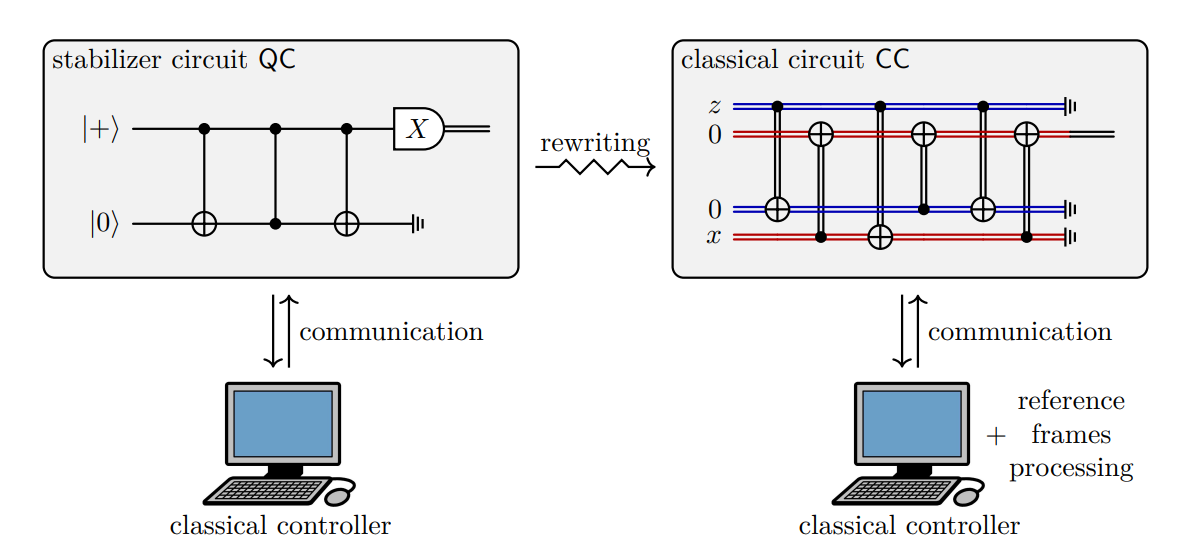
Stabilizer circuits represent a cornerstone of quantum computation, yet simulating their behaviour remains a significant challenge. Vsevolod I. Yashin, Evgeniy O. Kiktenko, Vladimir V. Yatsulevich, and Aleksey K. Fedorov investigate ways to refine these simulations by focusing on the underlying structure of stabilizer operations. Their work demonstrates that circuits composed of specific CSS-preserving operations can be rewritten as classical probabilistic circuits, achieving exact simulation without the computational cost typically associated with such tasks. The team clarifies this simplification through a novel quadratic form representation of stabilizer operations and links it to the concept of hidden variable models, offering a new understanding of how to efficiently simulate these crucial quantum circuits and providing a framework to explore the resource cost of simulating more complex, non-CSS-preserving circuits.
Efficient Simulation of CSS-Preserving Circuits
Scientists have created a new simulator for quantum circuits, focusing on circuits built from CSS-preserving stabilizer operations, commonly used in building reliable quantum computers. The team’s simulator outperforms existing tools when simulating these circuits, demonstrating the effectiveness of their approach. This improvement stems from exploiting the specific structure of CSS circuits, allowing for significant computational optimizations. The simulator, built using C++ code, provides a platform for testing and refining these advanced simulation techniques. To achieve this efficiency, researchers developed a mathematical framework based on subnormal stabilizer states and trace-decreasing Clifford channels. These concepts describe quantum states and operations that reduce the overall probability of a measurement outcome, essential for modeling noise and post-selection processes. The team represents these channels using a Standard Quadratic Form (SQF) expansion, a structured mathematical representation that simplifies calculations and allows for efficient manipulation.
CSS Circuits as Classical Probabilistic Simulations
Scientists have discovered a way to simulate quantum circuits more efficiently by rewriting circuits composed of CSS-preserving stabilizer operations as classical probabilistic circuits. This simplification avoids the computational burden typically associated with simulating quantum systems. The team achieved this by applying elementary circuit transformations, effectively translating quantum operations into classical probabilistic calculations. This allows sampling from the resulting classical circuit in a time proportional to the circuit’s depth. Researchers explored the mathematical foundations of stabilizer circuits, introducing a standard quadratic-form representation of general stabilizer operations.
This representation efficiently describes how stabilizer operations combine and facilitates simulation. Crucially, CSS-preserving operations correspond to simple linear forms within this framework, significantly simplifying calculations. Applying a mathematical transformation reveals a non-contextual hidden variable model, independently verifying the accuracy of the classical rewriting. The work extends beyond CSS-preserving circuits by introducing a theory of reference frames for multiqubit systems, where frames are encoded by quadratic forms. This allows expressing stabilizer operations as probabilistic maps for appropriate reference frames, effectively transforming any stabilizer state into a CSS form. Non-CSS-preserving stabilizer circuits require dynamic adjustments to these reference frames, embodying a computational resource that explains the overhead observed in their simulation. This framework offers a new perspective on simulating both stabilizer and near-stabilizer circuits within dynamically evolving quasiprobability models, potentially leading to more efficient quantum simulations.
Classical Simulation of CSS Stabilizer Circuits
Scientists have achieved a breakthrough in quantum computation by developing a new method for simulating quantum stabilizer circuits as classical probabilistic circuits. This work focuses on circuits composed of CSS-preserving stabilizer operations, fundamental to building fault-tolerant quantum computers. The team demonstrated that these specific circuits can be exactly transformed into classical circuits that reproduce the same measurement statistics, eliminating computational overhead. This achievement stems from a new understanding of stabilizer operations through the lens of quadratic forms, providing an efficient way to describe and simulate their compositions.
Researchers showed that CSS-preserving operations correspond to simple linear forms, significantly simplifying calculations. Applying a mathematical transformation reveals a non-contextual hidden variable model, offering an alternative proof of the rewriting process. The team further developed a theory of reference frames for multiqubit systems, encoding these frames using quadratic forms. This allows expressing stabilizer operations as probabilistic maps for appropriate reference frames, enabling efficient simulation. Experiments revealed that non-CSS-preserving stabilizer circuits necessitate dynamic modifications to these reference frames, embodying a computational resource that introduces overhead. This framework provides a new perspective on simulating both stabilizer and near-stabilizer circuits within dynamically evolving quasiprobability models. The team successfully demonstrated that rewriting a CSS-preserving stabilizer circuit results in a classical circuit with identical outputs, validating the method’s accuracy.
Stabilizer Circuits Simplify to Classical Simulation
This work presents a novel approach to simulating stabilizer circuits, a crucial element in quantum information processing. Researchers demonstrated that circuits composed of specific, CSS-preserving stabilizer operations can be exactly rewritten as classical probabilistic circuits, enabling efficient simulation on conventional computers without introducing computational overhead. This simplification stems from the underlying mathematical structure of these operations, which correspond to linear forms within a framework utilizing quadratic forms. The team established this equivalence through elementary circuit transformations and further supported it by demonstrating a connection to non-contextual hidden variable models.
Expanding this framework to encompass general stabilizer circuits, the researchers introduced the concept of quantum reference frames encoded by quadratic forms. This allows any stabilizer operation to be expressed as a probabilistic map within appropriately chosen reference frames, offering a context-dependent hidden variable description of stabilizer circuits. This approach facilitates efficient simulation by combining classical circuits with reference frame processing. The authors acknowledge that extending this work to qudit systems, particularly those with composite dimensions, presents a challenge for future research. They also propose exploring the potential of higher-rank forms and algebraic geometry to further advance the understanding of operations at higher levels of the Clifford hierarchy, suggesting a promising avenue for future investigation.
🗞 Further improvements to stabilizer simulation theory: classical rewriting of CSS-preserving stabilizer circuits, quadratic form expansions of stabilizer operations, and framed hidden variable models
🧠 ArXiv: https://arxiv.org/abs/2511.05478