

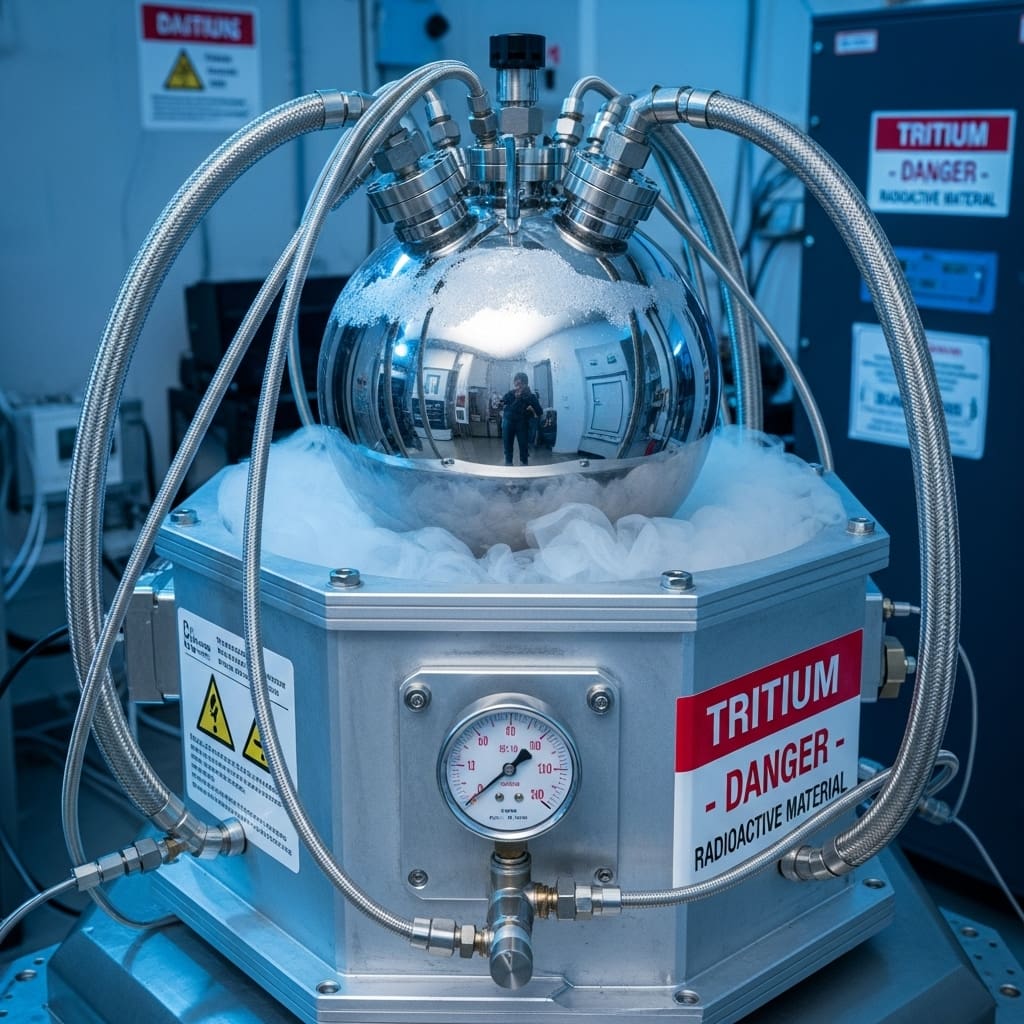
The quest to understand fundamental properties of matter and the nature of neutrinos drives innovation in atomic physics, and a new cryogenic source of atomic tritium promises significant advances in both areas. Aleksei Semakin, Janne Ahokas, and Tom Kiilerich, alongside Sergey Vasiliev, Francois Nez, and Pauline Yzombard, present a method for creating an intense beam of cold tritium atoms, achieving temperatures below one Kelvin. This breakthrough enables precision spectroscopy, allowing scientists to accurately measure the size of the tritium nucleus and rigorously test theoretical models of atomic structure. Crucially, this source also addresses a key limitation in the search for neutrino mass, paving the way for experiments with sensitivities far exceeding current capabilities and potentially revealing new physics beyond the Standard Model.
Compact Atomic Tritium Source Development
This research details the development of a high-brightness, compact source of atomic tritium for future neutrino experiments. These experiments require a concentrated source of tritium atoms, presenting challenges due to tritium’s radioactivity, rarity, and gaseous state at room temperature. The team focuses on efficiently releasing atomic tritium from a solid compound, such as a metal tritide, and then trapping these atoms for experimental use. This multidisciplinary effort combines expertise in cryogenics, vacuum technology, laser physics, materials science, and nuclear physics to overcome the technical hurdles associated with creating a practical tritium source for cutting-edge neutrino research.
Low-Energy Tritium Source for Precision Measurements
Scientists are pioneering a cryogenic source of atomic tritium for advanced spectroscopic studies and neutrino-mass measurements. This innovative system generates a low-energy atomic tritium beam suitable for magnetic trapping, a crucial step towards achieving high-precision physics. The team engineered a method to dissociate solid molecular tritium films at temperatures below one Kelvin using electrons from a pulsed radio frequency discharge, building on techniques previously demonstrated with atomic hydrogen. Following dissociation, the researchers employ a buffer-gas cooling technique, utilizing either helium-4 or helium-3 vapor, combined with radial magnetic compression to slow down and thermalize the atoms. Calculations predict that this method can achieve atomic fluxes exceeding one quintillion atoms per second at extremely low temperatures, enabling the creation of a dense, slow-moving beam of tritium atoms for precision measurements.
Sub-Kelvin Tritium Source for Magnetic Trapping
Scientists have developed a concept for a cryogenic source of atomic tritium, designed to produce atoms at sub-Kelvin temperatures and energies suitable for magnetic trapping. The core of this innovation lies in dissociating solid molecular tritium films below one Kelvin using electrons from a pulsed radio frequency discharge, a technique previously demonstrated with atomic hydrogen, combined with buffer-gas cooling and magnetic confinement. This approach addresses a critical need for high-precision measurements in several areas of physics. The research team predicts that this source can achieve atomic tritium fluxes exceeding one quintillion atoms per second, with kinetic energies of just one hundred milliKelvin at the entrance of a magnetic trap. This method bypasses limitations of current techniques by avoiding unwanted effects in beta-decay, offering a significant advantage for next-generation neutrino-mass measurements.
Cryogenic Tritium Source for Precision Measurements
This research presents a novel concept for generating a cryogenic source of atomic tritium, cooled to temperatures below one Kelvin, suitable for magnetic trapping. Through analysis of key processes like adsorption, spin exchange, and recombination, achieving atomic tritium fluxes exceeding one quintillion per second at energies of just one hundred milliKelvin is feasible at the entrance of a magnetic trap. This breakthrough paves the way for high-precision measurements of the triton charge radius, offering a crucial benchmark for testing quantum electrodynamics and improving comparisons of nuclear size determinations. Beyond spectroscopy, this source addresses a critical need for next-generation neutrino-mass measurements by eliminating unwanted effects in beta-decay, potentially improving sensitivity beyond current limitations. The researchers also highlight the source’s utility in generating a beam of deuterium atoms, serving as a valuable benchmark for trapping tritium and enabling precision spectroscopy. This work represents a significant step towards achieving high-precision measurements in fundamental physics.
👉 More information
🗞 Cryogenic source of atomic tritium for precision spectroscopy and neutrino-mass measurements
🧠 ArXiv: https://arxiv.org/abs/2511.08313

