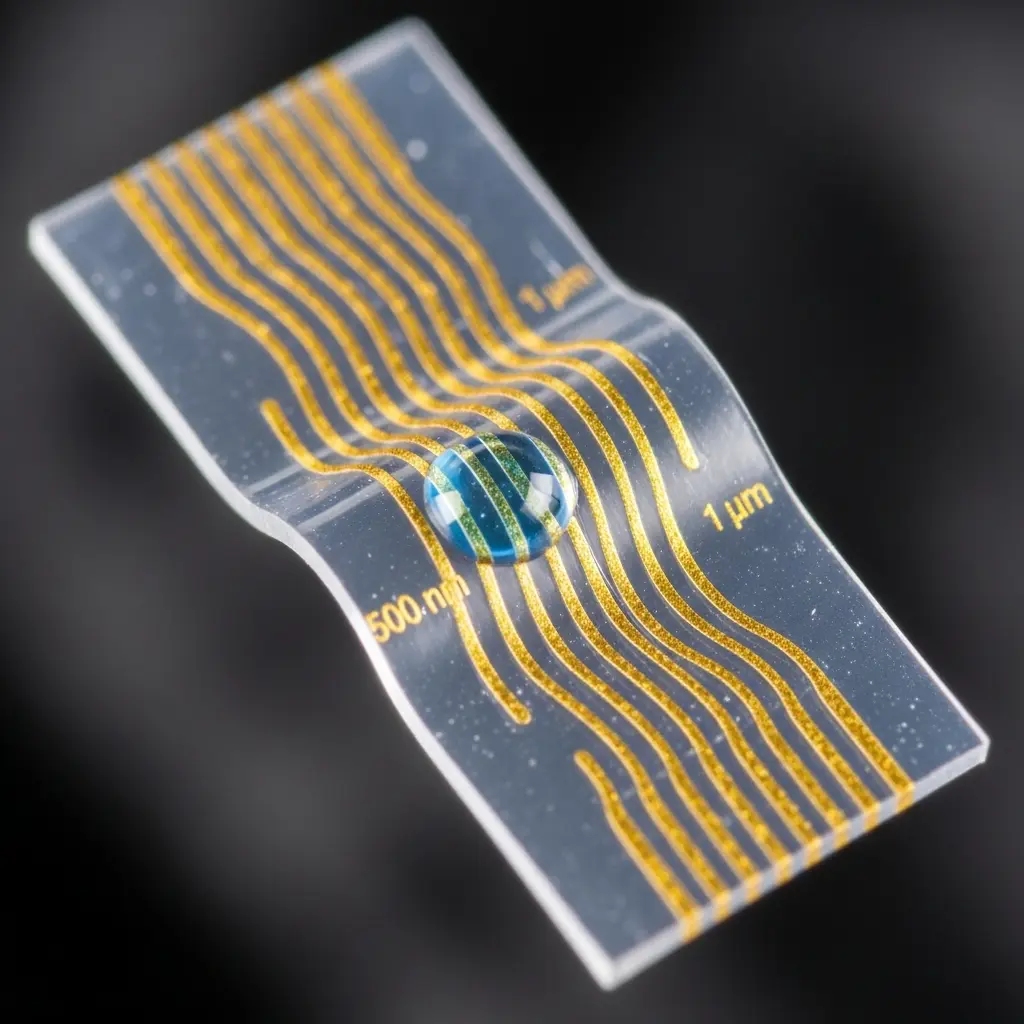
The interplay between correlated electron behaviour and magnetism represents a central challenge in modern condensed matter physics, and recent research explores how these phenomena can be manipulated in materials called altermagnets. Cong Li, Mengli Hu, and Jianfeng Zhang, alongside colleagues including Magnus H. Berntsen, Francesco Scali, and Dibya Phuyal, demonstrate a remarkable control over this interplay in the material chromium antimonide. The team successfully induces a transition from a metallic to an insulating state through the application of extreme tensile strain, revealing a reversible change at moderate strain and an irreversible change at higher strain levels. This achievement establishes a new pathway for engineering materials with tailored electronic and magnetic properties, potentially leading to innovative devices based on spin-selective filtering and correlated electron behaviour.
Strain Tuning of CrSb Electronic Structure
This research investigates how applying tensile strain alters the electronic structure of CrSb, an altermagnet possessing alternating magnetic moments. The core goal is to understand how strain can manipulate the electronic band structure, potentially inducing flat bands crucial for strong electron correlations and exotic phases like superconductivity or Mott insulators, ultimately driving phase transitions within the material. Scientists combined experimental techniques, including angle-resolved photoemission spectroscopy, X-ray photoelectron spectroscopy, and diffraction, with theoretical calculations using density functional theory to achieve this understanding. A key aspect involved applying strain in-situ during spectroscopic measurements, allowing real-time observation of changes in the electronic structure.
The most significant finding is the ability to induce flat bands in CrSb’s electronic structure through tensile strain. These flat bands appear at specific energy levels and their emergence is directly linked to the applied strain, resulting from the collapse of interactions between chromium and antimony atoms and a reduction in the bandwidth of electronic states. The Fermi surface, representing occupied electronic states, undergoes significant changes with strain; the characteristic hexagonal shape of unstrained CrSb distorts and diminishes as strain increases. Researchers observed a transfer of electronic charge as strain increased, with spectral weight shifting to the flat bands.
Crucially, they found evidence of irreversible changes in the electronic structure in highly strained regions, suggesting strain induces structural defects and disorder. By spatially mapping the spectroscopic signal, they correlated the electronic structure with the local strain level, demonstrating that flat bands are more pronounced in regions experiencing higher strain. Density functional theory calculations supported these experimental findings, confirming the strain-induced changes in the band structure and providing insights into the underlying mechanisms. The flat bands do not simply arise from band bending, but from a complex interplay of factors including weakened interactions between chromium and antimony atoms, enhanced localization of electrons, and the formation of a Van Hove singularity, a point in the band structure with a particularly high density of states.
The irreversible changes observed at high strain levels are likely due to bond rupture, defect formation, and surface degradation. The research proposes a phase diagram for CrSb under strain, outlining a progression from an altermagnetic metal to a correlated Mott-like phase with flat bands, and ultimately to a disorder-dominated insulating regime. This research is significant for several reasons: it provides valuable insights into strongly correlated electron systems, demonstrates the power of strain engineering as a tool for manipulating material properties, and potentially paves the way for discovering novel quantum phases like superconductivity or magnetism. The findings could also guide the design of new materials with tailored electronic properties. In essence, this research demonstrates that strain can be used to tune the electronic structure of CrSb, induce flat bands, and drive phase transitions, with implications for understanding correlated materials and developing new technologies.
Tensile Strain Induces Correlated Electronic States
Scientists have achieved a breakthrough in engineering correlated electronic states in the altermagnet CrSb by applying extreme tensile strain. High-quality single crystals of CrSb were grown using a chemical vapor transport method, employing stoichiometric chromium and antimony powders with iodine as a transport agent, heated to 925°C for one week before controlled cooling. These crystals, measuring 5-10mm with regular shapes, served as the foundation for detailed spectroscopic analysis. High-resolution angle-resolved photoemission spectroscopy measurements were performed at advanced synchrotron facilities, achieving high energy and angular resolution.
Samples were cleaved in situ and measured under ultrahigh vacuum conditions. A customized uniaxial strain device was developed, consisting of a bendable platform, actuator, and holder, all constructed from non-magnetic materials. Tightening a screw bends the platform, imposing tensile strain. The team achieved strong near-surface strain gradients sufficient to induce pronounced distortions of the Fermi surface and the emergence of flat-band features, with the most strongly deformed regions exhibiting a significant contraction of the surface Brillouin zone, as inferred from spectroscopic data. Band-structure calculations were performed using advanced computational methods, including a Hubbard U term to account for electron-electron correlations.
Wannier-based tight-binding Hamiltonians were constructed and used to calculate the Fermi surface. The stability of the strained CrSb system was also assessed using density functional perturbation theory. These calculations provided a theoretical framework for understanding the experimental observations and interpreting the changes in the electronic structure under strain.
Strain-Induced Electronic Reconstruction in CrSb
Researchers have demonstrated a novel route to controlling the electronic properties of the altermagnet CrSb through the application of extreme tensile strain. The team designed a novel strain device and mounting scheme to concentrate tensile stress into a near-surface layer of bulk CrSb crystals, creating a tunable strain-gradient layer while minimizing distortion in the bulk material. X-ray photoelectron spectroscopy measurements revealed a significant electronic reconstruction under strain, characterized by a transfer of spectral weight from the Fermi level to deeper binding energies, indicating a substantial change in the material’s electronic structure. Detailed analysis of valence band spectra showed the development of prominent peaks as strain was applied, further confirming the electronic reconstruction process.
Angle-resolved photoemission spectroscopy experiments demonstrated a clear evolution of the Fermi surface under strain. In the unstrained state, the Fermi surface exhibited hexagonal symmetry, but under tensile strain, it became strongly distorted, reflecting the applied mechanical stress. Remarkably, removing the strain fully restored the original hexagonal symmetry of the Fermi surface, demonstrating the reversibility of the strain-induced changes. The team observed a reversible regime at moderate strain, where a flat-band feature coexisted with a correlation-enhanced flat band. Further increasing the strain led to an irreversible regime, where partial bond decoupling drove an insulating spectral response.
Despite these significant changes, density-functional calculations confirmed that an orbital-selective altermagnetic spin texture persisted throughout the correlated regime, even with strong bandwidth renormalization. These results define a strain-symmetry-correlation map for CrSb, establishing extreme tensile strain as a powerful method to co-engineer flat-band tendencies and spin-textured, zero-net-moment correlated states within a single material. This breakthrough opens exciting possibilities for strain-adaptive, spin-selective Mott filtering and related device concepts, potentially leading to new spintronic technologies.
Strain Unifies Flat Bands and Altermagnetism
Researchers have demonstrated a novel route to manipulating the electronic properties of CrSb, an altermagnet exhibiting zero-net-moment magnetism. By applying a carefully controlled tensile strain gradient to a single crystal, the team induced and observed the coexistence of two distinct electronic phenomena: flat bands and altermagnetism. Flat bands, arising from reduced electron mobility, and altermagnetism, a specific spin texture, typically originate from different physical mechanisms, but this work reveals a pathway to unify them through extreme crystal distortion. The experiments show that moderate strain suppresses the….
🗞 Extreme Strain Controlled Correlated Metal-Insulator Transition in the Altermagnet CrSb
🧠 ArXiv: https://arxiv.org/abs/2512.07683