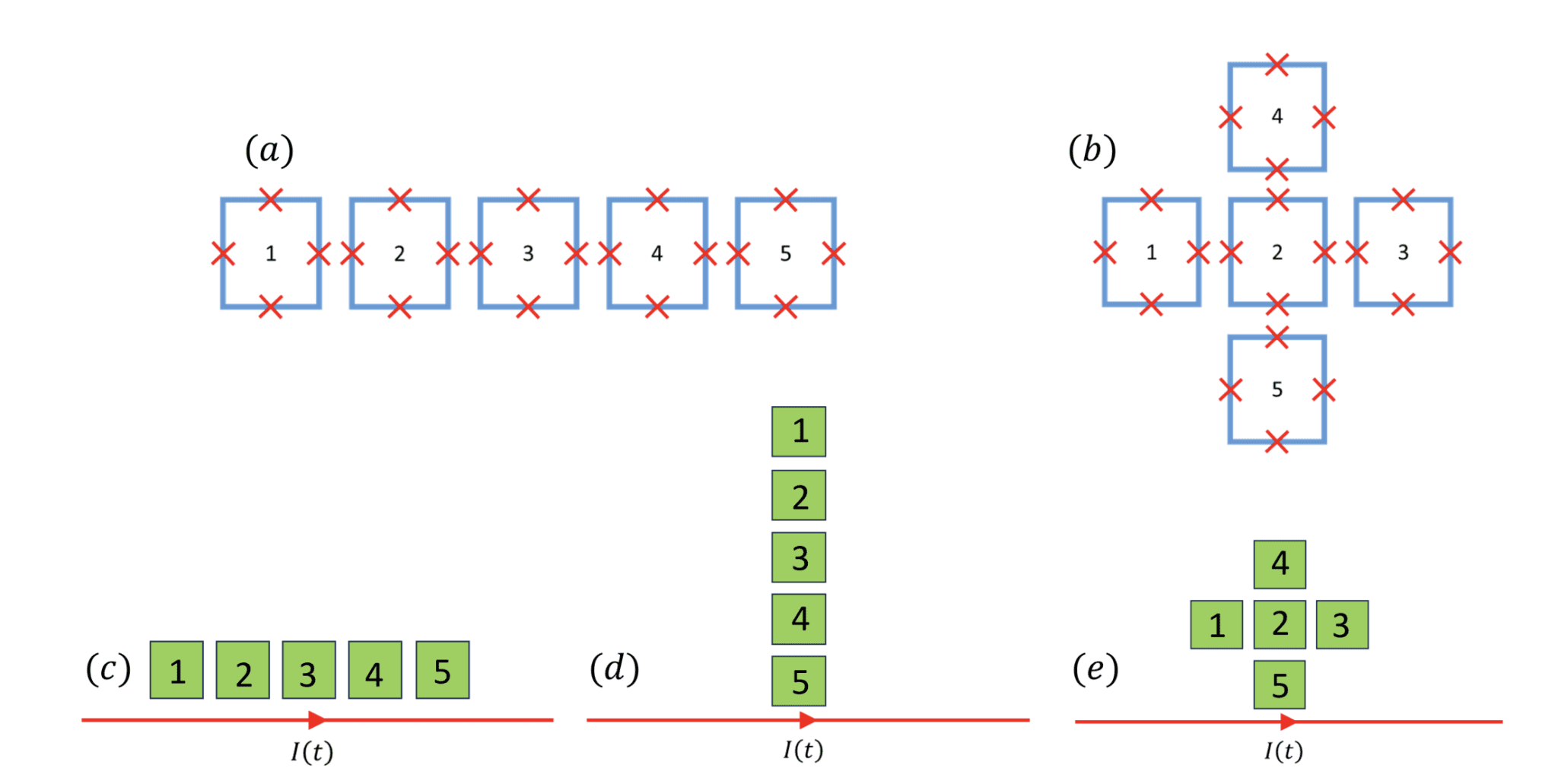
Superconducting qubits represent a promising avenue for building powerful quantum computers, but their potential extends beyond computation to include highly sensitive sensing applications. Researchers led by J. Settino of the University of Calabria, G. G. Luciano from the University of Lleida, and A. Di Bartolomeo of the University of Salerno now demonstrate how the arrangement of these qubits significantly impacts their ability to detect magnetic fields and process information. Their investigation reveals that cross-shaped networks of superconducting qubits exhibit a dramatically enhanced response to magnetic flux compared to linear arrangements, a result stemming from cooperative interactions between the qubits. This discovery establishes clear design principles for building superconducting circuits that can simultaneously function as sensitive electromagnetic sensors and as powerful ‘reservoirs’ for processing signals, paving the way for compact, integrated devices capable of both sensing and computation.
Qubit Topology Impacts Coherence and Scalability
The development of robust and scalable quantum technologies relies on systems that maintain quantum coherence while delivering practical functionality. Superconducting circuits, particularly those employing flux qubits, offer a promising platform for achieving this goal. Researchers are now investigating how the physical arrangement, or topology, of these interconnected qubits impacts their performance as both highly sensitive sensors and powerful information processors. A central challenge in quantum computing and sensing is minimising decoherence, the loss of quantum information due to environmental interactions.
This research focuses on the influence of network topology on the magnetic response of superconducting flux-qubit networks, comparing linear and cross-shaped arrangements. The team demonstrates that a cross-shaped network exhibits a significantly enhanced magnetic response compared to a simple linear array, a result stemming from cooperative interactions between the central and peripheral qubits within the network. This discovery establishes clear design criteria for building function-oriented superconducting circuits. By carefully controlling the arrangement of qubits, researchers can optimise the system’s ability to detect faint electromagnetic signals, pushing the limits of quantum sensing.
Furthermore, the unique properties of these networks make them well-suited for reservoir computing, allowing the network to process information directly, potentially enabling integrated systems where sensing and processing occur within the same device. By demonstrating dual functionality, acting as both a sensitive sensor and a powerful processor, these topologically-engineered qubit networks pave the way for entirely new architectures. These integrated systems promise to streamline quantum information processing, potentially leading to more efficient and versatile quantum devices capable of tackling complex problems in fields ranging from materials science to medical diagnostics.
Simulating Superconducting Qubit Network Magnetic Response
Researchers employed sophisticated computational methods to investigate the behaviour of superconducting flux-qubit networks, focusing on how the arrangement of qubits impacts their magnetic response. Rather than constructing physical devices, the team used exact diagonalization methods to simulate the networks’ properties, revealing its energy levels and how it responds to external stimuli. The study compared linear arrays and cross-shaped arrays to understand how topology influences the collective behaviour of the qubits. By modelling these arrangements, researchers could explore how the inductive coupling between qubits affects the overall magnetic response of the network, revealing that the cross-shaped array exhibits a significantly enhanced magnetic flux response compared to the linear array.
To characterise the dynamic behaviour of these networks, the team combined exact diagonalization with linear response theory, allowing them to map out the system’s response to external signals and providing insights into its potential as both a sensitive detector and a processing unit. By analysing the spectral and dynamical properties of the arrays, researchers demonstrated that the unique topology of the cross-shaped array facilitates cooperative coupling between qubits, enhancing its ability to process information and detect weak signals. This computational strategy offers a powerful means of exploring the design space for superconducting quantum circuits, enabling researchers to identify optimal network configurations for specific applications. By accurately modelling the complex interactions within these networks, the team has established quantitative design criteria for function-oriented circuits, paving the way for advancements in both quantum sensing and quantum information processing. The ability to simulate these systems allows for rapid prototyping and optimisation, accelerating the development of novel quantum technologies.
Cross-Shaped Networks Amplify Qubit Magnetic Response
Researchers have demonstrated a significant enhancement in the magnetic response of superconducting qubit networks by carefully designing their topology. These networks exhibit a markedly improved ability to detect external magnetic fields compared to simpler, linear arrangements, stemming from a “network effect” and cooperative interaction between qubits. The research focuses on comparing linear and cross-shaped qubit arrays, revealing that the cross-shaped configuration dramatically amplifies the magnetic flux response. This isn’t simply a matter of adding more qubits; the specific arrangement of connections within the cross-shaped array is crucial, enabling a collective behaviour that boosts sensitivity.
This discovery establishes clear design criteria for building more effective superconducting circuits, with implications for both quantum sensing and information processing. Beyond sensing, the team has shown these networks are also well-suited for reservoir computing. This means the same physical device can both detect a signal and process the information it contains, potentially leading to more compact and efficient quantum computers. By exploiting the complex, high-dimensional dynamics of these qubit arrays, researchers can perform computations directly within the sensor itself, reconstructing signals and solving problems without the need for separate processing units.
The study highlights the importance of network topology in quantum systems, demonstrating that the way qubits are connected profoundly influences their collective behaviour. This finding paves the way for designing integrated quantum devices that combine sensing and processing capabilities, offering a promising path toward more powerful and versatile quantum technologies. This dual functionality represents a significant step toward creating truly integrated quantum systems.
Cross-Shaped Qubit Networks Enhance Sensitivity and Processing
Researchers have demonstrated a significant enhancement in the magnetic response of superconducting qubit networks by carefully designing their topology. These networks exhibit a markedly improved ability to detect external magnetic fields compared to simpler, linear arrangements, stemming from cooperative interaction between qubits. The research focuses on comparing linear and cross-shaped qubit arrays, revealing that the cross-shaped configuration dramatically amplifies the magnetic flux response. This discovery establishes clear design criteria for building more effective superconducting circuits, with implications for both quantum sensing and information processing.
Beyond sensing, the team has shown these networks are also well-suited for reservoir computing. This means the same physical device can both detect a signal and process the information it contains, potentially leading to more compact and efficient quantum computers. By exploiting the complex, high-dimensional dynamics of these qubit arrays, researchers can perform computations directly within the sensor itself, reconstructing signals and solving problems without the need for separate processing units. The study highlights the importance of network topology in quantum systems, demonstrating that the way qubits are connected profoundly influences their collective behaviour. This finding paves the way for designing integrated quantum devices that combine sensing and processing capabilities, offering a promising path toward more powerful and versatile quantum technologies. This dual functionality represents a significant step toward creating truly integrated quantum systems.
👉 More information
🗞 Topology-Enhanced Superconducting Qubit Networks for In-Sensor Quantum Information Processing
🧠 DOI: https://doi.org/10.48550/arXiv.2507.13228