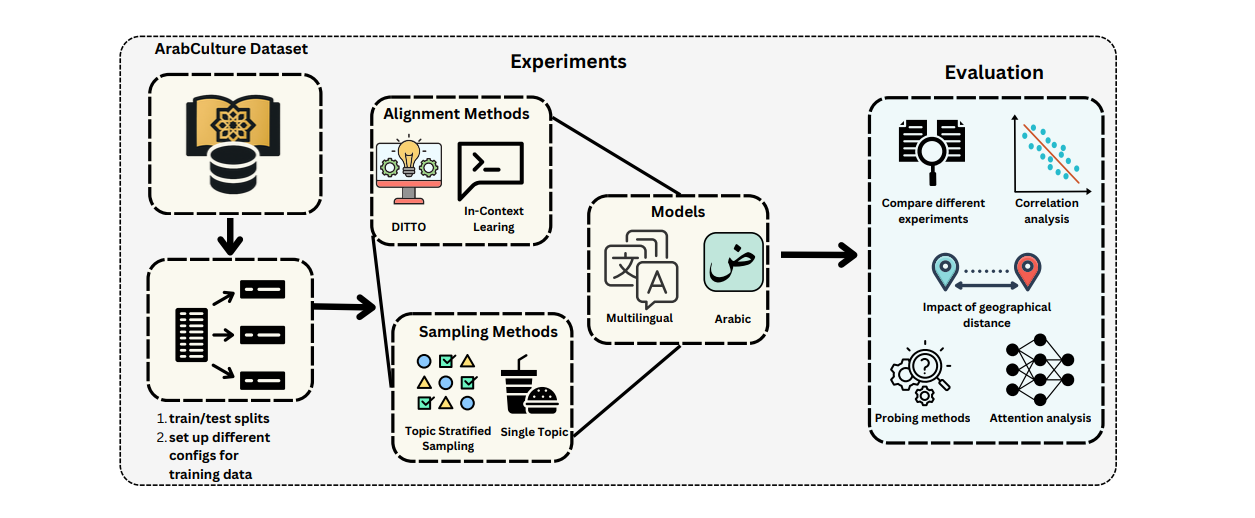
Commonsense reasoning in large language models often struggles outside of Western cultural norms, limiting their global applicability. To address this, Saeed Almheiri, Rania Hossam, and Mena Attia, all from Mohamed bin Zayed University of Artificial Intelligence, alongside Chenxi Wang, Preslav Nakov, and Timothy Baldwin, investigate whether cultural understanding gained in one region can improve performance in others. The team focuses on the Arab world, creating a unique dataset encompassing 13 Arab countries to evaluate methods for adapting language models. Their research demonstrates that even a small number of culture-specific examples, just twelve, can boost performance across different Arab nations by ten percent on average, and crucially, that commonsense knowledge from seemingly distant cultures like Indonesia and the US can prove surprisingly effective, offering a pathway to build more globally inclusive and adaptable artificial intelligence.
Cross-lingual Performance Differences Between Language Models
Researchers investigated the performance of two large language models, Ditto and SILMA 9B-Instruct, across different countries, assessing how well knowledge transfers between cultures. The study analyzed performance differences when models were trained on data from one country and evaluated on another, revealing patterns in cross-cultural understanding. Overall, models perform best when tested on the country they were trained on, but demonstrate varying degrees of transferability to other regions. Both models show regional trends, with relatively consistent performance within areas like the Middle East and North Africa, though they consistently struggle when trained on data from Yemen. Conversely, training on data from Tunisia and the United Arab Emirates appears to yield more generalizable results, improving performance across a wider range of target countries.
Cross-Cultural Reasoning in Large Language Models
Researchers pioneered a method for adapting large language models to different cultural contexts, focusing on the diverse Arab world. They assembled the ArabCulture dataset, a culturally grounded resource encompassing thirteen Arab countries and over three thousand examples, to evaluate how effectively cultural knowledge learned in one country can improve performance in others. Experiments involved training and evaluating models on data from one country and assessing performance on others, systematically testing the transferability of cultural knowledge. The results demonstrate that as few as twelve culture-specific examples from a single country can improve performance in others by an average of ten percent, and that demonstrations from cultures outside the Arab world, such as Indonesia and the United States, could match or surpass in-culture alignment, highlighting the potential for broader cultural commonsense transferability.
Cultural Alignment Boosts Commonsense Reasoning Performance
This research demonstrates a breakthrough in cross-cultural adaptation of large language models, achieving significant performance gains in commonsense reasoning within the Arab world. Experiments utilizing the ArabCulture dataset, encompassing thirteen countries and over three thousand examples, revealed that aligning LLMs with culture-specific data from a single source country improves performance in unseen target cultures by an average of ten percent, using only twelve culture-specific demonstrations. The team employed two lightweight alignment strategies across four LLMs, and DITTO achieved up to thirty-four percent accuracy gains in Arab commonsense reasoning multiple-choice questions. These results demonstrate the feasibility of transferring cultural knowledge, allowing LLMs to generalize across culturally distinct regions even with limited training data, and that geographic proximity and cultural similarity between countries correlate with the degree of knowledge transfer.
Cross-Cultural Adaptation in Large Language Models
This research demonstrates that large language models can successfully adapt to different cultural contexts using relatively simple alignment techniques. Experiments conducted across thirteen Arab countries reveal that incorporating just a few culture-specific examples from one country improves performance in others by an average of ten percent, with gains of fifteen to twenty percent observed across multilingual models. Probing analyses confirm that this targeted alignment enhances the encoding of cultural knowledge without negatively impacting overall performance, highlighting the feasibility of culturally adaptive natural language processing. The study establishes that lightweight alignment methods enable language models to learn robust cultural representations that generalize to new countries.
🗞 Cross-Cultural Transfer of Commonsense Reasoning in LLMs: Evidence from the Arab World
🧠 ArXiv: https://arxiv.org/abs/2509.19265