

The complex relationship between electron interactions and a material’s fundamental properties remains a key challenge in modern physics, and recent work by Abdiel de Jesús Espinosa-Champo and Gerardo G. Naumis, both from Universidad Nacional Autónoma de México, sheds new light on this interplay. Their investigation focuses on the Creutz ladder, a simplified model representing a one-dimensional insulator, and reveals how electron-electron interactions can drive dramatic changes in its magnetic and electronic structure. The researchers demonstrate a sharp, first-order transition where increasing these interactions causes the system to switch from an anti-ferromagnetic state to a ferromagnetic one, simultaneously undergoing a fundamental change in its electronic behaviour, evidenced by a distinct jump in a key quantum property. This discovery establishes the Creutz ladder as a valuable tool for understanding how electronic correlations control magnetic, electronic, and geometric properties, potentially paving the way for new materials with tailored characteristics.
Topology, Correlations, and Edge States in 1D
This research investigates the interplay of topology, quantum geometry, and strong electron interactions within a one-dimensional material modeled by the Creutz-Hubbard model. Scientists explore how these factors influence the material’s electronic properties, particularly its topological phase and the behavior of edge states, using both theoretical calculations and numerical simulations. The study focuses on understanding how electron behavior changes as a result of these combined effects. The Creutz-Hubbard model combines features of the Creutz ladder, a system known for its interesting topological properties, and the Hubbard model, which accounts for electron-electron interactions.
Researchers examine the topological properties of the electronic bands, characterized by a mathematical quantity called the Zak phase, which determines whether a system is topologically trivial or non-trivial, indicating the presence of topological edge states. The importance of quantum geometry, specifically the Fubini-Study metric, is also emphasized, as it captures the geometric properties of the quantum state space and influences electron behavior. Strong electron-electron interactions, represented by the Hubbard term, significantly modify the electronic band structure and topological properties of the system. Numerical simulations calculate the electronic band structure, Zak phase, and other relevant quantities. The research also investigates the influence of temperature on the topological phase, finding that higher temperatures tend to disrupt the topological order. This research provides insights into the complex interplay of topology, quantum geometry, and strong correlations in one-dimensional materials.
Hubbard Interactions Drive Topological Phase Transition
This study demonstrates how electronic interactions and band structure combine within the Creutz ladder, a model system for understanding one-dimensional insulators. Researchers employed a self-consistent mean-field approach to explore how on-site Hubbard interactions affect the magnetic and geometric properties of this system, allowing them to calculate the system’s ground state and how it changes with varying interaction strengths. The team discovered that increasing the Hubbard interaction induces a first-order phase transition, simultaneously altering the magnetic configuration from anti-ferromagnetic to ferromagnetic. Crucially, this magnetic transition coincides with a transition characterized by a quantized jump in the Zak phase, a topological invariant, from 0 to π.
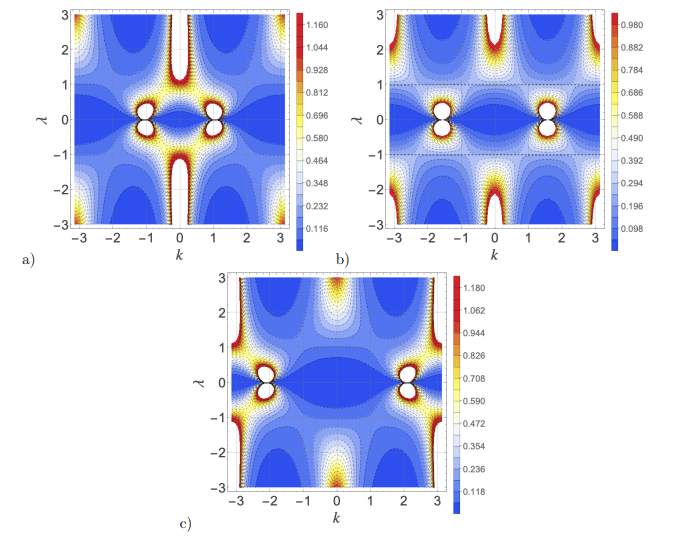
To systematically map the behavior of the system, scientists explored the phase diagrams by varying the on-site energy staggering and inter-chain hopping asymmetry, identifying the critical interaction strength at which the transition occurs. The team then analyzed the geometry of the Bloch states using the Fubini-Study metric, a tool for quantifying the curvature of the quantum state space. They found that divergences in the components of this metric precisely signal the phase transition, providing a geometric signature of the change in the system’s state.
Magnetic and Topological Transition in Creutz Ladder
Scientists have demonstrated a simultaneous magnetic and topological phase transition in a one-dimensional model system known as the Creutz ladder, achieved through the application of on-site Hubbard interactions. The research establishes that increasing the strength of these interactions drives an abrupt switch in the system’s ground state, transitioning it from an anti-ferromagnetic (AF) configuration to a ferromagnetic (F) one. This magnetic transition coincides precisely with a topological transition, evidenced by a quantized jump in the Zak phase from ±π to 0. The team systematically mapped the phase boundaries of the system by varying on-site energy staggering and inter-chain hopping asymmetry, revealing the critical interaction strength required to induce the transition.
Numerical results confirm a first-order phase transition, where the ground state abruptly changes with increasing interaction strength. By analyzing the full energy spectrum, researchers distinguished the true ground state from metastable excited states that emerge beyond the critical point, ensuring accurate identification of the system’s lowest energy configuration. Furthermore, scientists analyzed the quantum geometry of the Bloch states by calculating the Fubini-Study metric, revealing that its components exhibit divergences precisely at the phase transition point. This geometric analysis provides a direct link between the topological and magnetic transitions, confirming the formation of Dirac cones in the band structure. The ability to control both magnetic and topological properties via a single interaction parameter suggests potential applications in spintronic devices and quantum information processing.
Creutz Ladder Reveals Interaction-Driven Magnetic Transition
This research establishes a detailed understanding of how electronic interactions influence the magnetic and topological properties of the Creutz ladder system, a fundamental model in condensed matter physics. By employing a mean-field approach, scientists uncovered a first-order phase transition, where the system abruptly switches from an anti-ferromagnetic to a ferromagnetic state as the strength of electron-electron interactions increases. This magnetic transition is accompanied by a corresponding change in the system’s topological character, indicated by a quantized jump in a mathematical property known as the Zak phase. Detailed analysis revealed how this transition is sensitive to both the energy difference between sites on the ladder and the asymmetry in hopping between chains.
The team systematically mapped out the conditions under which this interaction-driven transition occurs, identifying a critical interaction strength that defines the boundary between different phases. Furthermore, they characterized the geometry of the electronic states, demonstrating that changes in this geometry precisely signal the phase transition, providing a robust way to detect the shift between magnetic and topological states. The researchers were able to distinguish the true lowest energy state of the system from other, less stable excited states that emerge as interactions become stronger. This minimal model provides a valuable platform for investigating the interplay between electronic correlations, magnetism, and topology, potentially guiding the design of materials with tailored electronic and magnetic properties.
👉 More information
🗞 Magnetic phase transitions protected by topological quantum geometry transitions: effects of electron-electron interactions in the Creutz ladder system
🧠 ArXiv: https://arxiv.org/abs/2509.26320

