The interplay between light and matter at the molecular level governs many crucial chemical and biological processes, and understanding these interactions requires increasingly sophisticated computational methods. Sachith Wickramasinghe, Amirhosein Amini, and Arkajit Mandal, all from Texas A and M University, now present a new approach to simulate the dynamic behaviour of vibrational polaritons, hybrid light-matter excitations formed when molecular vibrations couple with light confined within an optical cavity. Their work introduces a computationally efficient method for propagating these polaritonic dynamics, allowing researchers to model the real-time evolution of these complex systems, and crucially, offers a way to bypass the need for computationally expensive calculations without sacrificing the overall accuracy of predicted spectra. This advancement promises to unlock new insights into how molecules interact with light, potentially leading to breakthroughs in areas such as energy harvesting, chemical reactivity control, and the design of novel optical materials.
Vibrational Polaritons and Cavity Molecular Dynamics
This research details investigations into vibrational polaritons and their influence on chemical processes, using cavity molecular dynamics (cavMD) simulations. The work explores how strong coupling between molecular vibrations and light within an optical cavity alters chemical behaviour, and develops computational methods to accurately model these systems. A central focus is understanding how cavity confinement modifies the vibrational landscape of molecules. The research centres on vibrational polaritons, hybrid light-matter excitations forming new energy levels when molecular vibrations strongly couple to light.
These polaritonic states can change reaction rates, pathways, and energy transfer mechanisms. Scientists investigate these changes and develop accurate computational models, focusing on water as a model system to study the vibrational modes of the water bend and their response to cavity confinement. Energy disorder in the molecular environment impacts polariton formation and coherence. The primary computational technique is cavMD, which combines classical molecular dynamics simulations with quantum mechanical calculations to efficiently model the system. Density Functional Tight Binding (DFTB) calculates vibrational modes and forces.
Researchers developed cavOTF, a software package for simulating vibrational polaritons, and made code and data publicly available for collaboration. Large-scale simulations require access to high-performance computing resources. Analysis techniques include spectral analysis, energy transfer calculations, and trajectory analysis. Results demonstrate that cavity confinement alters vibrational spectra, creating new peaks and shifts. The research shows that cavity confinement can enhance energy transfer between molecules, potentially accelerating chemical reactions.
Energy disorder broadens polariton linewidths and reduces their coherence, impacting their effectiveness. Coupling multiple vibrational modes to the cavity field creates complex polariton landscapes. Studies on water reveal how cavity confinement affects the vibrational modes of the water bend and its hydrogen bonding network. Accurate quantum mechanical calculations are crucial for obtaining reliable simulation results. Challenges remain in computational cost and accurately modelling environmental effects.
Future work will focus on developing more accurate quantum mechanical methods and exploring new materials and systems. Bridging the gap between theory and experiment is essential, requiring experimental techniques to probe polariton dynamics and validate theoretical predictions. This research pushes the boundaries of understanding light-matter interactions at the molecular level, with potential applications in catalysis, energy transfer, and materials science. Accurate computational methods like cavMD are crucial for unlocking the full potential of vibrational polaritons.
Real-Space Reciprocal-Space Molecular Dynamics Simulations
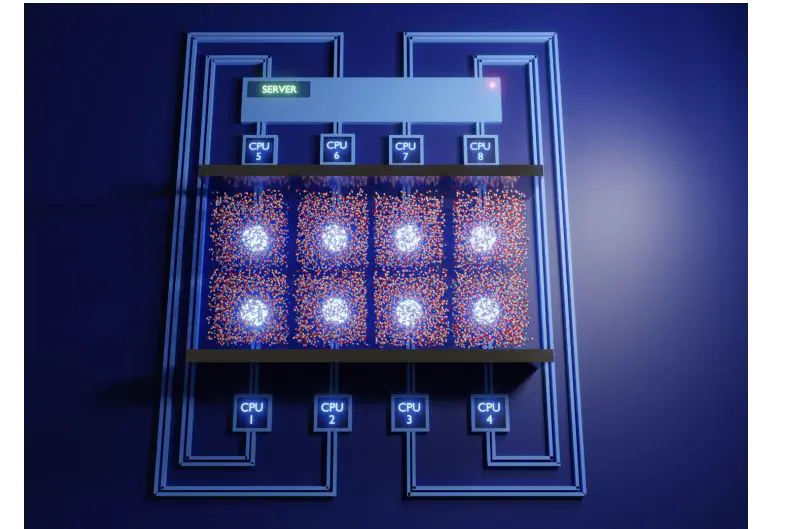
Scientists developed a novel computational approach to simulate vibrational polaritons, overcoming limitations of long-wavelength approximations. The study pioneers an on-the-fly molecular dynamics method that propagates part of the system’s Hamiltonian in real space while evolving the remainder in reciprocal space, enabling highly parallelized computations with minimal communication between processors. This innovative strategy distributes the computational workload, assigning each processor to propagate a distinct portion of the macroscopic system, significantly accelerating simulations of complex molecular ensembles. To model light-matter interactions, the team adapted a modified Holstein-Tavis-Cummings Hamiltonian, focusing on a two-dimensional system with cavity quantization in one direction and molecular extension in the other.
The core of the method involves solving the electronic structure of matter using the self-consistent-charge density functional tight binding approach, a computationally efficient technique for describing molecular interactions. Researchers discovered that while computationally expensive Born charges, required for accurate propagation, could not be replaced with static partial charges, the simpler Mulliken charges provided qualitatively accurate linear spectra when the light-matter interaction was not substantial. However, they cautioned that this simplification would introduce inaccuracies when analysing energy transport or chemical reactivity, leading to spurious heating of the system. The team successfully demonstrated the feasibility of this approach by simulating a system containing over 8000 atoms coupled to an ensemble of cavity modes.
They presented angle-resolved infrared spectra of liquid water, targeting both asymmetric stretch and bending modes, showcasing the method’s ability to capture complex vibrational dynamics. To facilitate further research, scientists implemented their approach as an open-source package, CavOTF, publicly available on GitHub, providing a powerful tool for in silico experiments and exploring the potential of confined radiation to modulate and catalyse chemical reactivity. This computational framework promises new opportunities to harness optical cavities for controlling chemical processes at the molecular level.
Vibrational Polariton Dynamics with Scalable Simulations
Scientists have developed a new computational approach for simulating the dynamics of vibrational polaritons, which are hybrid light-matter excitations formed by coupling molecular vibrations to light confined within an optical cavity. This work overcomes limitations of previous models by moving beyond the long-wavelength approximation and enabling simulations of complex systems with over 8000 atoms. The team achieved this by developing a highly parallelized algorithm that efficiently distributes computational load across multiple processors with minimal communication overhead. The core of this breakthrough lies in a novel Hamiltonian, adapted for simulating vibrational polaritons, and a computational strategy where part of the Hamiltonian is evolved in real space while the rest is propagated in reciprocal space.
This allows for accurate modelling of the light-matter interaction, even when the wavelength of light is comparable to the size of the molecular system. Researchers demonstrated that while computationally expensive Born charges, which describe how molecular polarity changes with deformation, are necessary for quantitative accuracy, they can be replaced with the simpler Mulliken charges for qualitatively accurate linear spectra when the light-matter interaction is not strongly nonlinear. However, this simplification is not suitable for studying energy transport or chemical reactivity, as it introduces spurious heating into the system. Experiments using this framework successfully simulated angle-resolved infrared spectra of liquid water under vibrational strong coupling, targeting both the asymmetric stretch and bending modes. The computational tool, implemented as an open-source package called CavOTF, promises to unlock new opportunities for in silico experiments, potentially allowing scientists to harness confined radiation within optical cavities to modulate and catalyse chemical reactivity. This advancement provides a powerful new platform for exploring the fundamental interplay between light and matter at the molecular level.
Vibrational Polariton Dynamics via Parallel Computation
This work presents a new computational approach for modelling the dynamics of vibrational polaritons, which arise from the strong coupling of molecular vibrations with light confined within an optical cavity. Researchers developed a parallelized method that efficiently calculates how these light-matter interactions evolve over time, using a real-space description to capture the system’s behaviour. A key achievement is the development of CavOTF, an open-source software package designed to facilitate these calculations and is publicly available. The team demonstrated the utility of their method by successfully computing both molecular and angle-resolved photonic spectra, providing insights into how cavity confinement alters molecular properties. They found that, in many cases, computationally simpler Mulliken charges can effectively replace more complex Born charges when calculating spectra, significantly reducing computational cost.
🗞 On-the-Fly Cavity-Molecular Dynamics of Vibrational Polaritons
🧠 ArXiv: https://arxiv.org/abs/2512.03277