
The technology sector has had a hard ride over the last few months. Some horrible names have seen naive destruction of their share pieces and/or have decided to cut headcounts. Amid this, we’ve seen the market adoption of AI with tools like ChatGPT. Could Quantum provide the next leap forward in technology? Could it help stem job losses and provide a new technology cycle, just as the GPU (Graphic Processing Unit) accelerated AI?
What is the Quantum Revolution?
Quantum technology has the potential to become a new revolution due to its transformative capabilities that can impact various industries and fields. At the core of this revolution lies the power of quantum computing, which leverages the principles of quantum mechanics to perform complex calculations and solve problems currently intractable for classical computers. The unique properties of quantum computing, such as superposition, entanglement, and quantum parallelism, enable it to process information differently than classical computing, providing the foundation for a wide range of novel applications.
One of the most significant areas where quantum technology could bring about a revolution is in cryptography and cybersecurity. Quantum computers have the potential to break existing cryptographic protocols, such as RSA and elliptic curve cryptography, which form the backbone of secure communications in today’s digital world. This looming threat has spurred the development of quantum-resistant cryptography and quantum key distribution, which can provide provably secure communication channels. By ensuring data security in an increasingly connected world, quantum technology can reshape how we approach privacy and information protection.
Beyond computing and cryptography, quantum technology holds promise in various fields, including material science, medicine, and communications. Quantum sensors and imaging devices can offer unprecedented precision and sensitivity, leading to advancements in areas like medical diagnostics and environmental monitoring. Additionally, quantum communication networks can enable ultra-secure and efficient data transfer, while quantum simulations can facilitate the discovery of new materials and drugs. As quantum technology matures and becomes more accessible, its potential to revolutionize these industries and reshape the global technological landscape becomes increasingly apparent.
Job losses in the technology sector
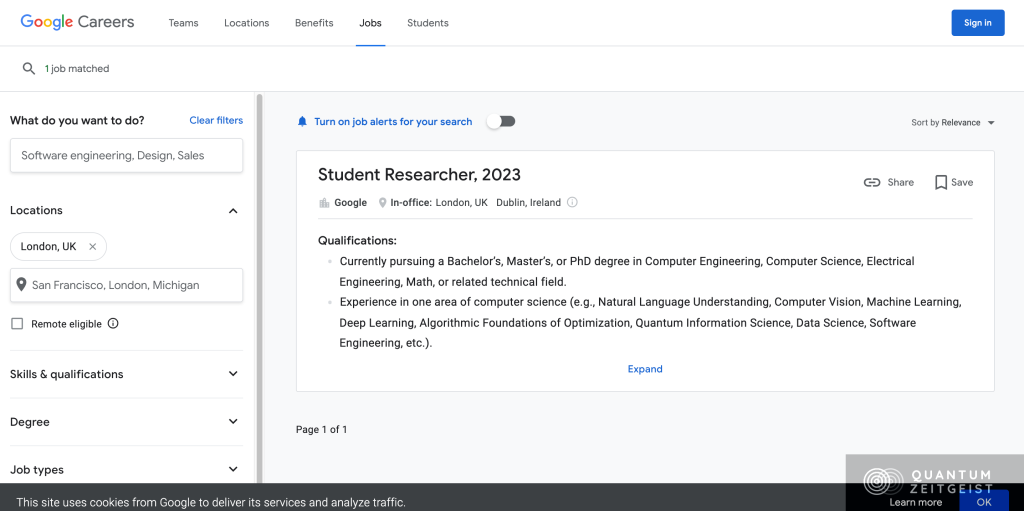
The tech sector has recently been haemorrhaging jobs, with Microsoft, Amazon, and many more shedding body counts as they aim to slim down. Does that make one wonder where the growth in jobs will come from? Companies like Google are displaying hiring freezes. For example, there is only one open position for Google in the entire UK, and it’s a student job at that!
As big tech looks to push back its headcount and do more with less, we could see hiring come from genuinely new expanding areas. Could that growth come from emerging technologies such as quantum computing or, more widely, quantum technology? Some have even questioned whether AI could further reduce the demand for tech workers. So if you are not working in AI, developing or using the latest tools like ChatGPT from OpenAI or Bard from Google, where might the growth opportunities lie? As big tech looks to thin-out its headcount, which rapidly expanded during the pandemic, we suspect that big tech will trim the fat in non-growth areas or where there is simply an opportunity to restrict costs.
The tech industry experienced many layoffs in 2022, which seems to continue in 2023. At the start of 2023, Amazon and Salesforce announced 26,000 job cuts. In 2022 alone, over 120,000 people were dismissed from their jobs at some of the most prominent players in tech, including Meta, Amazon, Netflix, and Google, as well as smaller firms and startups, according to Stanford.
However, we think that the main quantum will be largely unaffected because of its relatively small footprint and also the fact that whilst it might be seemingly non-core, observers will have seen the rapid rise of AI developments such as ChatGPT, which will help frame quantum in a more favourable light and instead of quantum being perhaps considered a long-shot will instead be thought of a whole new industry ready to be unlocked.
Quantum technology, whether quantum computing, quantum communication or cryptography, but especially Quantum Machine Learning, could create that new demand.
Quantum Machine Learning as a new technology accelerant
Quantum Machine Learning (QML) is a subfield of machine learning that combines the principles of quantum mechanics with traditional machine learning techniques. It aims to leverage the unique properties of quantum computing to improve the efficiency and effectiveness of learning algorithms, enabling the development of more robust models and the ability to solve complex problems that classical machine learning methods struggle with.
The link between quantum machine learning and classical machine learning lies in their core objective: to create models that learn from and make predictions or decisions based on data. Both fields use algorithms and mathematical models to process and analyze large datasets, recognize patterns, and optimize outcomes.
However, quantum machine learning takes advantage of the distinctive characteristics of quantum computing to enhance the performance of these models:
- Quantum superposition: Quantum computers use qubits instead of classical bits, which allows them to represent multiple states simultaneously. This property can lead to faster and more efficient optimization algorithms for machine learning.
- Quantum entanglement: The strong correlations between qubits, even when large distances separate them, enable quantum computers to perform certain intractable calculations for classical computers. This capability can be harnessed to develop new machine-learning algorithms and techniques.
These advantages make quantum machine learning a promising approach for tackling problems that are computationally expensive or intractable for classical machine learning methods, such as large-scale optimization, image and speech recognition, natural language processing, and drug discovery, among others. However, it is essential to note that quantum computing and quantum machine learning are still in their infancy, and their practical applications are yet to be fully realized.
Learning Quantum
The best time to learn about quantum technologies is now. Plenty of courses, books and resources are available for everyone to find the right level to enable them to onboard quantum skills, whether for business, knowledge or just curiosity.