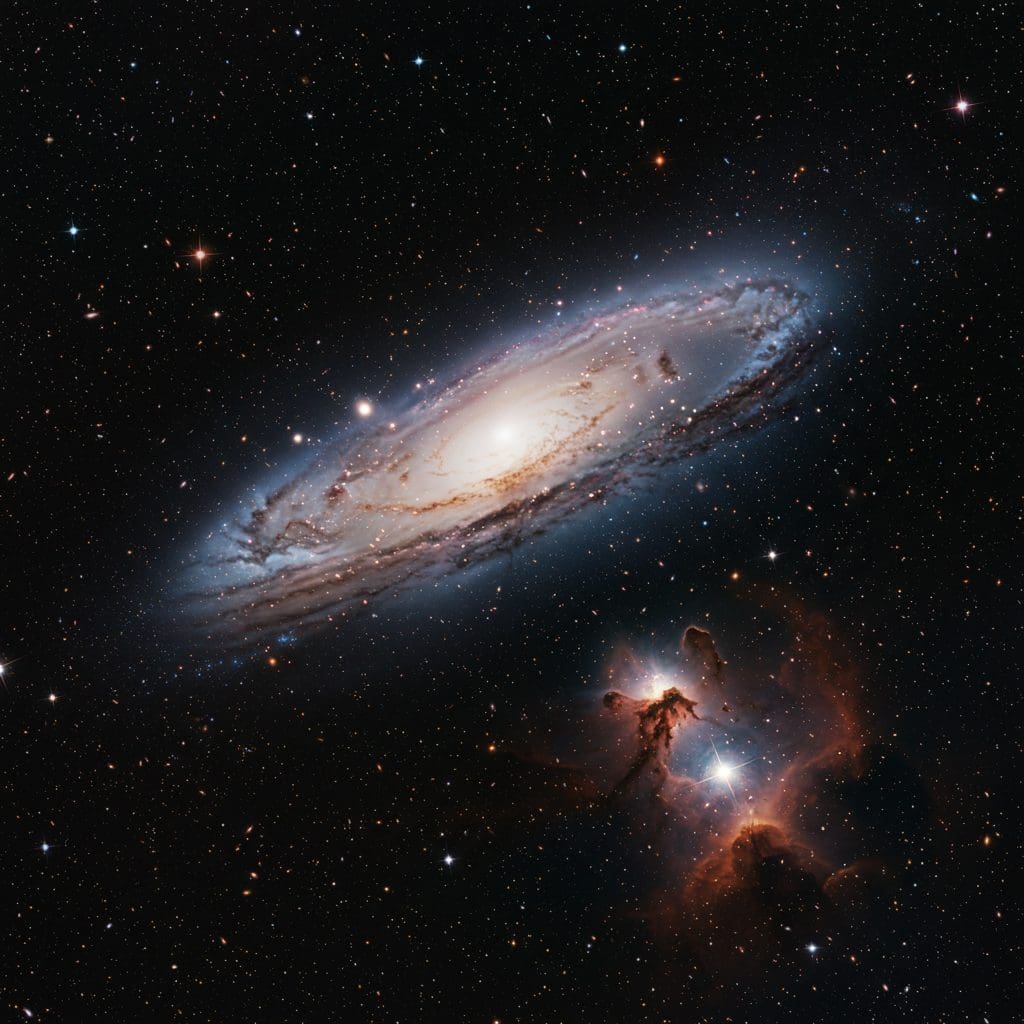
Cosmology, the study of the Universe’s origin, evolution and ultimate fate, rests upon a remarkably successful, yet incomplete, theoretical framework. Pedro G. Ferreira and Alexander Roskill, both from the Astrophysics department at the University of Oxford, present a foundational overview of modern cosmology and its current status. Their work highlights the astonishing predictive power of the Cold Dark Matter model, a framework built upon established physics that accurately describes a vast range of cosmological observations. Despite this success, significant mysteries remain regarding the unseen components of the Universe and emerging inconsistencies within the model, making a comprehensive understanding of its foundations increasingly crucial for future research.
A mathematical model, dependent on few ingredients and parameters, achieves a range of predictions and postdictions with astonishing accuracy. It builds upon well-known physics, including general relativity, quantum mechanics, atomic physics, statistical mechanics and thermodynamics, and predicts the existence of new, unseen components. Repeatedly, the model demonstrates remarkable precision when fitted to new data sets. Despite these successes, understanding of the unseen components of the Universe remains incomplete, and evidence suggests inconsistencies within the model. These lectures lay the foundations of modern cosmology.
Cosmological Parameter Estimation and CMB Analysis
Modern cosmology is driven by a wealth of observational data and sophisticated theoretical tools, encompassing topics from the Cosmic Microwave Background (CMB) and large-scale structure to dark energy and dark matter. Investigations focus on methods for precisely estimating cosmological parameters, crucial for understanding the Universe’s evolution and composition. Current research emphasizes the analysis of the CMB, providing precise measurements of these parameters, and the study of large-scale structure, mapping the distribution of matter across vast cosmic distances. Key areas of investigation include galaxy clustering, analyzing how galaxies are distributed to reveal the underlying distribution of dark matter, and weak gravitational lensing, measuring the distortion of galaxy shapes caused by intervening matter.
Baryon Acoustic Oscillations, using characteristic patterns in the early universe as a standard ruler for measuring distances, also play a vital role, alongside supernovae, used as standard candles to measure distances and the expansion history of the universe, and Big Bang Nucleosynthesis, the theory of element formation in the early universe, which provide further constraints on cosmological models. Several major cosmological surveys contribute significantly to this research, including the Dark Energy Survey, focused on measuring dark energy, and the Kilo-Degree Survey, contributing to our understanding of dark matter and dark energy. The Hyper Suprime-Cam survey and the Dark Energy Spectroscopic Instrument also provide valuable data, with future missions, such as Euclid, promising even more precise measurements of the Universe. Sophisticated statistical methods, such as Bayesian inference, are essential for parameter estimation and model selection.
Researchers employ powerful computational techniques, including N-body simulations, to model the formation of large-scale structure and test theoretical predictions. Halo models and the Effective Field Theory of Large-Scale Structure provide theoretical frameworks for describing the distribution of dark matter and galaxies. Current research focuses on understanding dark energy and dark matter, investigating the properties of massive neutrinos, and accounting for the intrinsic alignment of galaxies, which can affect measurements. Modeling the non-linear evolution of structure remains a significant challenge, with recent work highlighting the results from the DESI survey, providing precise cosmological constraints from measurements of baryon acoustic oscillations, and the KiDS-Legacy survey, offering constraints from cosmic shear.
These studies, along with the analysis of data from the Dark Energy Survey, are pushing the boundaries of our understanding of the Universe. This research paints a picture of a vibrant and active field, where cosmology is now a precision science. The current focus is on reducing systematic errors, testing the standard cosmological model, and probing the nature of dark energy and dark matter.
Power Spectrum Accurately Maps Cosmic Structure
Cosmological research has achieved remarkable precision in modeling the universe, building upon well-established physics like general relativity and atomic mechanics. This work predicts the existence of unseen components within the universe and consistently aligns with new observational data. Researchers have meticulously mapped the distribution of matter, demonstrating that the model accurately reproduces the linear power spectrum, a key measure of density fluctuations, even as gravity amplifies these fluctuations over time. Measurements confirm that non-linear growth boosts the amplitude of these fluctuations on smaller scales, altering the shape of the power spectrum in predictable ways.
To understand the expansion of the universe, scientists measure distances and redshifts, utilizing the principle that light from distant objects is stretched, shifting its frequency. Direct distance measurements are possible using parallax, observing the apparent shift in a star’s position as the Earth orbits the sun. The Gaia satellite has dramatically improved this technique, precisely measuring the positions and distances of over 1. 8 billion stars, extending accurate parallax measurements to distances of up to 10,000 light-years, and even beyond for the brightest stars. For greater distances, astronomers employ standard candles, objects with known intrinsic brightness.
Cepheid variable stars, which pulsate with a period directly related to their luminosity, are particularly useful, with measurements revealing a tight relationship between a Cepheid’s pulsation period and its absolute magnitude, allowing scientists to determine distances to galaxies hosting these stars. Furthermore, observations of Type IA supernovae, incredibly luminous stellar explosions with remarkably consistent behavior, extend distance measurements to even greater scales, achieving luminosities of around 10 9 times that of the sun. These techniques collectively provide a robust framework for mapping the universe and refining our understanding of its expansion.
Mapping Universe’s Expansion and Large-Scale Structure
This research establishes a robust framework for understanding the expansion history and large-scale structure of the Universe, building upon the successes of the standard cosmological model. By combining observations of Type Ia supernovae with measurements of baryon acoustic oscillations, scientists reconstruct the Universe’s expansion rate with increasing precision, allowing for refined estimates of cosmological parameters. The work details how fluctuations in the cosmic microwave background, when mapped and analyzed using spherical harmonics, reveal the distribution of matter on large scales, assuming statistical homogeneity and isotropy. This approach allows cosmologists to move beyond simply describing the Universe’s evolution to mapping its structure and testing fundamental assumptions about its properties.
The team demonstrates how analyzing fluctuations in the cosmic microwave background, treated as a stochastic process, provides insights into the distribution of matter across vast cosmic distances. By expanding these maps using spherical harmonics, researchers obtain coefficients that characterize the fluctuations and reveal the underlying large-scale structure. While the analysis relies on the assumption of Gaussian fluctuations and statistical homogeneity, these assumptions provide a powerful tool for interpreting observational data and testing cosmological models. The authors acknowledge that the validity of these assumptions requires ongoing scrutiny as observational precision improves.
👉 More information
🗞 A Short Introduction to Cosmology and its Current Status
🧠 ArXiv: https://arxiv.org/abs/2509.12121