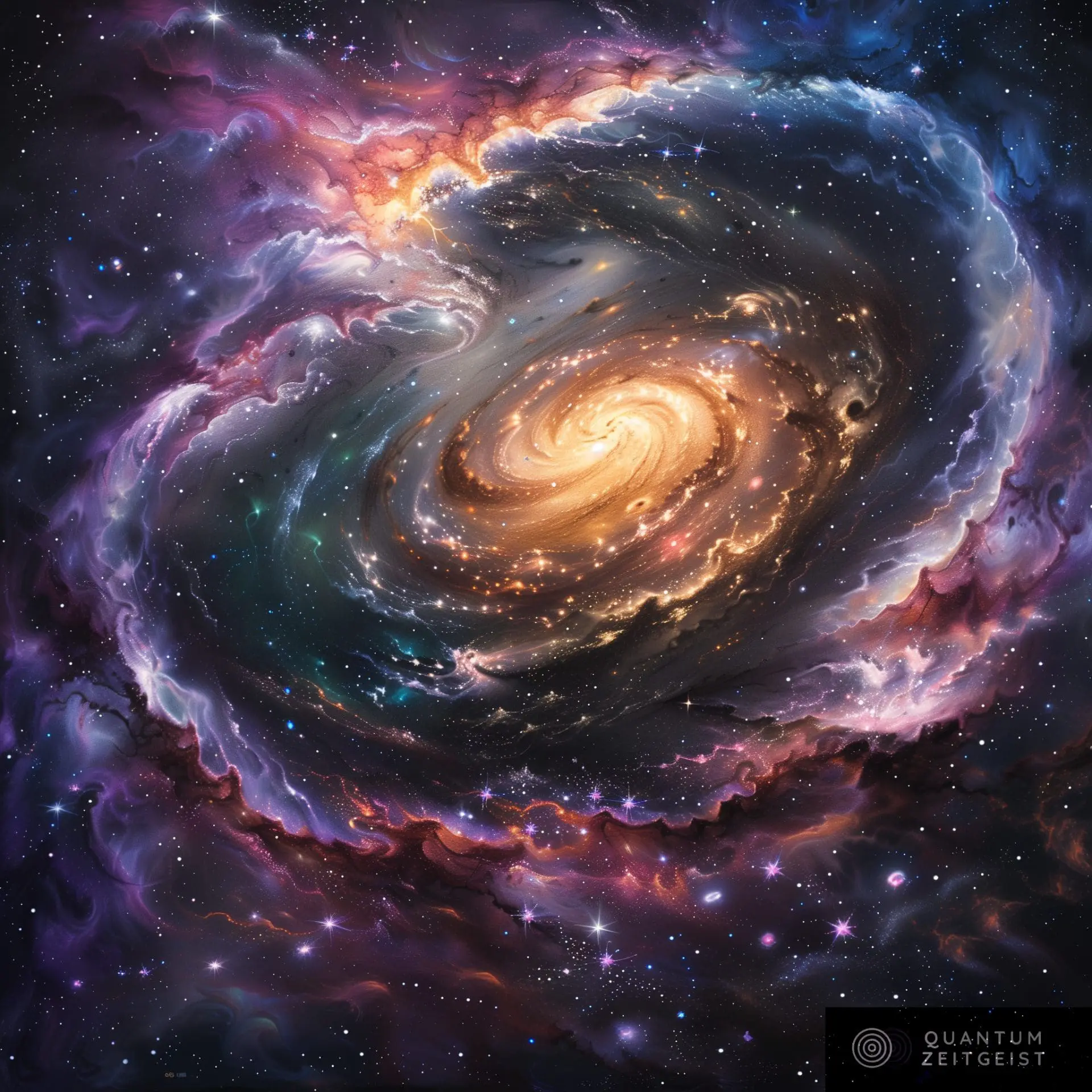
The theory of cosmic inflation, conceptualized by Alan Guth, explains the universe’s expansion and evolution. It suggests that the universe underwent an exponential expansion for a fraction of a second after the Big Bang, then continued to expand at a slower yet accelerating rate. This theory addresses several fundamental issues, including the horizon problem, the homogeneity problem, the flatness problem, and the absence of magnetic monopoles. Over time, the theory has evolved, with scientists like Andrei Linde and Paul Steinhardt proposing new concepts. The theory continues to evolve, providing insights into the nature of our universe and addressing key cosmological questions.
What is the Theory of Cosmic Inflation?
The theory of cosmic inflation is a widely accepted explanation for the expansion and evolution of the universe. According to this theory, the early Universe underwent an exponential expansion for a fraction of a second, specifically between 10^-33 and 10^-32 seconds after the Big Bang. Following this brief period, the universe continued to expand, but at a slower yet accelerating rate.
The popularity of the cosmic inflation theory is largely due to its ability to address several fundamental peculiarities about our universe. These include the horizon problem, the homogeneity problem, the flatness problem, and the absence of magnetic monopoles. The theory was primarily conceptualized by Alan Guth, who sought to explain the lack of magnetic monopoles. His theory introduced concepts such as vacuums, quantum fluctuations, tunneling inflatons, and how inflation is triggered by false vacuum decay.
How Has the Theory of Cosmic Inflation Evolved?
Over time, the theory of cosmic inflation has evolved and been refined by various scientists. Andrei Linde, for instance, proposed the inflaton field’s slow roll conditions, which differed from the quantum tunneling described by Guth. Linde also suggested how inflation could eternally sustain a multiverse in an infinite expanding fractal, with different physical properties defining each pocket universe.
More recently, Paul Steinhardt developed the concept of cyclic cosmology and the idea of repeating Big Bounces. These concepts offer reformed ways to explain the presence of dark energy and universal homogeneity. The evolution of the inflation theory, based on these different theories, continues to provide answers to cosmology’s unexplained fundamental questions.
What are the Key Problems Addressed by the Theory of Cosmic Inflation?
The theory of cosmic inflation addresses several key problems within the Big Bang model. One of these is the flatness problem, which questions why our universe is especially flat. The flatness problem is observed by comparing the critical energy density value, or the energy density value of a flat universe, to the energy density of our calculations. The calculated energy density and the critical energy density are almost exactly the same, which is unexpected since a flat universe is perfectly in between an open universe (negative curvature) and a closed universe (positive curvature).
Another problem addressed by the theory of cosmic inflation is the horizon problem. This problem challenges cosmology to explain the uniformity of the cosmic microwave background (CMB) radiation observed throughout the universe. In the hot Big Bang model, it is predicted that the universe consists of at least 10^83 causally disconnected regions, which are not able to communicate with each other via light signals.
How Does the Theory of Cosmic Inflation Fit into the Standard Model of the Big Bang?
In the Standard Model of the Big Bang, there is a point of singularity typically assigned to the moment t=0, where the temperature reaches infinity, making it impossible to set an initial value problem at t=0. However, once the temperature equals or exceeds the Planck mass (around 10^19 GeV), the Standard Model’s equations become unreliable due to the anticipated significant impact of quantum gravitational effects. Therefore, it is practical to start the hot Big Bang model at a temperature T0 well below the Planck mass, for example, 10^17 GeV. The universe can then be characterized by a set of initial conditions, allowing the equations of motion to dictate the further development of the universe.
What is the Future of the Theory of Cosmic Inflation?
The theory of cosmic inflation continues to evolve as new evidence emerges and theoretical developments occur. As scientists continue to refine and expand upon this theory, it will likely provide even more insights into the nature of our universe. The theory’s ability to address fundamental questions in cosmology, such as the flatness and horizon problems, makes it a crucial component of our understanding of the universe’s origin and evolution. As such, the future of the theory of cosmic inflation is likely to remain a central focus in the field of cosmology.
Publication Date: 2024-03-04
Authors: Zhe-Yu Chen, Elysse Ahmad Yusri, Samuel Huang, R. J. Punith Gowda, et al.
Source:
DOI: https://doi.org/10.31219/osf.io/r8kjc