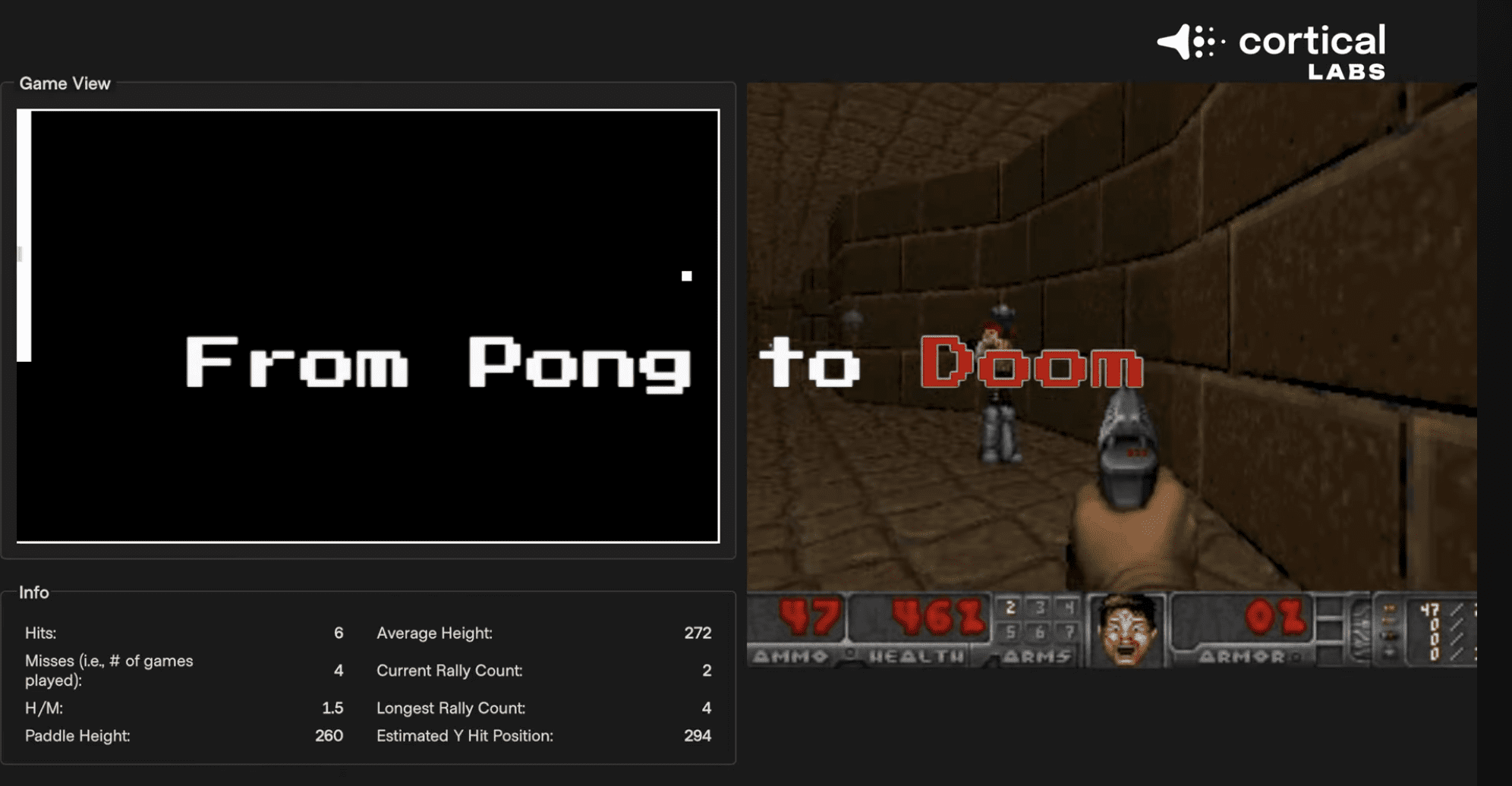
Cortical Labs has demonstrated that approximately 200,000 living human neurons, grown on a microchip, can play the notoriously complex video game Doom, a feat previously thought to require sophisticated artificial intelligence. The company’s CL1 device and accompanying API allowed an independent researcher to translate the game’s visual information into electrical stimulation for the neural culture, interpreting the neurons’ responses as in-game commands. “We’ve solved the interface problem,” explained Dr. Alon Lerfler of Cortical Labs, indicating a functional link between the digital and biological worlds has been established. While the neuronal “player” currently performs at a novice level, exhibiting learning through trial and error, this demonstration proves the potential for training and shaping the behavior of living brain cells to accomplish increasingly complex tasks.
CL1 System: 200,000 Neurons on a Multi-Electrode Array
The Cortical Labs CL1 houses approximately 200,000 living human neurons cultivated on a multi-electrode array, representing a significant step toward functional biocomputation. Launched last year, the system’s capabilities were recently demonstrated through an unexpected application: playing the video game Doom. Cortical Labs has prioritized user accessibility, developing an API intended to be as friendly, effective, and enjoyable as possible, according to company statements. This focus facilitated a collaboration with an independent researcher, Sean, who successfully coded a working version of Doom to run on the CL1 using the API in under a week. This achievement builds upon prior work where the same system demonstrated the ability to play Pong, a milestone that proved adaptive real-time goal-directed learning was achievable.
The complexity of Doom presented a considerable challenge; “Doom is chaos. It’s 3D, it has enemies, it needs to explore its environment, and it’s hard,” explained Dr. Alon Lerfler. The team overcame this by translating the game’s digital information into electrical signals interpretable by the neurons, stimulating sensory areas of the neural culture based on in-game events. Neuronal firing patterns then function as motor commands within the game, allowing the “Doom guy” to move and shoot. While the neuronal performance currently resembles that of a novice player, the system demonstrably learns, seeking out enemies and improving with feedback. Lerfler asserts, “we’ve solved the interface problem,” establishing a method for real-time interaction and behavioral shaping of these cells. Cortical Labs is now issuing an open invitation to the research community to explore the platform, focusing on refining learning algorithms and encoding methods, and asking what they will teach the neurons next.
Cortical Labs API Translates Doom into Neuronal Stimulation
The development of functional brain-computer interfaces has progressed beyond simple tasks; Cortical Labs is now demonstrating the capacity for living neurons to engage with complex digital environments. The company’s CL1 device houses approximately 200,000 human neurons cultured on a multi-electrode array, forming the basis for a novel neurocomputing system. This achievement follows earlier work where the system successfully played Pong, but presented a significantly greater challenge. Doom, a notoriously demanding first-person shooter, served as the test case for the CL1’s capabilities. “Doom is chaos.” To overcome this, Cortical Labs developed an API allowing users to translate digital information into electrical stimulation patterns understandable by the neuronal culture. Independent researcher Sean utilized this API to map the game’s video feed to specific electrode stimulation, effectively creating a sensory input for the neurons. Sean implemented this method in under a week using the Cortical Labs cloud platform. While the neuronal “player” is far from an eSports champion, playing a lot like a beginner who’s never seen a computer, the system demonstrates learning, seeking out enemies and executing basic actions.
Real-Time Learning Demonstrates Biocomputational Flexibility
Cortical Labs is pushing the boundaries of neurocomputation with its CL1 system, a device housing approximately 200,000 living human neurons on a multi-electrode array. Dr. Alon Lerfler explained that the company’s recent focus has been on refining user accessibility, culminating in the development of a Cortical Labs API designed for effective and enjoyable interaction. The transition from Pong to Doom presented substantial challenges; “Doom is chaos.” To overcome this, the team focused on translating the digital world of the game into the biological language of neurons, electrical signals. The CL API allows users to interact with the neural culture using Python commands, mapping the game’s video feed into patterns of electrical stimulation; for example, “When a demon appears on the left of the screen, specific electrodes stimulate the sensory area of the neural culture on the left side.” The resulting system allows the neurons to react to stimuli and, through interpreting their responses, issue commands within the game.