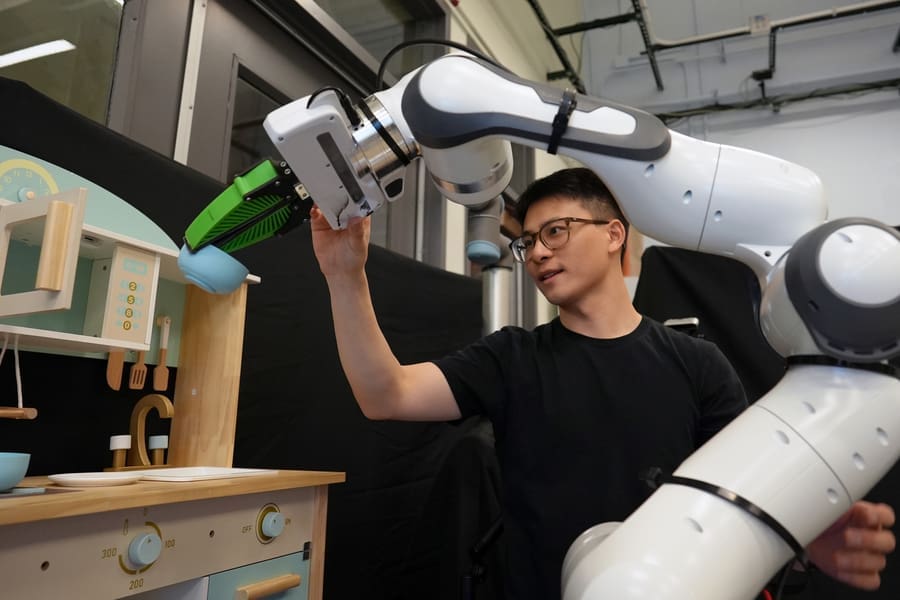
Researchers from MIT and NVIDIA have developed a framework enabling real-time corrections of robotic behavior through intuitive interactions such as pointing on a screen, tracing trajectories, or physically nudging the robot without requiring retraining. Tested with a 21% higher success rate than alternative methods, the approach allows users to guide robots in diverse tasks, addressing misalignments between pre-trained models and real-world scenarios. The research will be presented at the International Conference on Robots and Automation.
The framework developed by MIT and NVIDIA researchers enables real-time corrections of robotic behavior through intuitive human interactions. Instead of requiring users to collect new data and retrain machine-learning models, this method allows robots to adapt immediately to user feedback. Users can guide the robot in three ways: pointing to an object on a screen, tracing a trajectory toward it, or physically nudging the robot. This direct interaction ensures that the robot’s actions align with the user’s intent without losing critical spatial information.
The framework employs a sampling procedure to select valid actions. These actions most closely match the user’s goal. This procedure prevents collisions and invalid movements. The system logs corrective actions, enabling continuous improvement without explicit retraining. This feature enhances adaptability over time, making the robot more efficient and user-friendly.
In experiments conducted in a controlled kitchen setup, the framework demonstrated a 21% higher success rate than alternative methods. The improvement highlights the effectiveness of integrating immediate corrections and real-time adaptation. Future applications could extend beyond controlled environments to industrial settings or healthcare, each presenting unique challenges that require tailored adaptations.
Usability is a key strength of this framework, as it allows interaction without technical expertise. However, considerations remain about handling multiple corrections in real-time and potential system overload. The research represents a significant advancement in human-robot collaboration, with promising implications for dynamic environments.
More information
External Link: Click Here For More