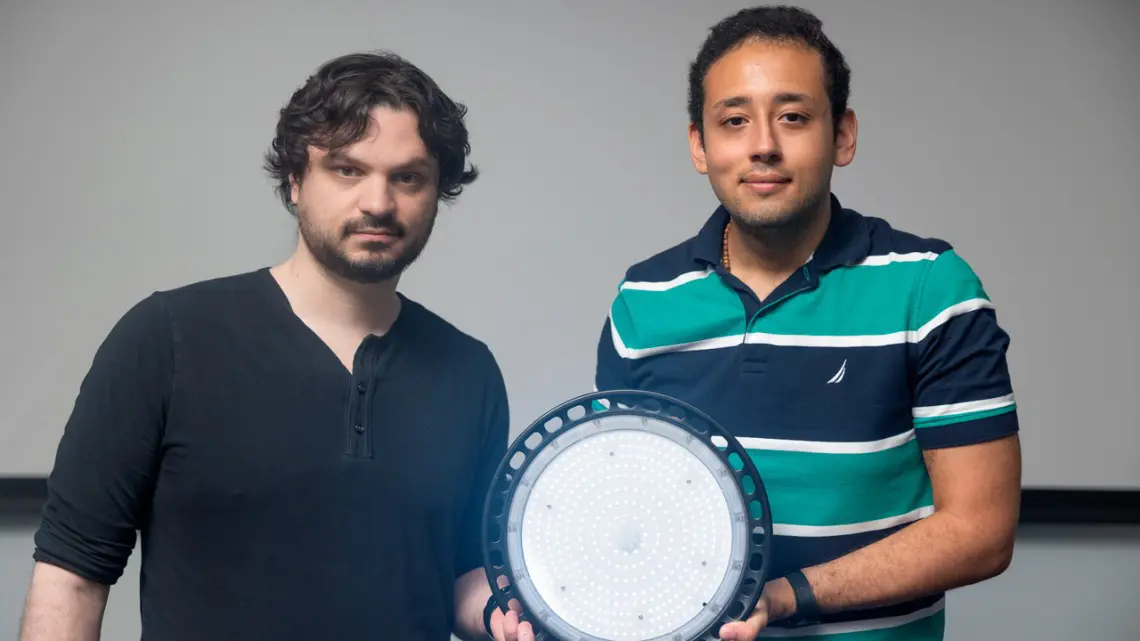
Researchers at Cornell University have developed a method to watermark light, enabling detection of video manipulation. The system, detailed in the study ‘Noise-Coded Illumination for Forensic and Photometric Video’, conceals a unique secret code within nearly imperceptible fluctuations of light emitted from sources such as screens and lamps. Led by graduate student Peter Michael and initially conceived by assistant professor Abe Davis, the technology allows verification of a video’s authenticity by detecting this hidden watermark, and will be presented on August 10th at SIGGRAPH 2025 in Vancouver, British Columbia. This approach addresses the increasing difficulty of discerning authentic video content given the proliferation of generative artificial intelligence and social media platforms.
Researchers at Cornell University have developed a system employing imperceptible fluctuations in lighting to watermark video content, providing a means of verifying authenticity and detecting manipulation. The technique conceals a unique secret code within lighting at specific locations or events, such as interviews or within buildings, which is then recorded as a hidden watermark in any captured video. These fluctuations are designed to remain below the threshold of human perception, ensuring the visual integrity of the footage is maintained while simultaneously embedding forensic data.
The system functions by programming the unique code into light sources, including computer screens, photography lamps, and integrated lighting systems. Any subsequent video recording captured under this illumination will contain the watermark, allowing for verification of the footage’s origin and the detection of any malicious editing. This approach addresses the increasing difficulty of discerning authentic video content, a problem exacerbated by the proliferation of generative artificial intelligence and social media platforms. The research, titled ‘Noise-Coded Illumination for Forensic and Photometric Video’, will be presented on August 10th at SIGGRAPH 2025 in Vancouver, British Columbia, and offers a potential solution to the growing challenge of video-based misinformation. The development acknowledges that while video was once considered a reliable source, the ease with which fabricated content can now be created necessitates new methods of verification.
The increasing sophistication and accessibility of generative artificial intelligence pose a significant challenge to the veracity of video evidence, necessitating innovative approaches to combat the spread of misinformation. Researchers at Cornell University have responded to this challenge with a novel system designed to watermark light within video recordings, providing a forensic tool for detecting manipulation. This technique embeds a unique, secret code within nearly imperceptible fluctuations of light emitted from programmed sources – encompassing computer screens, photographic lamps, and building-integrated lighting – at key locations or events.
The system’s efficacy rests on the fact that
The system’s efficacy rests on the fact that any video captured under this specifically illuminated environment will inherently contain the embedded watermark, allowing for subsequent verification of its authenticity. Should the footage be edited or manipulated, the watermark will be disrupted, revealing the tampering. This addresses a critical vulnerability, as video was previously considered a reliable source of truth, an assumption undermined by the ease with which fabricated content can now be produced. The research, formally titled ‘Noise-Coded Illumination for Forensic and Photometric Video’, will be presented at SIGGRAPH 2025 in Vancouver, British Columbia, on August 10th, and represents a proactive step towards bolstering the integrity of visual information in an era defined by increasingly convincing synthetic media. The development acknowledges the accelerating speed at which misinformation can disseminate via social media platforms, further highlighting the urgency of robust verification methods.
External Link: Click Here For More