Supervised quantum machine learning offers a potentially powerful new approach to data classification, but its success hinges on effectively translating classical data into a quantum format, a process known as embedding. Yujin Kim, Changjae Im, and Taehyun Kim from Yonsei University, along with Tak Hur and Daniel K. Park, present a novel method that combines classical and quantum techniques to optimise this embedding process, moving beyond the constraints of traditional quantum circuit design. Their research introduces a multi-channel convolutional neural quantum embedding, which significantly improves performance when classifying complex data, as demonstrated through rigorous testing on benchmark datasets like CIFAR-10 and Tiny ImageNet. This advancement represents a crucial step towards realising the full potential of quantum machine learning for real-world image recognition tasks and provides valuable theoretical insights for future model development.
It involves representing data within a quantum Hilbert space and optimising the parameters of the quantum circuit to train the measurement process. The efficacy of Quantum State Learning is strongly influenced by the chosen quantum embedding method. This study introduces a classical-quantum hybrid approach to optimise quantum embedding, extending beyond the limitations of standard quantum circuit models and allowing for the processing of general multi-channel data. Researchers benchmarked the performance of various models using the CIFAR-10 and Tiny ImageNet datasets, providing theoretical insights to guide model design and optimisation.
Variational Quantum Algorithms and Quantum Machine Learning
This research focuses on several key areas within quantum machine learning and quantum computing. Variational Quantum Algorithms (VQAs) are central, with efforts dedicated to improving and understanding these hybrid quantum-classical algorithms suitable for near-term quantum devices. This includes tackling challenges such as barren plateaus and optimising parameter settings. Quantum Machine Learning (QML) is explored through the development of quantum computers for tasks like classification, regression, and feature extraction, including the design of quantum neural networks and quantum kernels. Furthermore, the team investigates Quantum Error Mitigation, developing techniques to reduce the impact of noise and errors on quantum computations, particularly for devices where full error correction is not yet feasible.
The research also encompasses Quantum Circuit Design and Optimization, aiming to improve circuit structure and efficiency to enhance performance and reduce resource requirements. A significant focus lies on Quantum Data Encoding, investigating how to effectively represent classical data in a quantum format for use in QML algorithms. Finally, the team explores Quantum State Discrimination, using quantum states to distinguish between different inputs. Researchers developed a Semi-Agnostic Ansatz, a variable structure ansatz for VQAs that adapts to the problem at hand, and explored Adaptive Ansatz techniques to dynamically adjust circuit structure during optimisation, improving performance and mitigating barren plateaus.
Error mitigation strategies include Zero-Noise Extrapolation (ZNE), which estimates ideal results by extrapolating from noisy data, and Randomized Compiling, which uses circuit transformations to reduce noise. Post-processing with Detector Tomography and deep learning techniques are also employed to mitigate readout errors, alongside methods leveraging conditional independence and transfer learning to scale quantum error mitigation. The team utilises optimisation techniques such as the Adam Optimizer and Rectified Linear Units (ReLU) within neural networks, including quantum neural networks. Data encoding methods include Neural Quantum Embedding and the use of Convolutional Neural Networks to prepare quantum states.
Researchers address barren plateaus by understanding the influence of expressibility and entangling capability, and by employing adaptive circuit design. Quantum Convolutional Neural Networks are applied to quantum data, and deep learning is used to mitigate errors in quantum measurements. The research leverages several software tools and frameworks. Qiskit, an open-source framework developed by IBM, is used for quantum computing. PennyLane, an open-source framework for quantum machine learning with automatic differentiation capabilities, is also employed, alongside popular machine learning frameworks TensorFlow and PyTorch. In essence, this work presents a comprehensive overview of ongoing research to develop and improve quantum machine learning algorithms and techniques, with a strong emphasis on making these algorithms practical for near-term quantum devices, focusing on error mitigation, optimisation, and circuit design.
Classical-Quantum Embedding Boosts Image Classification Accuracy
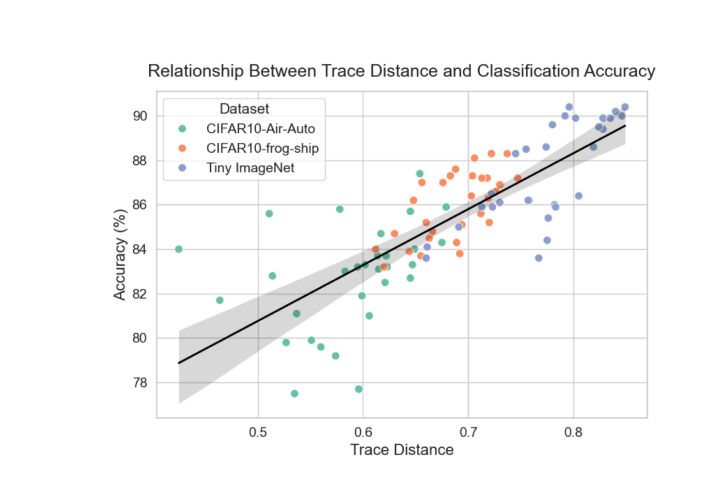
This study presents a novel classical-hybrid approach to optimising data embedding for quantum classification, moving beyond the limitations of standard quantum circuit models. Researchers investigated the performance of various models using the CIFAR-10 and Tiny ImageNet datasets, focusing on binary classification tasks involving images of airplanes, automobiles, frogs, ships, school buses, and maypoles. The core of the study centres on a technique that combines classical and quantum computation to improve the quality of data representation before classification. Experiments demonstrate a strong correlation between trace distance, a measure of embedding quality, and classification accuracy.
Detailed results show that using the ‘gc’ interface model consistently yields smaller trace distances compared to other models. Specifically, for the CIFAR-10 airplane and automobile classification task, the ‘gc’ model achieved a trace distance of 0. 511 with an accuracy of 85. 6%, while another model achieved 0. 623 with 83.
2%. For the CIFAR-10 frog and ship classification, the ‘gc’ model achieved a trace distance of 0. 511 with an accuracy of 85. 6%. These results demonstrate the effectiveness of the ‘gc’ interface model in improving both embedding quality and classification accuracy. The study also reports that performance remains stable as the number of qubits increases, indicating scalability without performance degradation.
Embedding Quality Drives Quantum Classification Performance
This research demonstrates a novel classical-hybrid approach to optimising data embedding for variational quantum circuits, addressing limitations inherent in standard computational models. By employing a technique that moves beyond completely positive and trace-preserving maps, the team successfully embedded multi-channel data and benchmarked performance using complex image datasets, including CIFAR-10 and Tiny ImageNet. Analyses reveal a strong positive correlation between trace distance, a measure of embedding quality, and classification accuracy, indicating that improved embedding directly contributes to enhanced performance in quantum classification tasks. Furthermore, the study systematically investigated the impact of different model architectures on the resulting trace distances. Results indicate that certain interface models consistently yield smaller trace distances, suggesting their superior effectiveness in preserving data structure during embedding. The authors acknowledge that optimisation variability and dataset characteristics also influence final results, and future work could explore methods to mitigate these factors and further refine the embedding process for even greater accuracy and robustness in quantum machine learning applications.
🗞 Multi-channel convolutional neural quantum embedding
🧠 ArXiv: https://arxiv.org/abs/2509.22355