

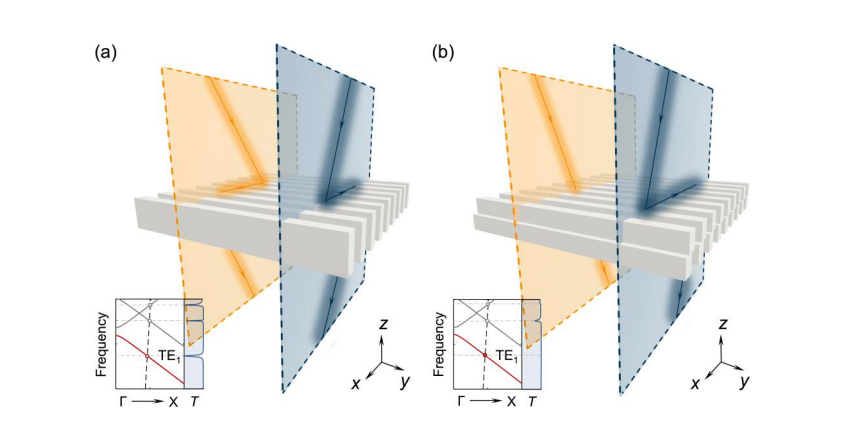
Research demonstrates control of the Goos-Hänchen shift, a phenomenon linked to wave behaviour, in transmission scenarios. This work achieves both enhancement and directional asymmetry of the shift, previously limited to reflection. This control expands potential applications including precision measurement and asymmetric optical switching. The Goos-Hänchen shift describes the transverse displacement of a light beam upon reflection or transmission.
The manipulation of light’s behaviour at interfaces represents a continuing area of research with implications for precision instrumentation and optical technologies. A team led by researchers at Nanjing University now details a method for precisely controlling the Goos-Hänchen shift, a phenomenon where a light beam experiences a lateral displacement upon reflection or transmission at an interface. This subtle shift, rooted in the wave nature of light and described by Fourier optics, typically occurs when light encounters a change in refractive index. The team, comprising Zhuolin Wu, Weiming Zhen, Zhi-Cheng Ren, Xi-Lin Wang, Hui-Tian Wang, and Jianping Ding, all affiliated with the National Laboratory of Solid State Microstructures and the School of Physics, present their findings in a paper entitled “Controlling Enhancement of Transmitted Goos-Hänchen Shifts: From Symmetric to Unidirectional”. Their work focuses on achieving enhanced and, crucially, directional control of this transmitted shift, moving beyond simple magnitude adjustments to enable asymmetric beam steering with potential applications in high-sensitivity measurement devices and advanced optical components.
Dislocated Layered Photonic Crystals (DLPCs) represent a novel approach to manipulating light, and recent research demonstrates substantial control over the Goos-Chén (GH) shift, a phenomenon where a light beam undergoes lateral displacement during reflection or transmission. This control extends beyond simply increasing the magnitude of the shift, to actively directing its orientation, transitioning from symmetrical enhancement to asymmetrical, unidirectional behaviour. The GH shift arises from internal reflections within a medium, causing a phase change that results in a small sideways displacement of the beam.
Traditionally, investigations into the GH shift have concentrated
Traditionally, investigations into the GH shift have concentrated on reflected beams, a comparatively simpler scenario. This work successfully demonstrates control over the GH shift occurring in transmission, a more technically demanding achievement. Researchers achieve this control by engineering specific dislocations within the layered photonic crystal structure, altering the way light propagates through the material. Photonic crystals are periodic optical nanostructures that affect the motion of photons in much the same way that the periodic potential in a semiconductor crystal affects the motion of electrons.
The enhanced GH shift facilitated by DLPCs translates directly into a highly sensitive refractive index sensor. Refractive index, a measure of how light bends when passing through a substance, changes with the composition and density of the material. Calculations indicate a maximum sensitivity of approximately 6.570 x 10⁶ nm/RIU (nanometres per Refractive Index Unit), remaining consistently above 1.0 x 10⁶ nm/RIU across a broad spectrum. This level of sensitivity surpasses many existing sensing technologies, potentially enabling the detection of minute changes in a material’s properties.
The research also reveals a nuanced understanding of light-matter interaction within the designed photonic crystal. Specifically, the scattering responses of dislocated and non-dislocated elements are demonstrated to be equivalent, suggesting that the dislocations primarily influence the direction of propagation rather than altering the fundamental scattering process. This finding is crucial for optimising the design of DLPCs for specific applications.
Numerical simulations corroborate the theoretical predictions, validating the
Numerical simulations corroborate the theoretical predictions, validating the accuracy of the models used to describe the behaviour of light within the DLPC structure. These simulations employed computational electromagnetics to model the propagation of light through the complex nanostructure, confirming the observed enhancement and directional control of the GH shift.
Future research will focus on miniaturising these DLPC structures to facilitate their integration into practical devices. Investigations into the performance of these structures with more complex incident beams, such as those carrying orbital angular momentum, are also planned. Furthermore, exploring the potential for dynamically controlling the GH shift through external stimuli, such as electric or magnetic fields, could unlock new functionalities for these photonic devices.
🗞 Controlling Enhancement of Transmitted Goos-Hänchen Shifts: From Symmetric to Unidirectional
🧠 DOI: https://doi.org/10.48550/arXiv.2506.16913


