Frequency combs, precise patterns of energy spacing arising from nonlinear dynamics, traditionally appear in optics but now extend to the realm of solid-state physics, offering new avenues for controlling energy and information. Christopher Heins, Amelie Fehrmann, and Lukas Körber, working at Helmholtz-Zentrum Dresden-Rossendorf, alongside colleagues including Joo-Von Kim and Attila Kákay, demonstrate deterministic control of these frequency combs in magnetic materials using precisely timed voltage pulses. The team successfully engineers these combs within magnetic vortices, controlling energy transfer between magnons, the fundamental units of spin waves, and the vortex core, even initiating or suppressing them below typical instability thresholds. This achievement establishes magnetic vortices as a robust platform for ‘Floquet engineering’, potentially bridging nonlinear spin dynamics with advanced frequency conversion and coherent spin-based technologies.
Frequency combs, characterized by precisely spaced energy levels, emerge from nonlinear dynamics in many physical systems. Extending this concept to collective excitations in solids, such as magnons, the quanta of spin waves in magnetically ordered materials, offers a powerful route to control energy flow and information processing. This research demonstrates deterministic control of Floquet-engineered magnon frequency combs in magnetic vortices using nanosecond voltage pulses, establishing a pathway towards manipulating energy and information at the nanoscale.
Microwave Control of Vortex Core Gyration
This research reveals the ability to control vortex core gyration in a nickel-iron disk using short, pulsed microwave fields. These pulses induce and control the excitation of Floquet magnons, which then drive the vortex core into circular motion. This allows for dynamic control of the vortex state, potentially useful for information storage and processing. Researchers used time-resolved Brillouin Light Scattering (BLS) microscopy and micromagnetic simulations to study this phenomenon, providing detailed insights into the underlying physics.
Voltage Pulses Steer Magnon Frequency Combs
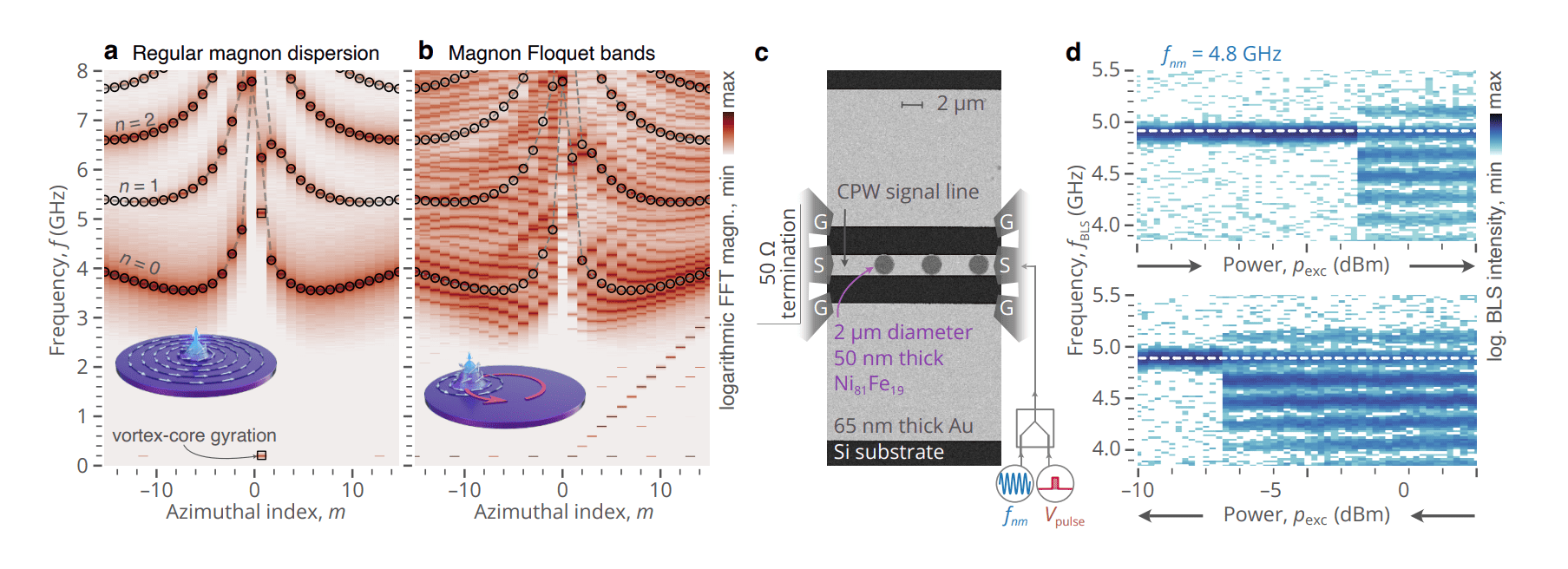
Scientists demonstrate deterministic control of Floquet-engineered magnon frequency combs in magnetic vortices using nanosecond voltage pulses, establishing a robust platform for manipulating energy flow in condensed matter systems. The research centers on controlling nonlinear energy transfer between magnons and the vortex core, enabling initiation or suppression of frequency combs even when conditions do not naturally support them. By carefully tuning pulse duration and timing, the team achieved coherent steering of this energy exchange, allowing on-demand generation and suppression of frequency combs. Experiments involved patterning 2 micrometer-diameter, 50 nanometer-thick nickel-iron disks onto a coplanar waveguide, then exciting them with a combination of a continuous microwave signal and nanosecond voltage pulses.
Brillouin light scattering microscopy revealed the emergence of distinct magnon frequency combs at sufficiently high excitation powers, demonstrating the onset of nonlinear scattering processes and self-induced Floquet magnon states. The team observed a clear hysteresis in the data, indicating a threshold behavior in the nonlinear magnon-magnon interaction. Under strong driving amplitudes, a single high-frequency magnon mode can self-induce Floquet magnons, spontaneously generating a frequency comb from a monochromatic excitation. In this active state, the vortex core becomes effectively undamped, sustaining auto-oscillation driven purely by magnon torque. Analysis of the spectra revealed the formation of additional Floquet sidebands and avoided crossings, reshaping the regular magnon dispersion and confirming the successful engineering of these frequency combs. These results establish magnetic vortices as a model platform for time-domain control of nonlinear spin dynamics, opening new pathways toward reconfigurable frequency combs.
Pulsed Control of Magnon Frequency Combs
Researchers have demonstrated precise control over magnon frequency combs within magnetic vortices using short voltage pulses. This work establishes a method for initiating or suppressing these combs, even below the threshold at which they would spontaneously appear, by carefully adjusting pulse duration and timing. The strong interaction between magnons and the vortex core allows sustained oscillations once initiated, or a return to a static state on demand. This achievement reveals that pulsed driving can coherently manipulate nonlinear excitations in magnetic systems, offering phase-controlled switching of magnon dispersions.
Compared to continuous driving methods, the use of short, precisely timed pulses improves efficiency and selectivity in exciting the vortex core. The team also showed that employing two separate pulses introduces an additional level of control, enabling phase-sensitive on/off switching of the magnon comb. While acknowledging the complexity of the system, the researchers highlight the potential for this approach to contribute to reconfigurable spintronic oscillators and neuromorphic computing architectures. This work establishes a fundamental principle for time-domain control in nonlinear wave systems, and provides a flexible platform for future magnonic devices.
👉 More information
🗞 Coherent control of Floquet-engineered magnon frequency combs
🧠 ArXiv: https://arxiv.org/abs/2511.01577