

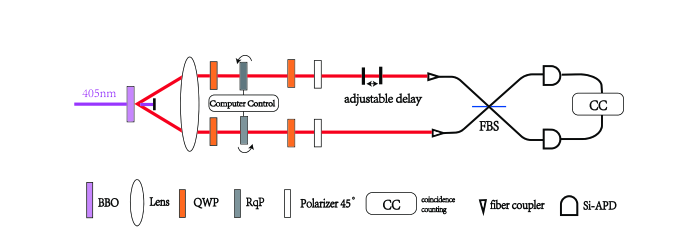
Researchers demonstrate continuous generation of entangled photon pairs using spontaneous parametric down-conversion and q-plate rotation, achieving flexible frequency entanglement without pre-set limitations. Analysis via joint spectrum calculation and Hong-Ou-Mandel interference enables reconstruction of the entanglement state in frequency space.
The manipulation of quantum entanglement, a phenomenon where two or more particles become linked and share the same fate regardless of the distance separating them, continues to be a central focus in the development of quantum technologies. Researchers are increasingly exploring methods to generate and control entanglement in diverse degrees of freedom, moving beyond traditional polarisation or spatial modes. A new approach, detailed in a recent publication, demonstrates the generation of frequency entanglement, a correlation in the frequencies of paired photons, through a combination of spontaneous parametric down-conversion – a process where a photon splits into two lower-energy photons within a nonlinear crystal – and the rotation Doppler effect, achieved by rotating specifically designed optical elements called q-plates. Bolong Yi, Ling Chen, and Baocheng Zhang, all from the School of Mathematics and Physics at the China University of Geosciences, present their findings in a paper entitled “Generation of frequency entanglement by rotating Doppler effect”, outlining a method for continuous generation of entangled photon pairs and offering enhanced control over their frequency characteristics at room temperature. Their analysis, utilising calculations of the joint spectrum and Hong-Ou-Mandel interference – a phenomenon demonstrating the indistinguishability of photons – allows for reconstruction of the entanglement state in the frequency domain, potentially benefiting applications in quantum information processing.
Quantum photonics witnesses a notable development with a new technique for generating continuous frequency entanglement in photon pairs. Researchers produce these entangled states via type-II spontaneous parametric down-conversion, coupled with manipulation utilising the rotational Doppler effect induced by rotating q-plates. This innovative approach circumvents the limitations of pre-set discrete frequency entanglement, offering substantial flexibility in controlling the properties of entangled photons and broadening the scope of quantum information processing. Crucially, they achieve this manipulation at room temperature, simplifying experimental requirements and expanding potential applications.
The team actively shapes the joint spectrum of
The team actively shapes the joint spectrum of the down-converted photons, enabling arbitrary modification of frequency entanglement across a wide range and overcoming limitations inherent in traditional static entanglement schemes. Validation of the generated entanglement occurs through combined calculations of the joint spectrum and Hong-Ou-Mandel interference, confirming the presence of quantum correlations and providing a robust verification of their methodology. These calculations allow reconstruction of a restricted density matrix within the frequency space, providing a detailed quantitative measure of entanglement quality and ensuring the reliability of the generated states.
Quantum photonics benefits from this development as it addresses the need for flexible and continuous entanglement sources, moving beyond traditional methods reliant on discrete frequency entanglement, which limits flexibility and bandwidth. This new approach offers enhanced control over the properties of entangled photons and paves the way for more sophisticated quantum communication and information processing protocols. The method’s operation at room temperature further simplifies implementation and broadens potential applications, making it a practical solution for a wide range of technologies.
Researchers initiate the process by employing type-II spontaneous parametric down-conversion within a nonlinear crystal, generating photons with orthogonal polarisations and establishing the foundation for subsequent entanglement manipulation. They then introduce rotating q-plates, optical elements that modify the polarisation state of light, inducing a frequency shift via the rotational Doppler effect and actively ‘tuning’ the entanglement. This effect arises because the photons experience a change in frequency as they interact with the rotating q-plate, enabling precise control over the entangled state.
The team analyses the generated entanglement state through a combined calculation of the joint spectrum and Hong-Ou-Mandel interference, providing a comprehensive characterisation of the entangled state and verifying the effectiveness of their dynamic manipulation techniques. The Hong-Ou-Mandel effect, a phenomenon where indistinguishable photons exhibit interference, serves as a crucial diagnostic tool for verifying entanglement and confirming the quantum correlations between the photons. This combined analysis allows for the reconstruction of a restricted density matrix within the frequency space, providing a detailed quantitative measure of entanglement quality and ensuring the reliability of the generated states.
This research demonstrates a novel method for generating
This research demonstrates a novel method for generating frequency entanglement, enabling the continuous production of entangled photon pairs utilising a hybrid degree of freedom through post-manipulation techniques. This allows for the arbitrary modification of frequency-entangled photons across a broad frequency range at room temperature, offering increased versatility for quantum information processing tasks and simplifying experimental setups. Researchers achieve this by leveraging the principles of spontaneous parametric down-conversion, where a photon splits into two lower-energy photons, termed the signal and idler, and coupling it with the rotational Doppler effect induced by rotating q-plates.
🗞 Generation of frequency entanglement by rotating Doppler effect
🧠 DOI: https://doi.org/10.48550/arXiv.2506.09488


