The nature of black holes and the limits of Einstein’s theory of General Relativity remain fundamental questions in astrophysics, and scientists continually seek ways to probe the extreme environments around these enigmatic objects. Anirban Dasgupta and Indrani Banerjee, both from the National Institute of Technology, Rourkela, along with their colleagues, investigate a specific alternative to the standard black hole model, known as the Simpson-Visser spacetime, which offers a singularity-free description. Their work focuses on high-frequency quasi-periodic oscillations observed in black hole power spectra, frequencies that arise from the motion of matter around these objects, and explores how these oscillations might constrain the properties of the Simpson-Visser spacetime. By testing eleven established models against observations from six black hole sources, the team achieves new spin constraints and identifies favoured models for each source, ultimately revealing that current data cannot yet distinguish between the predictions of General Relativity and this alternative spacetime, suggesting a need for further investigation into potential deviations from established physics in the strong gravity regime near black holes.
Black Hole Spin and Accretion Disk Dynamics
Current research focuses on understanding black hole behavior, particularly how spin influences surrounding material. Scientists are refining methods to measure black hole spin, analyzing the precession of accretion disks, the spectral characteristics of reflected X-rays, and emitted radiation. These measurements validate theoretical models and provide insights into the extreme environments near black holes. Investigations also explore quasi-periodic oscillations, variations in X-ray emission, to probe spacetime around these objects. A central theme is the detailed study of accretion disks, swirling masses of gas and dust orbiting black holes.
Researchers model their radiative properties and dynamics to better understand observed emission. Specific black hole systems, including GRO J1655-40, XTE J1859+109, GRS 1915+105, H1743-322, and Sagittarius A*, serve as key testbeds for these investigations. Scientists are also exploring how alternative theories of gravity might affect black hole properties and observational signatures. The research community pursues multiple spin measurement methods, comparing results for accuracy and consistency. Precise measurements of black hole spin and spacetime geometry are essential for rigorously testing Einstein’s theory of general relativity. Understanding the complex physics of accretion disks is a major focus, with researchers striving to develop more accurate models that explain observed emission. The team employed the Simpson-Visser metric to model spacetime around rotating black holes, extending previous work on static, non-rotating solutions. To understand particle motion within the Simpson-Visser spacetime, scientists calculated epicyclic frequencies, describing the orbital and vertical oscillations of particles in circular orbits.
This involved deriving an effective potential governing particle motion, utilizing conserved quantities like energy and angular momentum, and solving the equations of motion to determine the frequencies. The resulting expressions for the epicyclic frequencies depend on the black hole’s mass, spin, and a regularizing parameter, providing a means to connect theoretical models to observational data. The team compared these theoretical predictions with observed HFQPO frequencies from six black hole sources, systematically varying the black hole’s spin and the regularizing parameter to find the best fit to the observed data. Sophisticated simulations were employed to refine parameter constraints and assess uncertainties. By comparing the resulting constraints with independent spin estimates, researchers aimed to identify the observationally favored models for each source and determine whether the data support the Simpson-Visser scenario or favor the standard Kerr black hole solution.
Regular Black Holes Constrain Quasi-Periodic Oscillations
Scientists are investigating regular black holes, alternatives to standard models, to explore the boundary between classical physics and strong gravity. This work focuses on the Simpson-Visser spacetime and its influence on high-frequency quasi-periodic oscillations (HFQPOs) observed in black hole power spectra. The research team explored how a regularizing parameter within the Simpson-Visser spacetime affects the orbital and epicyclic frequencies of test particles moving around the black hole. The team tested eleven established HFQPO models against data from six black hole sources, obtaining spin constraints and identifying the observationally favored models for each source.
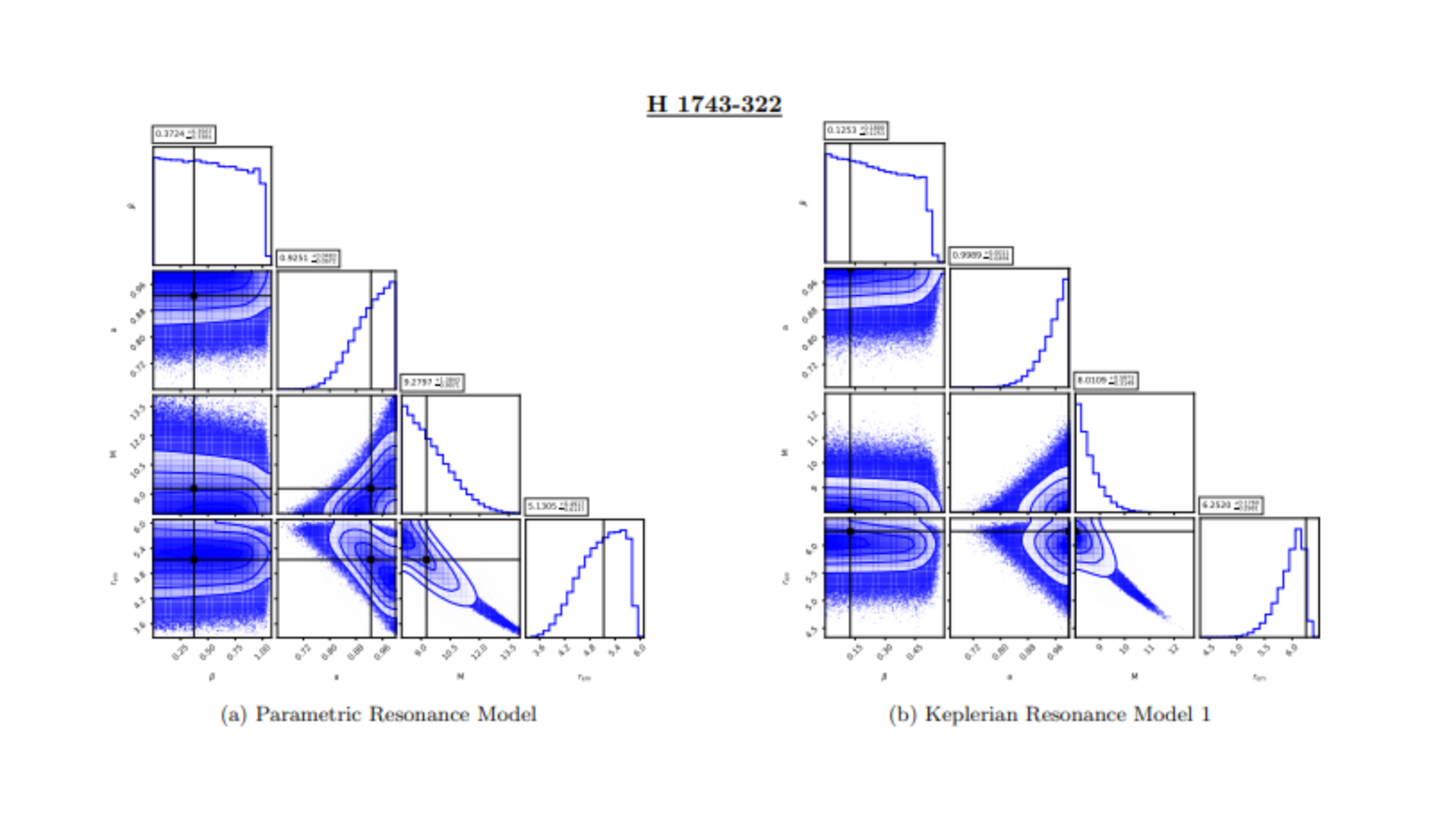
Results demonstrate that, based on current data, the favored models cannot definitively distinguish between the Kerr black hole scenario and the Simpson-Visser scenario. Specifically, scientists analyzed how the quality of the fit varies with the regularizing parameter for each black hole source. For several sources, the best fit occurs with a regularizing parameter close to zero. The team established confidence intervals, ruling out certain values of the regularizing parameter based on the data. These results indicate that all six black holes studied are consistent with the Kerr scenario within a certain level of confidence.
HFQPOs Constrain Regular Black Hole Spacetime
This work investigates the potential of high-frequency quasi-periodic oscillations (HFQPOs) observed in black holes as a means to probe the strong gravity regime and test alternatives to standard general relativity. Researchers explored the Simpson-Visser (SV) spacetime, a regular black hole solution avoiding the singularities predicted by general relativity, by examining the influence of a regularizing parameter on observed HFQPOs. The team compared observations from six black hole sources with predictions from eleven established HFQPO models, estimating model parameters using robust techniques. The analysis reveals that, for the studied sources, the observationally favored models cannot definitively distinguish between the predictions of the standard Kerr black hole and the Simpson-Visser scenario.
Specifically, for GRO J1655-40, certain models provided the most consistent explanations, suggesting a preference for either a Kerr black hole or a very small regularizing parameter. The team acknowledges that existing discrepancies in independent spin estimates for these black holes may indicate deviations from general relativity, but further investigation is needed. Researchers note that the current data do not allow for strong constraints on the regularizing parameter, and future work will focus on obtaining more precise HFQPO observations and exploring a wider range of theoretical models. The reliability of the obtained parameter estimates was carefully tested. This research contributes to the ongoing effort to.
👉 More information
🗞 Constraining the rotating Simpson-Visser spacetime from the observed quasi-periodic oscillations in black holes
🧠 ArXiv: https://arxiv.org/abs/2509.15761