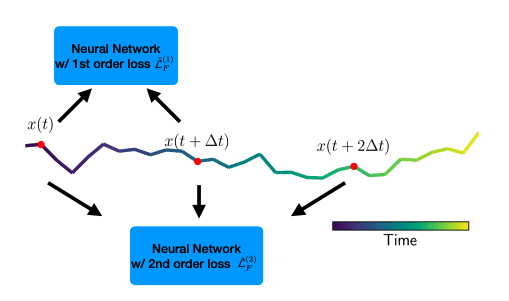
On April 26, 2025, Jinghao Lyu, Kyle J. Ray, and James P. Crutchfield introduced Learning Stochastic Thermodynamics Directly from Correlation and Trajectory-Fluctuation Currents, a study that bridges machine learning with stochastic thermodynamics by developing loss functions to estimate entropy production directly from system dynamics without relying on traditional TURs.
The research focuses on inverse dynamics problems in small systems with stochastic behaviour, using Langevin dynamics and currents for modelling. A connection between cumulant currents and machine learning loss functions is established without relying on thermodynamic uncertainty relations (TURs). This approach accurately estimates key thermodynamic quantities, including per-trajectory entropy production even in far-from-steady-state conditions. The method unifies dynamic inference with entropy production estimation, revealing a link between diffusion models in machine learning and stochastic thermodynamics.
Entropy production is a pivotal concept in thermodynamics, serving as a measure of irreversibility in physical systems. It is crucial for understanding energy flow and dissipation, with applications spanning physics, engineering, and beyond. Traditionally, estimating entropy production has demanded detailed knowledge of system dynamics, often unattainable in complex real-world scenarios. Recent innovations in deep learning have opened new pathways, enabling estimation without explicit dynamic knowledge. This article explores these advancements, focusing on overdamped dynamical systems and Markovian jump processes.
In overdamped systems, characterized by continuous state changes, traditional entropy production estimation relies on temporal score functions measuring probability distribution evolution over time. However, this approach requires detailed dynamic knowledge, often challenging to obtain. Deep learning addresses this by estimating entropy production through empirical currents constructed using learned weights from data. Neural networks optimize these weights, allowing analysis of complex systems where conventional methods may not apply.
For discrete state systems governed by Markovian jump processes, characterized by abrupt state transitions, deep learning introduces the concept of generalized thermodynamic forces to quantify irreversibility. Researchers estimate entropy production without explicit transition probability knowledge by training neural networks to learn this force from data.
The application of deep learning to estimate entropy production marks a significant advancement in understanding irreversibility. This approach enables studying complex systems where traditional methods may not be feasible, opening new research and practical applications across various fields. As deep learning evolves, further sophisticated approaches can enhance our grasp of fundamental thermodynamic principles, promising exciting future developments.
👉 More information
🗞 Learning Stochastic Thermodynamics Directly from Correlation and Trajectory-Fluctuation Currents
🧠 DOI: https://doi.org/10.48550/arXiv.2504.19007