The quest to discover and design new materials with tailored properties receives a significant boost from a novel computational framework, exa-AMD, developed by Weiyi Xia, Maxim Moraru from Los Alamos National Laboratory, Ying Wai Li from Los Alamos National Laboratory, and Cai-Zhuang Wang from Ames National Laboratory, Iowa State University, et al. This new code tackles the immense computational demands of modern materials science by employing advanced parallelisation techniques and optimised data management, enabling simulations on a scale previously unattainable. exa-AMD automates the entire process, from initial elemental input to predicting stable material structures and energies, and ultimately updating phase diagrams, thereby accelerating the discovery of promising candidates. By providing a robust and extensible tool ready for the next generation of exascale computers, this work promises to transform materials science and facilitate the design of innovative materials with unprecedented efficiency.
AI Accelerates Materials Discovery with High-Throughput Computation
This work details exa-AMD, a scalable workflow designed to accelerate materials discovery and design using artificial intelligence. The system combines machine learning with high-throughput computational materials science to efficiently explore vast chemical spaces and identify promising materials, overcoming the limitations of traditional trial-and-error methods. The workflow incorporates AI-driven exploration using machine learning models to predict material properties, high-throughput calculations employing density functional theory to validate predictions, and an adaptive genetic algorithm for crystal structure prediction, allowing exploration of complex arrangements. exa-AMD utilizes open-source software, allowing for customization and collaboration, and enables the design of materials with specific desired properties. Successful applications include the discovery of rare-earth-free magnetic materials, the search for stable and metastable Ce-Co-Cu ternary compounds, and the discovery of Fe-Co-Zr magnets with tunable magnetic anisotropy, demonstrating its versatility in general materials discovery and design.
Automated Materials Discovery with Machine Learning and DFT
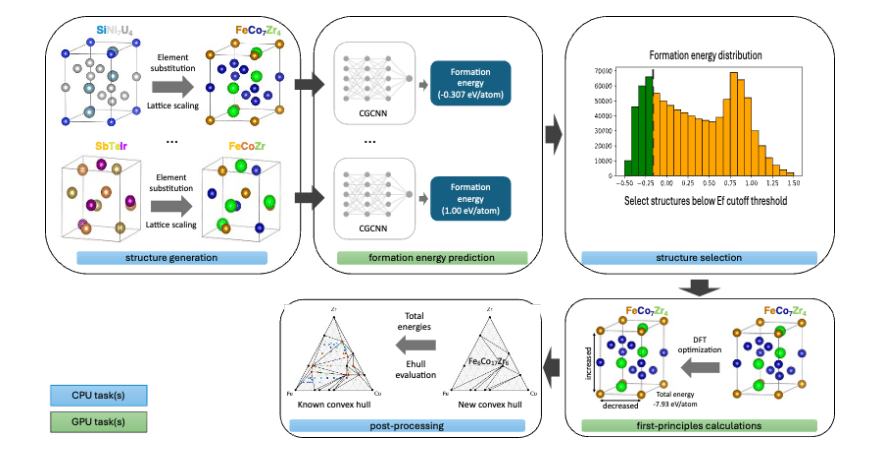
Scientists developed exa-AMD, a new framework for accelerated materials discovery, addressing the computational challenges of exploring complex chemical spaces. The study pioneers a modular workflow that automates structure generation using template substitution, rapidly screening candidates with machine learning models before validating results with density functional theory calculations. This approach efficiently filters potential materials based on energy thresholds and structural similarity, then computes convex hulls to assess thermodynamic stability, enabling the discovery of both stable and metastable compounds. The research team engineered a system that integrates data mining, machine learning, workflow automation, and first-principles computation into a unified framework.
exa-AMD employs the Parsl library for dynamic task distribution across CPU and GPU clusters, maximizing computational efficiency and scalability. Scientists harness machine learning models to predict formation energies and stability metrics, significantly reducing screening time while maintaining predictive reliability, crucial for tackling complex problems like designing novel battery materials requiring multi-objective optimization of stability and synthesizability. The study demonstrates exa-AMD’s effectiveness by applying it to the design of Fe-Co-Zr and Na-B-C compounds, automating the workflow, outputting structures and energies of promising candidates, and updating phase diagrams. The framework supports elastic scaling on high performance computing platforms, enabling discovery within hours to days. Researchers made exa-AMD publicly available on GitHub, complete with detailed documentation and reproducible test cases to encourage community engagement and collaborative research, advancing materials science by providing a robust, efficient, and extensible tool ready for exascale platforms.
Exa Workflow Accelerates Materials Discovery and Screening
Scientists have developed a new computational workflow, exa-, designed to accelerate the discovery of novel materials through high-throughput screening and machine learning integration. This work addresses the computational challenges inherent in exploring vast chemical spaces, particularly for multinary systems where the number of potential materials grows exponentially. The team implemented a modular system automating structure generation, stability screening, and thermodynamic assessment on both CPU and GPU-enabled clusters. Experiments demonstrate that exa- efficiently filters candidate materials by energy thresholds and structural similarity, enabling the rapid computation of convex hulls for assessing thermodynamic stability.
The workflow leverages machine learning models to predict formation energies, significantly reducing the computational cost compared to traditional density functional theory calculations. This data-driven approach accelerates screening, potentially reducing analysis time while maintaining predictive reliability. The team successfully applied exa- to the design of Fe-Co-Zr and Na-B-C compounds, illustrating its effectiveness in identifying promising materials candidates. By automating the workflow and integrating machine learning, exa- enables the exploration of significantly larger chemical spaces than previously possible, delivering a robust and extensible tool ready for deployment on exascale computing platforms, paving the way for accelerated materials discovery and innovation. The system’s modular design supports elastic scaling on high performance computing platforms, allowing researchers to efficiently explore complex materials spaces.
Exa-AMD Accelerates Multinary Material Discovery
This work presents exa-AMD, a new computational framework designed to accelerate the discovery of materials, particularly within complex multinary systems. The code automates workflows for generating, screening, and validating potential material structures, leveraging both machine learning and density functional theory calculations. By efficiently managing computational tasks across high-performance computing clusters, exa-AMD significantly reduces the time required to identify promising candidate materials from a user-defined set of elements. The achievement lies in the integration of several key components, including automated structure generation, machine learning-accelerated screening, and scalable parallel computing, enabling researchers to explore vast compositional spaces and predict the stability of novel compounds, moving beyond the limitations of traditional materials discovery methods.
The framework’s modular design and support for both CPU and GPU architectures further enhance its versatility and adaptability to diverse computing environments. Future development will likely focus on expanding the framework’s capabilities to incorporate more sophisticated structure generation techniques and explore a wider range of materials compositions. The publicly available code, complete with documentation and test cases, facilitates collaborative research and encourages further advancements in computational materials science.
👉 More information
🗞 exa-AMD: An Exascale-Ready Framework for Accelerating the Discovery and Design of Functional Materials
🧠 ArXiv: https://arxiv.org/abs/2510.01170