Spin glass systems, complex lattices of disordered magnets, present a significant challenge in both fundamental magnetism research and the development of algorithms for hard combinatorial optimization problems. Fredrik Hasselgren from the University of Oxford and Quantum Dice Ltd, alongside Max O. Al-Hasso and Amy Searle from Quantum Dice Ltd, and Joseph Tindall from the Flatiron Institute, now demonstrate a new approach to solving these intricate systems using probabilistic computing. Their work focuses on complex spin glass topologies, solved through a simulated probabilistic computing realization of an Ising machine, and reveals that the number of computational steps needed to find high-quality solutions scales independently of system size after a certain point, assuming full hardware parallelization. This constant scaling, maintained across varying solution qualities, suggests that probabilistic computing architectures can offer a powerful advantage over existing methods by exchanging computational depth for parallel width, and the team shows their architecture can achieve comparable results to state-of-the-art annealers in a fraction of the time, with Marko von der Leyen also contributing from the University of Oxford and Quantum Dice Ltd.
Spin Glasses Benchmark Optimisation Algorithms
Research into combinatorial optimization utilizes spin glass models as a crucial benchmark. These models, representing disordered magnetic systems, possess complex energy landscapes that rigorously test the capabilities of new optimization algorithms with applications in logistics, finance, and machine learning. Scientists are investigating both quantum annealing and probabilistic computing as potential solutions, aiming to surpass the limitations of classical algorithms. A significant focus lies on developing specialized hardware, including quantum annealers, Ising machines, and probabilistic computers utilizing probabilistic bits (p-bits). Improving the connectivity of these machines is a key challenge, with researchers exploring various topologies to enhance performance and scalability. Alongside hardware development, scientists are creating and benchmarking new algorithms on challenging problems like spin glass instances, fostering a highly interdisciplinary field of research.
Probabilistic Computing Solves Complex Spin Glasses
Scientists have developed a novel probabilistic computing (PC) architecture that effectively tackles complex spin glass topologies, demonstrating a significant advancement in solving challenging optimization problems. The research focused on three-dimensional Edwards-Anderson cubic spin-glasses, both randomly generated and previously documented, to establish a performance baseline. Researchers identified biclique topologies as particularly promising, simulating various sizes to assess their potential. Experiments employed a simulated PC realization of an Ising machine, allowing scientists to explore the scaling behavior of solution quality with system size.
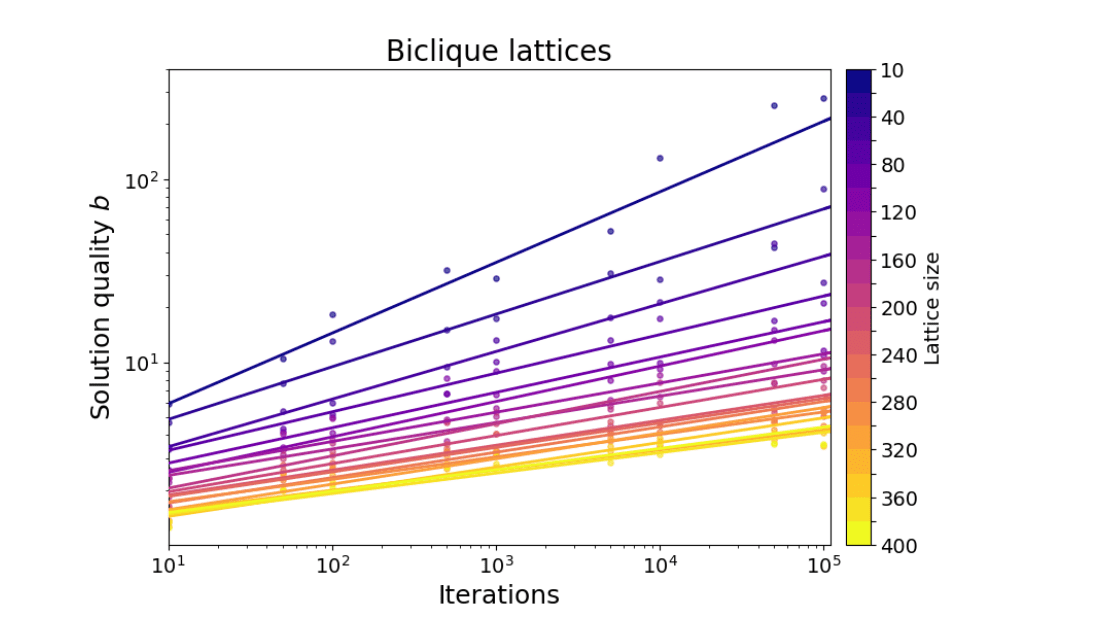
The team discovered that, assuming perfect parallelization, the number of iterations required to find solutions of a given quality exhibited constant scaling with system size beyond a certain saturation point. This suggests the PC architecture can effectively trade computational depth for parallelized width, connecting a number of p-bits that scales linearly with system size. This constant scaling persisted across various solution qualities, and the PC architecture could solve spin-glass topologies to the same quality as the most advanced quantum annealer in a matter of minutes, based on reasonable assumptions regarding hardware implementation. By framing the problem as a weighted max-cut, scientists leveraged theoretical limits of algorithmic efficiency to contextualize the performance gains achieved with the PC architecture, offering a promising pathway for tackling complex optimization problems.
Constant Scaling Solves Complex Spin Glasses
Scientists have achieved significant advancements in solving complex spin glass problems using a probabilistic computing (PC) architecture, demonstrating a novel approach to combinatorial optimization. The research centers on solving spin glass topologies using a simulated PC realization of an Ising machine, employing probabilistic bits (p-bits) to represent the system’s state. Experiments involved both randomly generated three-dimensional Edwards-Anderson cubic spin-glasses and benchmark topologies, alongside biclique structures investigated for performance advantages. Results demonstrate that the number of iterations required to find solutions of a given quality exhibits constant scaling with system size, beyond a saturation point, assuming perfect parallelization.
This means the computational time does not increase proportionally with the complexity of the problem, a crucial breakthrough for tackling large-scale optimization challenges. The constant scaling persists across various solution qualities, and the PC architecture achieves solution qualities comparable to the most advanced annealers in a matter of minutes, with modest assumptions regarding hardware implementation. Specifically, the team observed significant time-to-solution improvements for a max-cut problem compared to Quantum Adiabatic Computers and Coherent Ising Machines, and a substantial improvement over classical CPU algorithms. The research also details the importance of update groups, sets of p-bits that can be updated in parallel, for maximizing computational speedup. For balanced lattices, the PC architecture achieves optimal performance with bi-partite update groups, maximizing both the number and size of these parallelizable units, establishing a promising pathway for developing efficient algorithms for complex optimization problems.
Probabilistic Computing Solves Complex Spin Glasses Quickly
This work demonstrates a probabilistic computing (PC) approach to solving complex spin-glass topologies, achieving solution qualities comparable to state-of-the-art annealing devices in a fraction of the time. Researchers successfully solved randomly generated and benchmark cubic spin-glasses using a simulated PC architecture, revealing a constant scaling of computational effort with system size beyond a saturation point, assuming full hardware parallelization. This suggests a potential trade-off between the depth of other methods and the parallel width offered by a PC implementation, where the number of connected probabilistic bits scales linearly with system size. The team achieved solution qualities as high as b ≈10⁵ for smaller systems, and observed a strong relationship between solution quality and the number of iterations required. While acknowledging limitations in extrapolating these results due to the variance in random datasets, the findings indicate the potential for significantly improved performance with a dedicated hardware implementation. Future research directions include optimizing the annealing schedule and exploring alternative solving methods to further reduce computational complexity and potentially unlock even greater speedups, highlighting the need for a fully benchmarked hardware implementation to investigate the role of quantum behavior in achieving these results.
👉 More information
🗞 Probabilistic Computing Optimization of Complex Spin-Glass Topologies
🧠 ArXiv: https://arxiv.org/abs/2510.23419