Researchers are increasingly exploring ways to perform computation directly within the physical properties of materials, offering the promise of energy-efficient, rapid data processing. Sreeveni Das, Rhodri Mansell, and Aarne Piha, from Aalto University, alongside colleagues including Lukáš Flajšman and Maria-Andromachi Syskaki, now demonstrate a new approach using a lithium-based magneto-ionic device that functions as a ‘reservoir’ for forecasting complex, chaotic patterns in time-varying data. This innovative device encodes information using voltage signals and reads out results by analysing magnetic patterns, achieving accurate predictions across different timescales. The team’s findings reveal how key design parameters, such as input speed and data smoothing, influence performance, and establish crucial principles for optimising these magneto-ionic systems for diverse applications requiring real-time analysis of dynamic data.
Physical Systems Simplify Reservoir Computing Training
Scientists have engineered a new type of computer that leverages the intrinsic dynamics of materials to process information, offering a potentially low-power alternative to traditional computing architectures. This research focuses on physical reservoir computing, a technique where a fixed physical system, the ‘reservoir’, processes input signals and a simple trainable output layer learns to produce the desired result. This contrasts with conventional neural networks where all components are trained, significantly simplifying the process. The team explored magneto-ionic materials as the basis for this physical reservoir.
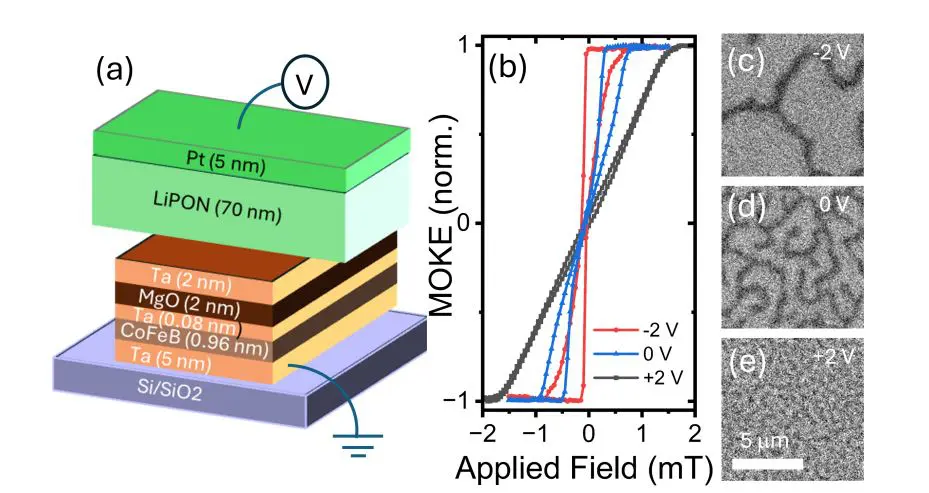
These materials allow control of magnetic properties, specifically tiny magnetic swirls called skyrmions, through the movement of ions driven by applied voltage. By carefully controlling the position, size, and density of these skyrmions, scientists can create a dynamic system capable of processing complex information. Different materials, including those based on nitrogen, oxygen, and lithium, were investigated for their suitability. The device consists of a layered structure where voltage application modulates the magnetic properties of a cobalt-iron-boron layer. Measurements using magneto-optical Kerr effect microscopy reveal how voltage alters the arrangement of magnetic domains, transitioning from broad stripes to denser, finer patterns.
This dynamic reconfiguration forms the basis of the reservoir’s computational ability. The team then tested the device by injecting a chaotic time series, known as the Mackey-Glass series, as input. Experiments demonstrate that the magneto-ionic device successfully predicts the chaotic Mackey-Glass time series, proving its ability to handle complex, dynamic data. The size and density of skyrmions within the material significantly influence performance, and slower input rates generally lead to more stable reservoir states. This research highlights the potential for building low-power neuromorphic computing systems that accelerate machine learning tasks by exploiting the inherent parallelism of physical materials. Future research will focus on optimizing material properties, exploring different reservoir architectures, and developing more sophisticated input and output schemes. This work opens up exciting possibilities for applying physical reservoir computing to more complex machine learning tasks and investigating other physical systems for building brain-inspired computing systems.
Lithium-Ion Migration Modulates Magnetic Anisotropy
Researchers have demonstrated a novel magneto-ionic device capable of forecasting chaotic time series, representing a significant step towards low-power, physical computing. The device utilizes a layered structure, meticulously fabricated with materials ranging in thickness from fractions of a nanometer to 70 nanometers. Applying voltage causes lithium ions to migrate within the material, altering its magnetic properties and creating a dynamic system for information processing. Measurements reveal that negative voltages enhance magnetic anisotropy, leading to broader magnetic stripe domains, while positive voltages suppress anisotropy, resulting in denser, finer patterns.
This dynamic reconfiguration of magnetic domains forms the basis of the device’s computational ability. The team then injected a chaotic Mackey-Glass time series into the device by mapping the signal onto a voltage range. Experiments conducted at varying input rates demonstrate how the device responds to different temporal dynamics. Analysis of the magnetic domain patterns reveals distinct changes with each voltage application. A spatial 2D Fourier transform of these patterns generates the reservoir signal, capturing the complex time evolution of the magnetic state.
The team observed that slower input rates yield more stable reservoir states, while faster rates induce more dynamic changes. These findings demonstrate the potential of magneto-ionic systems for advanced computing and provide design principles for optimizing performance based on input signal characteristics. The ability to control magnetic properties with voltage offers a pathway towards building low-power, real-time data processing systems.
Physical Reservoir Computing with Magneto-Ionic Devices
Scientists have engineered a novel magneto-ionic device capable of forecasting chaotic time series, achieving real-time data processing directly within a physical material. The device, measuring just over 100 micrometers in size, utilizes a layered structure where voltage application modulates the magnetic properties of a cobalt-iron-boron layer, enabling nonlinear dynamics crucial for temporal information processing. Measurements reveal that applying a negative voltage enhances magnetic anisotropy, while a positive voltage suppresses it, resulting in a transition from broad stripe domains to a denser, finer domain pattern. This dynamic reconfiguration of magnetic domains forms the basis of the device’s computational ability.
The team then injected a chaotic Mackey-Glass time series into the device by mapping the signal onto a voltage range. Experiments conducted at varying input rates demonstrate how the device responds to different temporal dynamics. Analysis of the magnetic domain patterns reveals distinct changes with each voltage application. A spatial 2D Fourier transform of these patterns generates the reservoir signal, capturing the complex time evolution of the magnetic state. Results show that slower input rates are more tolerant to smoothing, while faster rates degrade both memory capacity and processing. These findings establish the potential of magneto-ionic systems for advanced computing and offer design principles for optimizing performance based on input signal characteristics. The ability to control magnetic properties with voltage offers a pathway towards building low-power, real-time data processing systems.
Material Reservoir Forecasts Chaotic Time Series
This research demonstrates a novel magneto-ionic device capable of forecasting chaotic time series, representing a significant advance in the field of reservoir computing. Scientists successfully constructed a device where voltage-controlled magnetic domain patterns encode and process information, enabling the prediction of complex dynamics within a chaotic system. The findings reveal a critical interplay between system parameters and predictive performance. Short-term forecasting benefits from smoothed data and larger reservoir states, while accurate long-term prediction requires unsmoothed data, extended training, and maximal reservoir dimensionality.
Researchers observed a fundamental trade-off between nonlinearity and memory capacity, consistent with established principles in reservoir computing. The authors acknowledge that high voltages can saturate the magnetic response and that further optimization of device fabrication and readout strategies is needed. Future work should focus on tailoring reservoir characteristics to specific forecasting tasks and exploring the potential of these magneto-ionic systems for processing other complex time-series data. These results underscore the promise of this approach for low-power, real-time data processing and offer a pathway towards developing physical reservoirs for advanced computational applications.
🗞 Reservoir computing in a lithium-based magneto-ionic device
🧠 ArXiv: https://arxiv.org/abs/2511.08346