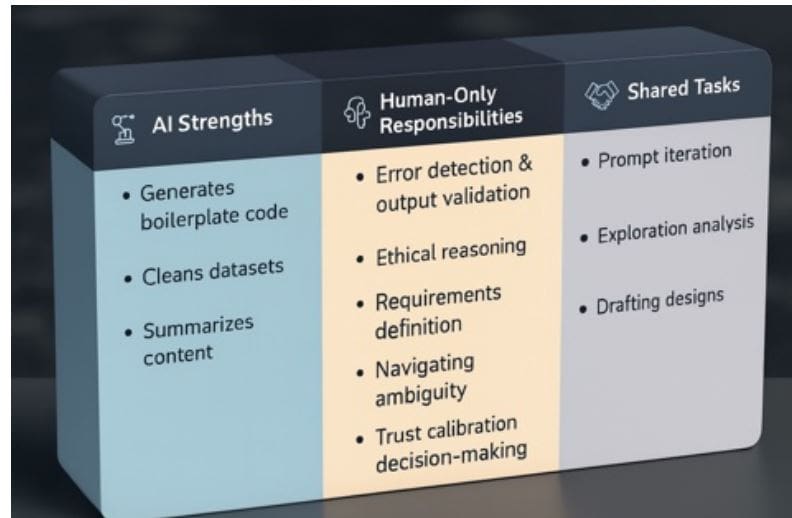
The ability to translate ideas into working computer programs has traditionally required mastering a programming language, but advances in artificial intelligence now promise to broaden access to computational power. Douglas C. Schmidt and Dan Runfola, both from William and Mary, investigate this shift, exploring how large language models are rapidly commoditising computational thinking and challenging established approaches to computer science education. Their work demonstrates that the focus is moving beyond coding itself, towards the ability to clearly articulate problems in natural language and critically evaluate the results produced by AI-powered tools. This research significantly impacts how educators prepare future generations of computational thinkers, ensuring they can harness the power of AI while upholding fundamental principles of computational science and effective problem-solving.
Prompt Engineering And The Future Of Software
The rise of Large Language Models (LLMs) and Generative AI is fundamentally changing software development and computational thinking. This isn’t about AI replacing humans, but augmenting them, leading to a new era of productivity and innovation. The core shift involves a move away from traditional coding as the primary skill, with prompt engineering, effectively communicating with LLMs, becoming increasingly important and potentially democratizing software creation. This allows developers to focus on higher-order thinking, such as problem definition, system architecture, design, testing, and ethical considerations, freeing them from more rote coding tasks.
Computational thinking is evolving to emphasize what to compute, not just how. AI-assisted programming tools like GitHub Copilot and ChatGPT are becoming integral to the development workflow by automating repetitive tasks and suggesting code snippets, demonstrably increasing developer productivity and driving company growth, a concept the authors term the ‘Developer Coefficient’. This changing landscape necessitates a re-evaluation of computer science education, with curricula needing to emphasize higher-level thinking, problem-solving, and AI integration. Universities are beginning to offer programs focused on AI studies and prompt engineering, and education should emphasize the importance of human oversight and ethical considerations in AI development.
The future envisions a shift from mastering programming languages to understanding the underlying logic and principles of computation, with LLMs acting as collaborative partners. This democratization of software creation is lowering the barrier to entry, allowing more people to participate in technology creation. Developers and educators must embrace AI tools and adapt their skills and curricula accordingly, focusing on creativity, critical thinking, and ethical judgment while AI handles routine tasks. Ethical considerations are paramount, and AI development must be guided by ethical principles and responsible innovation, ultimately creating a more innovative and productive world.
Prompt Engineering Evolves Into Structured Practice
Prompt engineering is maturing from initial experimentation into a discipline mirroring established software engineering practices. Early prompting was largely intuitive, but researchers discovered that carefully structured natural language inputs reliably shaped model outputs, establishing prompt engineering as a means of programming through AI, rather than programming the AI itself. This maturation is characterized by the adoption of reusable prompt patterns, techniques like chain-of-thought reasoning, and explicit planning, all designed to guide models toward more logical and consistent results. The work anticipates a third phase, “prompt engineering in-the-large”, where prompting transcends individual experimentation to become a scalable, professional discipline integrated into larger systems with rigorous practices analogous to traditional software development.
Quality assurance is paramount, requiring verification of AI outputs for accuracy and relevance. Teams must explore alternate phrasings and input scenarios to assess consistency and identify potential failure cases, alongside ongoing maintenance and version tracking as models evolve. Attention to integration is crucial, ensuring AI-generated components seamlessly interact with traditional systems, including robust error handling and prompt chaining. A scalable engineering mindset unlocks potential through curated libraries of validated prompt templates and the implementation of prompt design reviews. The maturation of AI tooling, including integrated development environments offering features to debug and optimize prompt flows, will solidify prompt engineering as a central discipline in future software development.
Natural Language Commoditizes Computational Thinking
Generative AI is commoditizing computational thinking, enabling individuals to harness computing power simply by articulating problems in natural language. Historically, applying computational thinking demanded fluency in languages like Python or Java, presenting a significant barrier to entry. Computing has progressed from requiring detailed knowledge of machine architecture to focusing on conceptual problem-solving, mirroring the evolution of the automobile industry from requiring mechanical expertise to simply steering. This transition is driven by AI assistants capable of generating code and analyzing information, blurring the line between writing and using programs.
AI agents can autonomously browse sources, explore datasets, and synthesize answers, functioning as tireless virtual research assistants. Non-experts can now rapidly generate non-trivial software, including web interfaces and data visualization tools. The core of computational thinking, logic, abstraction, decomposition, pattern recognition, generalization, and automation, remains vital, but the means of implementation is changing. Success in this new paradigm depends on fusing human creativity with machine intelligence to address challenges ethically and effectively.
AI Commoditizes Computational Thinking, Education Must Adapt
Generative AI is commoditizing computational thinking, prompting a re-evaluation of computer science and data science education. Instead of solely focusing on coding, curricula must now prioritize the development of critical thinking, solution design, and the ability to verify results generated by AI systems. Human oversight is crucial in an AI-augmented world, with a clear distinction between the ‘black box’ nature of some AI outputs and the layered reasoning characteristic of human judgment. There is an ‘optimal zone’ for AI-augmented learning, where AI supports routine tasks while learners continue to develop core reasoning skills, but over-reliance on AI could lead to intellectual atrophy. Challenges include maintaining academic integrity, addressing bias in AI training data, and mitigating the environmental costs of large-scale AI models, issues currently under discussion at institutions like William and Mary. Future work should focus on designing learning environments that actively.
👉 More information
🗞 Liberating Logic in the Age of AI: Going Beyond Programming with Computational Thinking
🧠 ArXiv: https://arxiv.org/abs/2511.17696