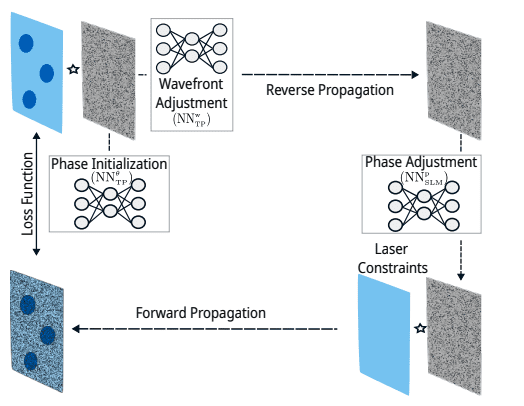
Researchers Ankit Amrutkar, Björn Kampa, Volkmar Schulz, Johannes Stegmaier, Markus Rothermel, and Dorit Merhof published Towards Robust and Generalizable Gerchberg Saxton based Physics Inspired Neural Networks for Computer Generated Holography: A Sensitivity Analysis Framework. This study introduces a sensitivity analysis framework focusing on Gerchberg-Saxton-based physics-inspired neural networks (GS-PINNs) for computer-generated holography (CGH). The research highlights that SLM pixel resolution significantly impacts performance and demonstrates the superiority of free space propagation forward models over Fourier holography, enhancing parameterisation and generalisation.
The study addresses challenges in computationally generated holography (CGH) by analysing how forward models (FMS) and hyperparameters (FMHS) affect Gerchberg-Saxton-based physics-inspired neural networks (GS-PINNS). Using Saltelli’s extension of Sobol’s method, the research identifies SLM pixel-resolution as the primary factor influencing GS-PINN sensitivity, followed by pixel-pitch, propagation distance, and wavelength. Free space propagation FMs outperform Fourier holography in terms of parameterization and generalization. A composite evaluation metric is introduced to benchmark CGH configurations, combining performance consistency, generalization capability, and hyperparameter resilience. The findings provide guidelines for selecting forward models, designing neural architectures, and evaluating performance, advancing robust and interpretable neural networks for diverse holographic applications.
The study delves into Gerchberg-Saxton (GS) phase retrieval performance using Physics-Informed Neural Networks (PINNs), or GS-PINN, across various forward models. Central to this research is a comparison between free-space propagation and Fourier holography, two methodologies pivotal in optical computing. The findings reveal that free-space propagation outperforms Fourier holography in terms of accuracy and image quality, consistently across different loss functions.
The study highlights the critical importance of scaling outputs to match the mean intensity of original images. This normalisation process plays a crucial role in facilitating accurate comparisons between free-space propagation and Fourier holography. The results underscore the superior performance of free-space propagation in preserving image fidelity, supported by statistical analysis confirming these findings.
The implications of this research are profound for industries reliant on holographic imaging, such as medical diagnostics and augmented reality. Improved image reconstruction could lead to more accurate diagnostic tools and enhance the immersive experience of AR applications. This advancement elevates the practicality of holographic displays and underscores the necessity of selecting appropriate forward models in optical computing systems.
In conclusion, this study provides invaluable insights for developers working on next-generation optical systems. While it highlights the advantages of free-space propagation, it also acknowledges niche applications where Fourier holography remains relevant. As demand for high-quality holographic imaging grows, this research sets a robust foundation for future advancements in the field.
👉 More information
🗞 Towards Robust and Generalizable Gerchberg Saxton based Physics Inspired Neural Networks for Computer Generated Holography: A Sensitivity Analysis Framework
🧠 DOI: https://doi.org/10.48550/arXiv.2505.00220