Researchers developed a new classical algorithm to fully resolve the bound-state spectrum of self-bound many-body problems, yielding both energy levels and total angular momentum. Applied to a realistic strong-interaction Hamiltonian, the method successfully calculated hadron spectra and associated values within the relativistic Basis Light-Front Quantization approach.
Understanding the internal structure of composite particles, such as atomic nuclei and hadrons, requires solving complex many-body problems in quantum mechanics. Current computational methods often struggle with accurately determining the complete spectrum of energy levels and associated structural properties. Researchers from the Chinese Academy of Sciences and Lawrence Berkeley National Laboratory, led by Weijie Du, Yangguang Yang, and Zixin Liu, alongside Chao Yang and James P. Vary, present a new hybrid computational approach detailed in their article, ‘Ab initio many-fermion structure calculations on a quantum computer’. Their method, utilising a novel combination of theoretical formulation and computational scanning, successfully calculates the complete bound-state spectrum – including total angular momentum – for a realistic strong-interaction Hamiltonian, offering a pathway to improved understanding of hadron spectra and related relativistic quantum calculations.
Complete Spectrum Resolution Advances Understanding of Many-Body Systems
A new classical computational approach successfully resolves the complete bound-state spectrum of self-bound many-body systems, overcoming limitations present in existing algorithms. Current methods typically access only a restricted range of energy levels and provide limited insight into structural properties, hindering progress in fields such as nuclear and particle physics.
The innovation centres on the method’s ability to determine the complete bound-state spectrum – all possible energy levels where the system is stable – alongside the total angular momentum associated with each energy level, or eigenstate. Angular momentum describes the intrinsic rotation of a quantum system and is a crucial property for characterising its behaviour. This provides a more complete description of the system’s quantum mechanical properties than previously achievable with comparable classical techniques, and allows for detailed characterisation of nuclear structure.
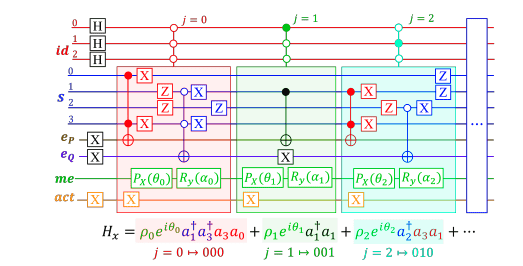
The method employs a second-quantized Hamiltonian – a mathematical operator describing the total energy of the system – expressed within a novel input model, coupled with a systematic scan scheme. This allows for broad applicability to configuration-interaction calculations, extending beyond specific systems and offering a versatile tool for diverse physical investigations. Configuration-interaction methods approximate solutions to the Schrödinger equation by combining multiple possible configurations of particles within the system.
Researchers applied this hybrid method to the helium nucleus, ⁶He, and, for the first time, yielded a complete bound-state spectrum alongside corresponding total angular momentum values. This achievement validates the method’s efficacy and demonstrates its potential for accurately modelling complex nuclear systems, and confirms the accuracy of theoretical predictions. The results align with, and complement, existing data obtained through relativistic Basis Light-Front Quantization – a different theoretical framework employing relativistic quantum field theory – reinforcing the robustness of the findings.
Future work will extend the application of this method to heavier nuclei and explore its potential for predicting excitation spectra – the energies required to promote the system to higher energy states. Researchers also plan to refine the input model to further enhance accuracy and broaden applicability, and to investigate the method’s performance with more complex interactions. Automation of the scan scheme will facilitate calculations on larger systems and accelerate the discovery of new bound states. Further investigation will explore the connection between the obtained angular momentum values and the underlying symmetries of the system, providing a deeper understanding of complex nuclear structure.
👉 More information
🗞 Ab initio many-fermion structure calculations on a quantum computer
🧠 DOI: https://doi.org/10.48550/arXiv.2505.19906