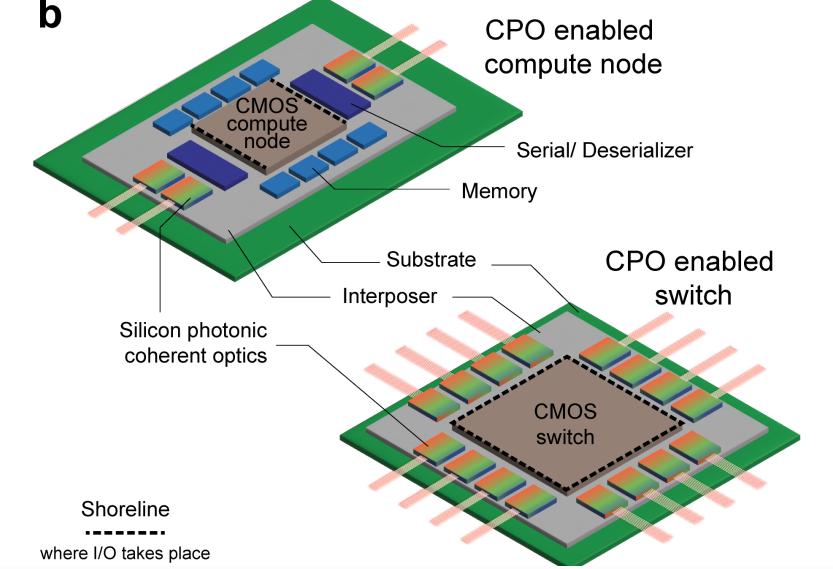
Driven by the increasing bandwidth demands of artificial intelligence and high-performance computing, current optical interconnect technologies face critical limitations in scalability and efficiency. To address this, Alireza Geravand, Erwan Weckenmann, and Jean-Michel Vallée, along with colleagues from Université Laval and the Chinese Academy of Sciences, present a novel comb-driven coherent optical transmitter architecture on a silicon/silicon nitride platform. This innovative design achieves a record shoreline density of 4 terabits per millimeter, significantly improving bandwidth density and energy efficiency, and paving the way for compact, high-performance co-packaged interconnects. Through the integration of microring-assisted Mach-Zehnder modulators and dense wavelength-division multiplexing interleavers, this architecture demonstrates the potential to exceed 10 terabits per second per fiber, representing a crucial step towards petabit-scale interconnects for future computing systems.
Silicon Nitride Microring Stabilisation Techniques
This research details the components, fabrication, and stabilisation techniques employed in a sophisticated optical communication system. Scientists investigated multi-stage ARMA filters for signal processing and explored the advantages of silicon nitride as a material for photonics compared to silicon-on-insulator. A significant focus lies on stabilising microring modulators, utilising a perturb-and-observe algorithm to precisely lock the modulators to the laser wavelength, ensuring stable and reliable operation. The system also incorporates a quantum dot laser, characterised by its fabrication process, epitaxial structure, and performance metrics including threshold current, output power, and spectral purity. Furthermore, researchers designed a wideband silicon nitride interleaver, a crucial component for wavelength division multiplexing, enabling increased data capacity. This work provides a comprehensive understanding of the technologies underpinning a high-performance optical communication link.
Silicon Photonics Achieves 4Tbps/mm Transmission
Scientists engineered a silicon-on-silicon nitride platform to meet the demands of large-scale artificial intelligence applications, overcoming limitations in transmitter bandwidth density and energy efficiency. The team pioneered a comb-driven coherent transmitter architecture, demonstrating a net line rate of 400 Gbps per polarization using 16-QAM modulation at 120 GBd within the O-band. This achievement resulted in a record shoreline density of 4 Tbps/mm while maintaining exceptionally low energy consumption of only 10 fJ/bit for modulation. To achieve this performance, researchers developed ultra-compact microring-assisted Mach-Zehnder modulators and dense wavelength-division multiplexing interleavers as critical building blocks.
Experiments transmitted 1. 08 Tbps over a distance of 5km using a quantum-dot frequency comb and six 100GHz-spaced WDM channels. Detailed analysis focused on the trade-offs between bandwidth, modulation efficiency, and loss within the microrings, utilising an overcoupled add-drop configuration to achieve full complex plane coverage essential for coherent optical transmission. This work demonstrates a clear path toward future petabit-scale interconnects.
Gbps Silicon Photonics Transmitter Demonstrated
Scientists have developed a new transmitter architecture for future high-capacity optical interconnects, addressing limitations in current technologies as data demands increase. This work presents a comb-driven coherent transmitter built on silicon and silicon nitride platforms, designed to deliver the necessary bandwidth density, energy efficiency, and compact size for advanced computing clusters. The team demonstrated a net line rate of 400 Gbps per polarization using 16-QAM modulation at 120 GBd within the O-band, achieving a record shoreline density of 4 Tbps/mm. This modulation consumed only 10 fJ/bit, representing a significant improvement in energy efficiency.
Experiments further revealed transmission rates of up to 160 GBd using QPSK modulation and 100 GBd over 7km of fiber without the need for dispersion compensation. Utilizing a quantum-dot frequency comb, the researchers successfully transmitted 1. 08 Tbps over 5km using six 100GHz-spaced wavelength-division multiplexing channels. System-level analyses demonstrate the potential to support combined transmission rates exceeding 10 Tbps per fiber, paving the way for petabit-scale interconnects. A key innovation lies in a multi-bus design incorporating flat-top silicon nitride interleavers, which mitigates signal interference and reduces transmission loss.
Silicon Nitride Boosts Optical Interconnect Bandwidth
This research demonstrates a new transmitter architecture for optical interconnects, designed to overcome bandwidth limitations in next-generation artificial intelligence and high-performance computing systems. By integrating silicon and silicon nitride technologies, the team achieved a record shoreline bandwidth density of 4 terabits per millimeter, alongside a modulation energy efficiency of 10 femtojoules per bit. Experiments confirm data transmission rates of up to 400 gigabits per second per polarization using advanced modulation formats, and sustained 1. 08 terabits per second over 5 kilometers of fiber without the need for dispersion compensation.
The researchers validated scalability through the development of key building blocks, including compact microring-assisted Mach-Zehnder modulators and dense wavelength-division multiplexing interleavers. System-level analyses indicate that this architecture can realistically support combined transmission rates exceeding 10 terabits per second per fiber, paving the way for future petabit-scale interconnects. The current prototype exhibits a relatively high fiber-to-chip coupling loss, which limits overall performance, and optical signal-to-noise ratio currently governs multi-channel performance. Future work will likely focus on minimizing these losses and further optimizing the system for even greater bandwidth and efficiency.
🗞 Comb-Driven Coherent Optical Transmitter for Scalable DWDM Interconnects
🧠 ArXiv: https://arxiv.org/abs/2509.20584