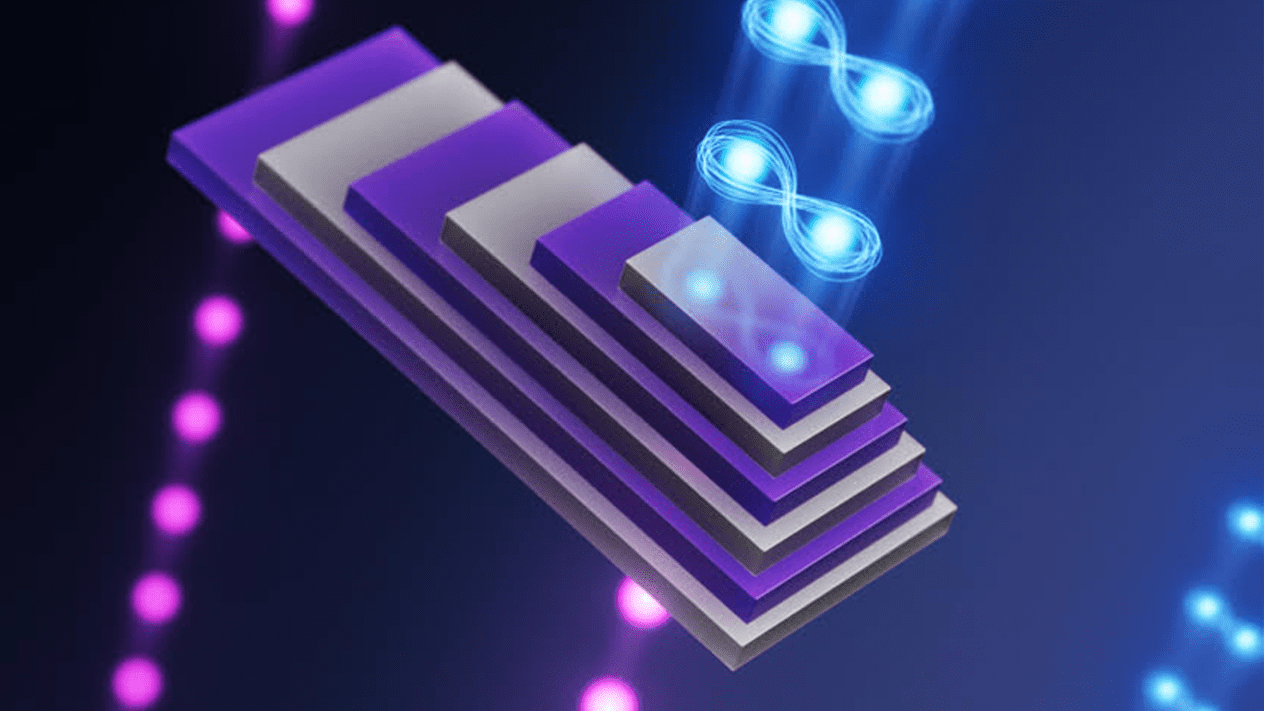
Researchers at Columbia Engineering have made a crucial advancement in creating photon pairs that can influence each other from any distance, a phenomenon known as quantum entanglement. Led by P James Schuck, associate professor of mechanical engineering, the team developed a new method to generate these photon pairs using thin molybdenum disulfide crystals, a van der Waals semiconducting transition metal.
This breakthrough could transform computing, telecommunications, and sensing technologies. The new device, measuring just 3.4 micrometers thick, is more energy efficient and performs better than current methods, requiring larger equipment. Schuck worked with postdoctoral researcher Chiara Trovatello and other scientists from various institutions, including the Department of Energy’s Programmable Quantum Materials center.
The research was supported by several organizations, including the US Department of Energy and the European Union’s Horizon Europe program. This innovation could potentially revolutionize various fields and was published in the journal Nature Photonics.
The researchers built on their previous work, which demonstrated the potential of MoS2 for nonlinear optics, but was limited by interference between light waves. By alternating the direction of the slabs in the stack, they were able to counteract this problem and achieve highly efficient generation of photon pairs.
This breakthrough has significant implications for the development of quantum communication technologies, including satellite-based distribution and mobile phone quantum communication. The researchers believe that their innovation will have an immediate impact in diverse areas and could enable all future on-chip technologies.
The study was published in the journal Nature Photonics. It was supported by the US Department of Energy, the European Union’s Horizon Europe research and innovation program, and other funding agencies. The research was conducted within the Programmable Quantum Materials energy frontier research center at Columbia University, in collaboration with other labs and researchers.
External Link: Click Here For More