Cold atoms represent a powerful new frontier for precision measurement and quantum computing, but understanding how large groups of these atoms behave remains a significant challenge. The researchers investigate the behaviour of cold atoms subjected to intense light. Their work reveals a surprising shift in the atoms’ resonant frequency, a dynamic displacement that grows with the density of the atomic cloud, yet diminishes with increased light intensity. This discovery, which manifests as a change in the collective oscillations of the atoms, has important implications for techniques like Ramsey spectroscopy, where strong light pulses and dense atomic samples are commonly used to achieve high precision.
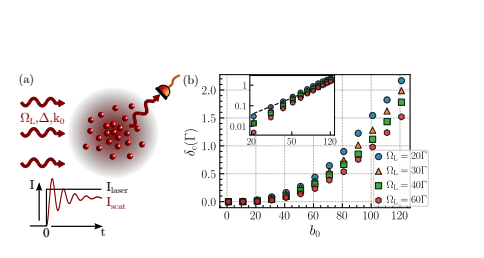
Cold atom setups represent important contenders for quantum simulation, yet Rabi oscillations from optically-thick cold clouds remain largely unexplored. This research investigates Rabi oscillations driven by high-intensity coherent light, predicting a dynamic displacement from the atomic resonance. This displacement can be detected through the collective Rabi oscillations of the atomic ensemble, and differs from linear-optics shifts by growing quadratically with optical depth. Importantly, this dynamic displacement reduces with increasing pump power, as dipole-dipole interactions become less effective, a modification particularly relevant for Ramsey spectroscopy when strong pulses and optically dense samples are used.
Attenuation and Scaling of Resonance Displacement
This supplemental material validates the mean-field model’s ability to accurately capture the attenuation of the driving laser field as it propagates through the cold atom cloud, demonstrating alignment with predictions from the Beer-Lambert law. The research explores different scaling variables to collapse data onto a single curve, revealing that a scaling factor of N/(kR)^2. 4 best captures the collective resonance displacement, primarily governed by optical depth with a slight correction related to spatial density or geometry. This suggests that exploring lower spatial densities but high optical depths could further clarify the contributions of geometry and density. Essentially, the supplemental material provides validation of the modeling approach, a refined understanding of scaling, and direction for future research.
Collective Resonance Shift in Dense Atomic Clouds
Scientists have achieved a breakthrough in understanding the collective dynamics of cold atoms, revealing a previously unobserved resonance displacement in Rabi oscillations. The work demonstrates a shift in the atomic resonance frequency that grows with increasing optical depth, arising from the interaction of atoms within the cloud and vanishing for low optical depths. Experiments reveal that this displacement scales quadratically with optical depth but diminishes as pump power increases, indicating a reduction in the effectiveness of dipole-dipole interactions. This collective dynamic resonance displacement is distinct from static frequency shifts observed in steady-state experiments, highlighting its dynamic nature, and was not observed when monitoring total scattered intensity or in the linear regime with weak laser intensity. The breakthrough delivers a new understanding of collective atomic behavior and opens possibilities for advanced applications in metrology and computation, particularly in Ramsey spectroscopy where strong pulses and dense samples are utilized.
Strong Excitation Alters Atomic Resonance Frequency
This research demonstrates a collective modification to the frequency of Rabi oscillations in optically thick clouds of cold atoms, driven by intense light. The team discovered that dipole-dipole interactions cause a dynamic displacement of the atomic resonance, an effect that emerges when the system is strongly excited and diminishes as the system reaches a steady state. Simulations reveal this displacement scales quadratically with the cloud’s optical depth, yet decreases with increasing laser power, reflecting the interplay between atomic interactions and population changes. Importantly, this newly observed effect differs from previously reported collective shifts observed under weaker excitation conditions and cannot be explained by simple light attenuation, highlighting a new regime of light-matter interaction where saturation reshapes collective behaviour. The findings have particular implications for precision measurements, such as Ramsey spectroscopy and atomic clocks, where the area of short pulses may be affected by these collective effects. Future investigations could explore more complex effects, while the experimental setup could be readily implemented with cold atoms trapped in magneto-optical traps or analysed within optical atomic clocks.
👉 More information
🗞 Collective dynamical resonance displacement from strongly driven cold atoms
🧠 ArXiv: https://arxiv.org/abs/2509.12106