The pursuit of more efficient engines continually drives innovation in thermodynamics, and researchers are now exploring the potential of quantum coherence to surpass conventional limits. Federico Amato from Universita degli Studi di Palermo, alongside Gerardo Adesso from the University of Nottingham and Massimo G. Palma from Universita degli Studi di Palermo, and their colleagues, demonstrate a novel engine powered by a specially prepared gas of atoms exhibiting quantum coherence. Their work establishes a realistic model for harnessing coherence as a resource to enhance engine efficiency, moving beyond traditional thermal constraints, and importantly, proposes a scalable design using multiple engine cycles. This research showcases the operational viability of coherence-driven engines, opening exciting possibilities for future technological applications and a new paradigm in energy conversion.
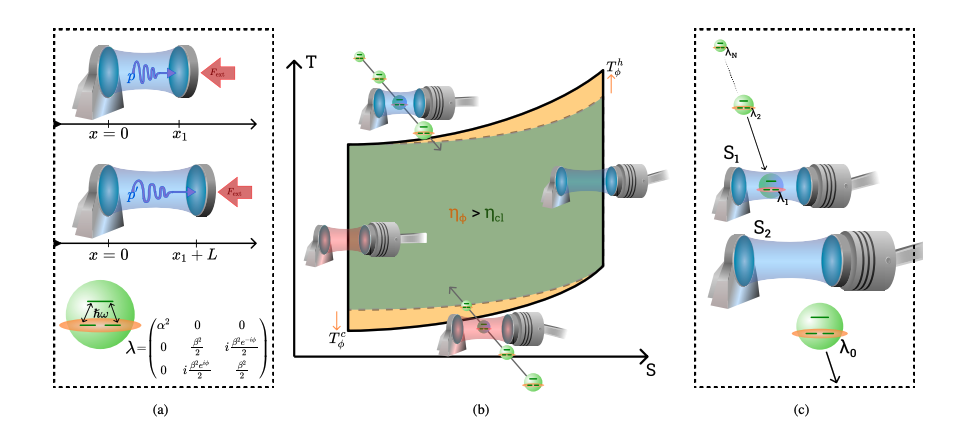
Emilio Segrè, Università degli Studi di Palermo, Via Archirafi 36, I-Palermo, Italy. This research presents a realistic implementation of a quantum engine powered by a phaseonium gas of coherently prepared three-level atoms, where quantum coherence acts as a thermodynamic resource. Using a model to describe how phaseonium interacts with optical cavities and the mechanics of those cavities, the team constructs a complete engine cycle using two reservoirs that don’t rely on traditional heat sources, each characterised by coherence-induced effective temperatures. This configuration enhances the efficiency of a simple optomechanical engine operating beyond standard thermal paradigms. The researchers further address scalability by coupling a second.
Phaseonium Drives Quantum Optomechanical Work
This research proposes and theoretically investigates a novel optomechanical engine powered by quantum coherence, specifically utilizing a system called phaseonium. The core idea is to build an engine where light acts as the working fluid and motion is driven by quantum effects, rather than traditional thermodynamic principles. The engine leverages the unique properties of phaseonium, a simple quantum system, to create a temperature difference and drive mechanical work. Key components include phaseonium, which exhibits apparent temperature differences due to quantum coherence, an optomechanical engine envisioned as a piston-cylinder arrangement where light pressure drives a piston, and quantum coherence, which is essential for creating the necessary temperature difference and driving the engine cycle.
The paper presents a theoretical model of the engine, analysing its performance and efficiency based on the principles of quantum thermodynamics. The theoretical analysis suggests that such an engine is, in principle, feasible and could potentially operate with efficiencies exceeding those of classical engines under certain conditions, demonstrating a quantum advantage. The authors argue that the proposed engine is within reach of current experimental capabilities, given advancements in optical cavity technology and optomechanics. This research contributes to a deeper understanding of the interplay between quantum mechanics and thermodynamics, and explores the potential for harnessing quantum effects for practical energy conversion, representing a significant step towards bridging the gap between fundamental quantum research and practical applications in energy conversion.
Phaseonium Powers Functional Quantum Thermal Engine
Researchers have successfully demonstrated a functional quantum engine powered by a unique state of matter called phaseonium, a gas of specially prepared atoms exhibiting strong quantum coherence. This engine operates using a cascade configuration of two optical cavities, each driven by the same phaseonium gas, and represents a significant step towards scalable quantum thermal machines. The team’s work establishes a direct link between microscopic quantum systems and the extraction of macroscopic mechanical work, opening new avenues for thermodynamic applications. The engine’s performance hinges on the ability of phaseonium to act as a tunable quantum reservoir, influencing the temperature of the cavities and driving the engine cycle.
Calculations reveal that the stable temperature reached by the cavity, when interacting with phaseonium, is directly affected by the coherence present within the atomic gas. Specifically, the researchers demonstrate that, for certain coherence phases, the presence of these quantum properties increases the stable temperature of the cavity compared to a traditional thermal reservoir. This enhancement is quantified by comparing the ratio of quantum to classical temperatures, showing a clear advantage for the phaseonium-driven engine. The engine operates by carefully controlling the coherence phase of the phaseonium atoms, which allows precise tuning of the thermalization temperature within the cavities.
This control is crucial for maximizing the engine’s efficiency, as it directly impacts the amount of work that can be extracted during each cycle. The results demonstrate that, under specific conditions, the engine can achieve a higher efficiency than conventional engines relying on classical thermal baths, highlighting the potential of quantum coherence as a valuable resource for thermodynamic tasks. This innovative approach establishes a framework for building scalable quantum thermal machines with tunable environments, offering a promising platform for future experimental realizations in cavity quantum electrodynamics and optomechanical systems.
Coherence Drives Work Beyond Thermal Limits
This research presents a functional model of a quantum engine powered by ‘phaseonium’, a gas of coherently prepared atoms, demonstrating a pathway beyond conventional thermal limitations. The engine operates by harnessing coherence as a resource to drive two optical cavities in parallel, each capable of performing mechanical work on a movable mirror, and exhibits performance not reliant on internal correlations between the cavities. By solving the equations governing the engine’s cycle without approximation, the researchers were able to track work and heat transfer, allowing for a direct comparison between classical and quantum thermodynamic predictions. The study successfully demonstrates the operational viability of coherence-driven engines and establishes a benchmark for reconciling quantum and classical thermodynamics, offering a conceptually minimal and experimentally relevant system for exploring these principles.
While the engine’s output may be affected by non-thermal effects, the impact on mechanical work is not as severe as predicted by some quantum definitions. The authors acknowledge that scaling the engine to include more cavities may introduce complexities, but their model provides a foundation for future development of scalable quantum engines. With ongoing advances in optical cavity technology, the realization of a piston-based optomechanical engine powered by quantum coherence appears increasingly feasible, potentially serving as a testbed for fundamental studies at the quantum, classical interface.
🗞 Boosting Thermodynamic Efficiency with Quantum Coherence of Phaseonium Atoms
🧠 ArXiv: https://arxiv.org/abs/2509.02353