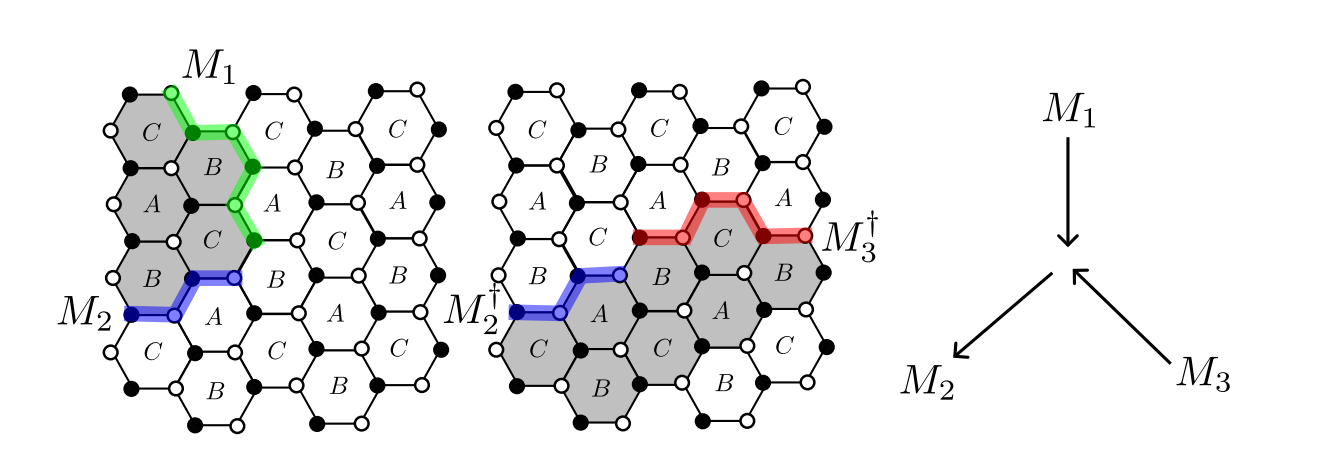
The pursuit of stable quantum information hinges on developing codes that can correct errors arising from the fragility of quantum states, and recent work focuses on harnessing exotic states of matter to achieve this goal. Dongjin Lee and Beni Yoshida, both from the Perimeter Institute for Theoretical Physics and the University of Waterloo, alongside their colleagues, introduce a new family of three-dimensional quantum codes, termed chiral color codes, which demonstrate the potential to realise and manipulate robust fermionic and chiral anyons. These codes uniquely exhibit chiral topological order, meaning their properties are not preserved under spatial reflection, and crucially, they allow for single-shot error correction, a significant advancement over traditional methods requiring repeated measurements. By constructing codes with inherent fault-tolerance and the ability to switch between different configurations, this research establishes a promising pathway towards building more resilient and powerful quantum computers capable of handling complex calculations.
The chiral color codes build upon the established gauge color code, inheriting its inherent fault-tolerance features and allowing transitions to other stabilizer color codes, offering versatility in quantum computation. The team demonstrates that the code’s bulk exhibits short-range entanglement by constructing a specific local channel that prepares the ground state, providing insight into its stability and robustness. While current models operate under specific parameters, the researchers suggest future work could broaden the code’s applicability to more complex systems and diverse topological phases, ultimately contributing to more efficient and scalable quantum computers.
Chiral Semion Surface Codes for Computation
This excerpt details the construction of topological quantum computation schemes using abelian anyon theories, specifically focusing on chiral semion surface topological order. Topological quantum computation aims to perform quantum calculations in a way that is inherently resistant to local noise by encoding information in the topology of a system, rather than in local properties. Anyons, quasiparticles with unique exchange statistics, are central to this approach. Unlike bosons and fermions, anyons acquire a phase upon exchange, and chiral semions are a specific type of anyon exhibiting this behavior.
The process of moving anyons around each other, known as braiding, defines the quantum gates that perform the computation, and the topological protection arises because small disturbances do not alter the braiding itself. The research focuses on chiral semion surface topological order, where anyons exist on the surface of a three-dimensional material, simplifying the implementation of braiding operations. The team highlights a scheme using three-fermion operators to perform computation, a promising approach for achieving universal quantum computation. Pauli topological subsystem codes protect quantum information from errors by encoding it redundantly, and the use of higher-group symmetry provides further protection through more general symmetries.
The excerpt also explores mixed-state topological order, which allows for topological order even in systems not in a pure quantum state, and quantum cellular automata, a type of quantum computation based on discrete time steps. Manipulating boundary modes and defects in the material is crucial for implementing the braiding operations. This work represents a significant step towards robust quantum computation, requiring the development of new materials and devices with exotic properties. The study also provides new insights into fundamental physics and connects to other areas like condensed matter physics, quantum information theory, and mathematical physics. In essence, this research program aims to build a fault-tolerant quantum computer based on the unique properties of anyons, a highly theoretical and mathematically complex field with potentially enormous rewards.
Chiral Color Codes Enable Single-Shot Error Correction
Researchers have developed a new family of three-dimensional stabilizer codes, termed chiral color codes, which successfully realize both fermionic and chiral topological orders, representing a significant advance in topological quantum error correction. These codes demonstrate a unique ability to support chiral anyonic excitations and, crucially, achieve single-shot error correction, meaning they can correct errors with only a single round of noisy measurements. The chiral color codes build upon the existing gauge color code, inheriting its fault-tolerance features and enabling code switching to other stabilizer color codes, offering flexibility in quantum computation. The team’s work extends beyond simply creating a functional code; they have also demonstrated an understanding of the underlying mechanisms enabling single-shot error correction, a previously open question in the field.
By constructing an explicit local channel, they prove the short-range entanglement of the code’s bulk, providing insight into its stability and robustness. While the current models focus on specific parameters, the researchers acknowledge limitations related to these constraints and suggest future work could explore broader applicability. They envision extending these codes to more complex systems and investigating their potential for realizing diverse topological phases, ultimately paving the way for more efficient and scalable quantum computers.
🗞 Chiral Color Code : Single-shot error correction for exotic topological order
🧠 ArXiv: https://arxiv.org/abs/2509.18324