Universal quantum computation, the ability to perform any calculation with quantum bits, faces a significant hurdle in the need for both error correction and flexible operations, often limited by fundamental constraints on code design. Dawei Jiao, Mahdi Bayanifar, and Alexei Ashikhmin, alongside Olav Tirkkonen, from Aalto University and Nokia Bell Labs, now present a pathway to overcome these limitations by employing triorthogonal codes. Their work demonstrates how to achieve universal quantum computation with reduced overhead, circumventing a key theorem that previously restricted the design of error-correcting codes. By simplifying logical operations and introducing a method for pairing codes with transversal gate capabilities, the team enables all operations to be performed efficiently, representing a substantial advance towards practical, fault-tolerant quantum computers.
The team investigates methods to minimise the number of physical qubits required to encode a single logical qubit, thereby lowering the overhead associated with quantum error correction, a critical challenge in building large-scale quantum computers.
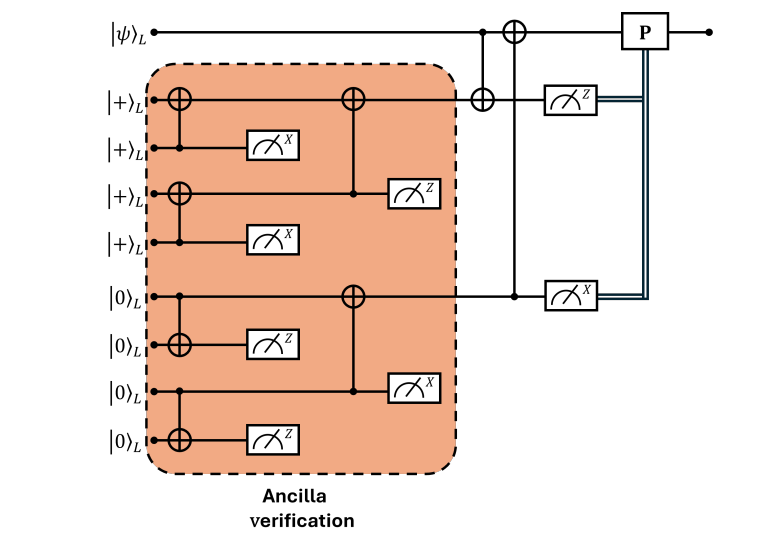
Researchers streamlined the implementation of a logical Hadamard gate for triorthogonal codes by exploiting their inherent transversal controlled-Z gates, resulting in a circuit with reduced complexity. They then developed a procedure for generating a symmetric Calderbank-Shor-Steane code paired with a triorthogonal code, enabling both CNOT and CZ gate transversality across the pair of codes. Furthermore, the team designed a circuit for realising a logical state teleportation protocol between the two codes, allowing all logical operations to be performed transversally.
Transversal Gates Enable Universal Fault-Tolerant Computation
This paper presents two novel approaches to achieving universal fault-tolerant quantum computation using triorthogonal codes. The authors aim to minimise the resource overhead, both in terms of gates and qubits, required for these computations. First, they demonstrate how to implement a logical Hadamard gate more efficiently by leveraging the transversal CZ gate property of triorthogonal codes. Second, they introduce a method to generate a symmetric CSS code from a triorthogonal code, allowing for universal computation through state teleportation between the two codes while maintaining the crucial property of using only transversal gates.
Transversality is key because it simplifies error correction, as errors do not spread as easily. A significant contribution is demonstrating that both of these methods can be integrated into the well-established Steane error correction framework without adding extra overhead, making the proposed techniques more practical for implementation. The authors provide an example using 15 qubits to illustrate the validity of their approach and discuss the potential benefits of each method in different scenarios, such as when frequent Hadamard gates or Clifford gates are required.
These methods could lead to more efficient quantum computations, requiring fewer qubits and gates, which is crucial for building practical quantum computers. By reducing resource overhead, these techniques could make it easier to scale up quantum computers to larger sizes. The ability to switch between different codes, triorthogonal and CSS, could provide more flexibility in designing quantum architectures. This work contributes to the ongoing effort to develop robust and reliable fault-tolerant quantum computers.
Triorthogonal and Calderbank-Shor-Steane Codes Enable Universality
This research presents significant advances in the pursuit of practical, fault-tolerant quantum computation. Researchers have developed two novel methods to overcome limitations previously identified by the Eastin-Knill theorem. The team successfully simplified the implementation of a logical Hadamard gate for triorthogonal codes by leveraging their inherent transversal controlled-Z capabilities, resulting in a more efficient circuit design.
Furthermore, they introduced a procedure for generating a symmetric Calderbank-Shor-Steane code in conjunction with a triorthogonal code, enabling transversal implementation of all logical operations through state teleportation between the two codes. Demonstrating the validity of their approach with a 15-qubit triorthogonal code, the researchers constructed teleportation circuits that facilitate efficient logical state transfer. Importantly, both the optimised Hadamard gate and the teleportation protocols integrate seamlessly into the established Steane error correction framework without increasing resource demands, preserving fault-tolerance and enhancing the practicality of scalable quantum architectures.
The authors acknowledge that their methods currently focus on triorthogonal codes and the Steane framework. Future research directions may involve extending these techniques to other code families and exploring integration with alternative fault-tolerant frameworks, potentially broadening the applicability and impact of this work. These results contribute to reducing the overhead associated with universal quantum computation by minimising both gate and qubit resource requirements.
🗞 Low Overhead Universal Quantum Computation with Triorthogonal Codes
🧠 ArXiv: https://arxiv.org/abs/2510.05708