The search for robust quantum error correction remains a central challenge in developing practical quantum computers, and product codes offer a promising route towards achieving this goal. Meng-Yuan Li and Yue Wu, researchers at unnamed institutions, have investigated fracton orders within a novel family of codes known as generalized hypergraph product (HGP) codes. Their work details the identification of unusual properties in these codes, including a non-monotonic ground state degeneracy and the presence of non-Abelian lattice defects. Significantly, the researchers discovered ‘fragmented excitations’ in four-dimensional orthoplex models, where point-like defects project onto connected objects, representing a new intermediate class of quantum excitation and establishing HGP codes as a valuable platform for exploring complex quantum phenomena. This discovery advances understanding of fracton orders and could contribute to the development of more resilient quantum computing architectures.
HGP Codes and Fracton Topological Order
Generalized Hypergraph Product Quantum Code Construction
Scientists demonstrate a significant advancement in the field of fault-tolerant quantum computation through the investigation of a novel family of quantum codes. This work centres on generalized hypergraph product (HGP) codes, constructed using a recently proposed method that extends the capabilities of standard product code construction. The research establishes these codes as a versatile platform for exploring fracton orders, a unique class of long-range entangled quantum phases characterised by restricted excitation mobility and potential for robust quantum memories. By mapping these codes to exactly solvable spin models, termed orthoplex models, the team has uncovered intriguing properties related to their topological order.
The study reveals a series of unusual characteristics within the 3D orthoplex model, including a non-monotonic ground state degeneracy that changes as system size increases, and the presence of non-Abelian lattice defects. These defects exhibit a surprising behaviour, exchanging the properties of certain excitations when braided around them, indicating a complex interplay between geometry and topological order. This finding builds upon previous work and demonstrates the sensitivity of fracton orders to geometric arrangements, challenging conventional understandings of quantum phases. The researchers meticulously analysed the models, identifying fundamental lineon excitations and their composite planon forms.
Most remarkably, the team discovered fragmented topological excitations in 4D orthoplex models, representing a novel intermediate class between point-like and spatially extended excitations. These excitations manifest as discrete points in real space, yet their projections onto lower-dimensional planes form connected structures, such as loops, revealing an intrinsic topological nature previously unseen. This discovery challenges the conventional categorisation of topological excitations and opens new avenues for designing self-correcting quantum codes. The work details how these fragmented loops appear as scattered points in three-dimensional space, but coalesce into continuous loops when viewed in two dimensions.
Mapping Stabilizer Codes to Topological Matter
The research establishes a strong connection between quantum stabilizer codes and topological matter, building on the foundation laid by the 2D toric code. By systematically decomposing and reconstructing tensor product complexes, the scientists have expanded the scope of product codes and identified a family of models exhibiting fracton orders. This approach allows for analytical tractability, providing valuable insights into the physics of these exotic phases. The generalized HGP codes offer a powerful and versatile framework for studying the interplay between topology, geometry, and quantum entanglement, paving the way for future investigations into more complex and robust quantum systems.
Orthoplex Models via Hypergraph Product Construction
Defining Orthoplex Models via Hypergraph Products
The research team pioneered a generalized hypergraph product (HGP) code construction to investigate fracton orders, naming the resulting exactly solvable spin models “orthoplex models”. This work extends the standard HGP framework by leveraging the direct sum structure inherent in chain groups within a tensor product complex, denoted as K. Rather than applying the conventional homological construction of product codes, the scientists treated each direct summand individually, enabling the creation of a diverse range of quantum codes. This innovative approach allows for the partitioning of direct summands into four disjoint sets, SQ, SX, SZ, and SU, designating basis elements as qubits, X-stabilizers, Z-stabilizers, or leaving them unused.
Experiments employed a precise protocol to define chain groups: CQ, CX, and CZ, representing qubits, X-stabilizers, and Z-stabilizers, respectively. Boundary operators, ∂X and ∂Z, were then defined to connect these groups, ensuring the CSS condition for well-defined chain complexes was met. The team specifically focused on a partition strategy defining orthoplex models, assigning qubits to chain groups where the sum of indices is odd, X-stabilizers to even-dimensional cells extending along the p-th dimension, and Z-stabilizers to even-dimensional cells not extending along that dimension. Stabilizer action was localized to nearest qubits on a lattice, establishing a direct correspondence between stabilizer operators and cells in a p-dimensional cubic lattice.
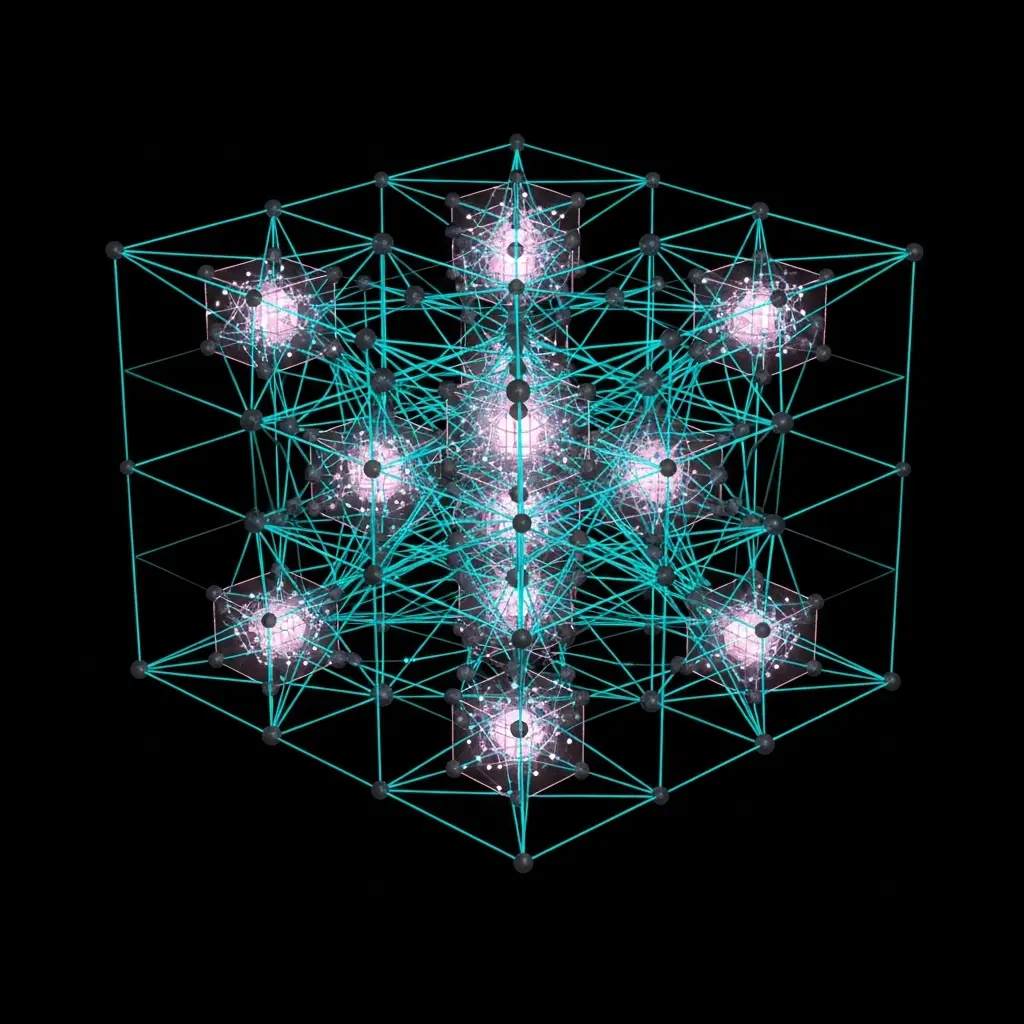
For p=3, this configuration manifests as an octahedron with six qubits forming its vertices, a structure generalized to higher dimensions. The technique reveals that X-stabilizers are associated with even-dimensional cells, acting on qubits residing on odd-dimensional cells located at γd ±1/2 xμ, where xμ represents the basis elements of the lattice. This arrangement precisely defines the vertices of a p-dimensional orthoplex centered on the stabilizer operator. The study’s discovery of fragmented excitations in 4D orthoplex models, loops manifesting as scattered quasiparticles preserving loop topology when projected onto 2D planes, was made possible by this meticulous construction and analysis of the model’s geometric properties. This innovative methodology establishes generalized HGP codes as a versatile platform for studying the physics of fracton orders, characterized by non-monotonic ground state degeneracy and non-Abelian defects.
Orthoplex Models Reveal Fracton Order Properties
Scientists have achieved a significant breakthrough in understanding fracton orders through the investigation of a novel code family termed generalized hypergraph product (HGP) codes. This work introduces ‘orthoplex models’, exactly solvable spin models derived from these codes, and reveals intriguing properties within a three-dimensional instantiation of the model. Experiments demonstrate a non-monotonic ground state degeneracy (GSD) as a function of system size, indicating a complex interplay between topology and geometry in these fracton orders. The team meticulously mapped the qubit and stabilizer relationships, establishing a characteristic orthoplex geometry where each stabilizer operator connects six qubits forming an octahedron.
Further research into the 4D orthoplex model yielded a remarkable discovery: fragmented excitations. These excitations, while appearing as discrete points in real space, project onto lower-dimensional subsystems as connected objects, specifically loops. Measurements confirm that these fragmented excitations represent an intermediate class between point-like and spatially extended excitations, challenging conventional categorizations of topological orders. The formation of a connected loop, visually demonstrated in the research, highlights the topological nature of these excitations and their restricted mobility.
Data shows that the 3D orthoplex model exhibits restricted excitation mobility, a hallmark of fracton orders. Scientists recorded that movement of an excitation requires a non-local operation acting on a macroscopic region, or the creation of additional gapped excitations, contrasting with the free movement of excitations in conventional topological orders. The study details the construction of orthoplex models in arbitrary dimensions using a generalized HGP protocol, providing an analytically tractable platform for exploring the physics of fracton orders. The research establishes generalized HGP codes as a versatile tool for studying these complex systems. The team precisely defined the model using qubits assigned to links and cubes, with X-stabilizers on plaquettes normal to the x- or y-axis and Z-stabilizers on vertices and plaquettes normal to the z-axis. This arrangement, detailed through the Hamiltonian equation, provides a clear framework for further investigation into the behaviour of these unique excitations and their potential applications in fault-tolerant quantum computation.
Fracton Orders in Hypergraph Product Codes
This research details the discovery of fracton orders within a family of codes constructed using a generalized hypergraph product (HGP) approach. The authors demonstrate that these codes, termed orthoplex models due to their geometric properties, exhibit intriguing characteristics such as non-monotonic ground state degeneracy and non-Abelian lattice defects in three dimensions. Crucially, investigation of the four-dimensional orthoplex model revealed fragmented excitations, a novel class of excitations that appear point-like in real space but project as connected objects onto lower-dimensional subsystems. These findings establish generalized HGP codes as a valuable, analytically tractable framework for exploring the physics of fracton orders, expanding upon previous work in the field. The discovery of fragmented excitations represents a significant contribution, positioning them as an intermediate phase between point-like and spatially extended excitations and furthering understanding of long-range entanglement. The authors acknowledge limitations inherent in focusing on a specific code family derived from repetition codes, and suggest future research could explore the broader implications of their findings by investigating other input codes within the generalized HGP construction.
🗞 Fragmented Topological Excitations in Generalized Hypergraph Product Codes
🧠 ArXiv: https://arxiv.org/abs/2601.09850